


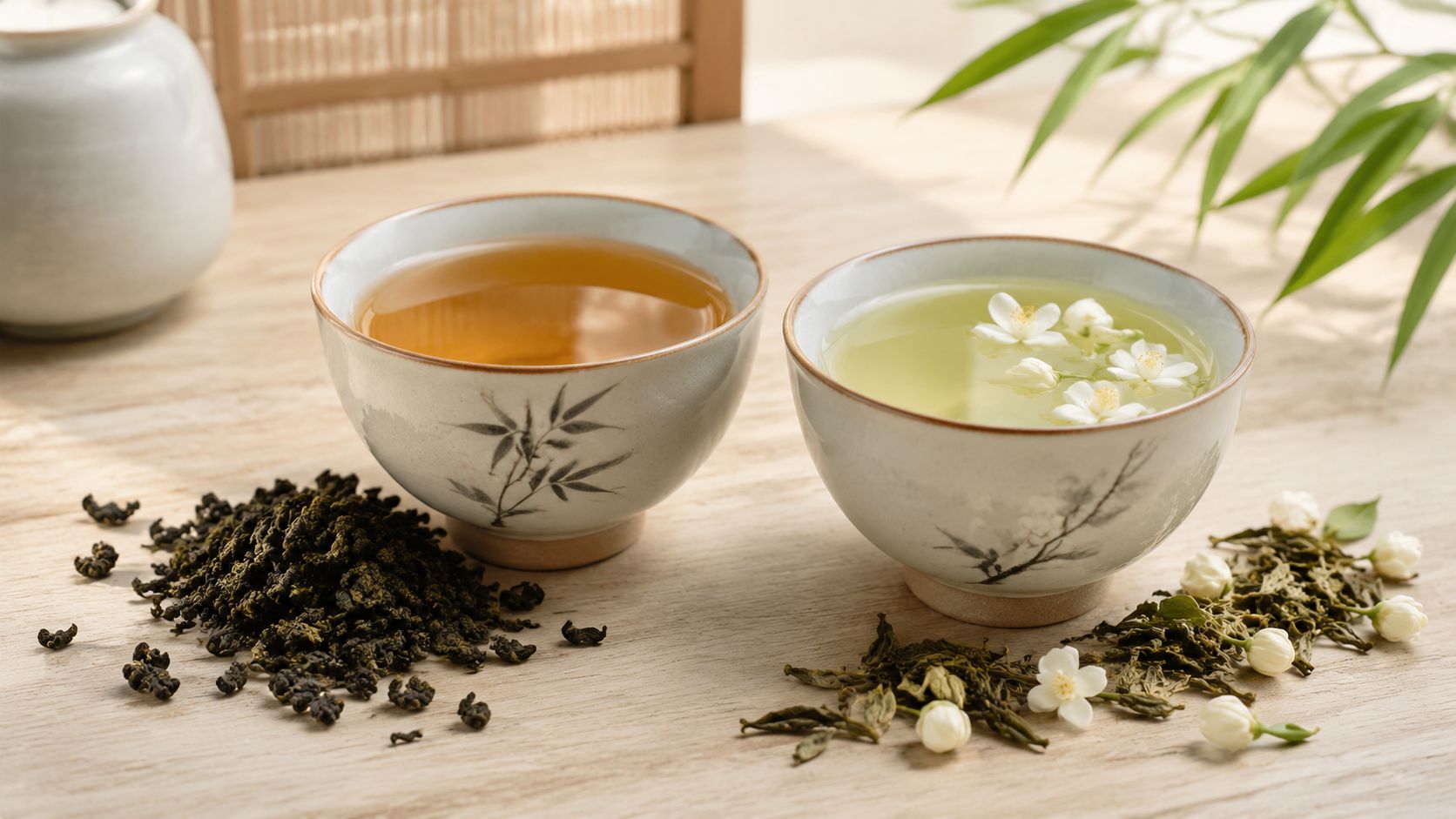
The topic of oolong and jasmine tea often encompasses two distinct, unrecognized questions. Do you mean a comparison between oolong tea and jasmine tea, or are you looking for a tea that combines both, such as jasmine oolong? That small wording difference causes a lot of confusion.
The answer matters because these teas are defined in different ways. Oolong is a tea category shaped by oxidation. Jasmine is usually a scenting method shaped by fresh blossoms. Once you separate those ideas, the whole subject becomes much easier to understand, taste, and brew well.
For anyone exploring Japanese tea culture and authentic tea shopping, this distinction is useful. Japan has a deep tea tradition of its own, and knowing how tea is processed helps you read labels with more confidence, choose styles you'll enjoy, and avoid buying something that sounds right but tastes completely different from what you expected. If you also enjoy exploring small-batch ingredients beyond tea, this collection of fresh organic herbs and teas is a helpful reference point for understanding how plant quality shapes aroma from the start. For a broader look at drink culture from Japan, Buy Me Japan also has a useful guide to non-alcoholic Japanese drinks.
Understanding Oolong Tea The In-Between Brew
Oolong tea sits between green tea and black tea, but that simple description only tells part of the story. A better way to think about it is this: oolong is a wide family of teas made from the same plant, Camellia sinensis, then shaped by a careful level of oxidation that leaves room for many different personalities in the cup.
Some oolongs are pale, floral, and almost creamy. Others are darker, toasted, mineral, or gently fruity. That range is why one person can say they love oolong while another says they dislike it, and both can be right. They may be talking about two very different styles.
What makes oolong oolong
Oolong's identity comes from process, not from one fixed flavor. Its long history in China reaches back to the Tang Dynasty (618–907 CE) with broader recognition in the Song Dynasty (960–1279 CE), and its defining method is partial oxidation ranging from 8% to 85% according to this history of oolong tea. That wide range explains why the category can feel so broad.

A lightly oxidized oolong often tastes bright and fragrant. A more oxidized or roasted one can feel warmer, fuller, and more autumnal. The leaf may be rolled into tight pearls or left in long twisted shapes, and those forms also affect how it opens in the pot.
Practical rule: Don't ask, “What does oolong taste like?” Ask, “Which kind of oolong is this?”
Why oxidation changes the cup
Oxidation isn't a decorative detail. It changes the chemistry of the leaf and, with it, the aroma and structure of the tea. A critical review notes that oolong is a semi-oxidized tea and that more than 100 chemical constituents have been isolated from it, with oxidation acting as the main driver that shifts its profile between green and black tea in this PubMed review on oolong tea chemistry.
That sounds technical, but the effect in the teacup is easy to notice. Less oxidation usually gives you fresher, greener, more floral tones. More oxidation tends to bring depth, baked fruit, wood, toast, or honeyed notes, depending on style.
If you already know Japanese green tea well, it helps to think of oolong as a category with more swing in texture and aroma. For readers who want to compare that experience with matcha and other Japanese green styles, this overview of Jade Leaf Matcha gives a useful contrast in how processing creates taste.
How to taste it like a tea professional
Try oolong in three steps:
- Smell the dry leaf: Look for floral, toasted, creamy, or mineral impressions.
- Taste the first sip warm: Notice whether the tea feels silky, brisk, airy, or dense.
- Pay attention after swallowing: Good oolong often leaves a lingering finish that changes subtly.
That changing finish is one reason seasoned tea drinkers return to oolong again and again.
Decoding Jasmine Tea A Process of Perfume
Jasmine tea isn't a separate tea plant. That's the first point to fix, because many labels make it sound as if jasmine tea grows on its own. In most cases, jasmine tea is a base tea that has been scented with fresh jasmine blossoms.
Usually, that base is green tea. Sometimes it can be white tea or oolong. The flower doesn't replace the tea. It perfumes it.
Jasmine is a craft process, not just a flavor
Jasmine tea holds an important place in Chinese tea culture because the leaves are perfumed with fresh jasmine blossoms, and that style became globally influential through a long artisanal tradition rather than one single invention date, as described in this historical review of tea and jasmine tea processing.

In high-quality jasmine tea, fresh blossoms are layered with tea leaves so the leaves absorb the floral aroma. The flowers are often removed afterward. What remains should smell expressive but not loud, elegant but not soapy.
A cheap jasmine tea often smells one-dimensional. A good one smells alive. You may notice a soft floral lift first, then the character of the base tea underneath.
Where people get confused
The phrase oolong and jasmine tea creates a trap. It can mean:
- oolong tea compared with jasmine tea
- jasmine tea made on a green tea base
- jasmine-scented oolong tea
That last option is real, and it matters.
One technical point helps here. Jasmine tea is usually a scented tea matrix, and its quality depends on the fit between the base tea and the scenting process. Factors like moisture, leaf shape, and scenting cycles affect whether the result smells clean and floral or dull and vegetal, as noted in this jasmine tea explanation from Harney & Sons.
Good jasmine tea should smell like the flower passed through the tea leaf, not like perfume sitting on top of it.
What to expect in the cup
A jasmine green tea usually feels lighter and more direct than an oolong. The floral note rises quickly. The body is often gentler. The finish can be refreshing, especially when the tea is brewed with restraint.
If the water is too hot or the steep is too long, the cup can turn sharp and the floral charm can flatten. Jasmine tea rewards a lighter hand.
The Hybrid Hero Understanding Jasmine Oolong Tea
Jasmine oolong is the point where both ideas meet. It's not a marketing fantasy and it's not “oolong plus flowers” in a casual sense. It's a real tea style made by scenting oolong leaves with jasmine blossoms.
That distinction is important because the base tea changes the whole experience. A jasmine green tea and a jasmine oolong may share floral aroma, but they don't drink the same way at all.
Why jasmine oolong tastes different
High-quality jasmine oolong is made by layering jasmine flowers over lightly oxidized tea leaves, and one of the biggest content gaps in tea education is that many readers don't know whether they're seeing a comparison or a single hybrid tea, as explained in this guide to jasmine oolong.
A good jasmine oolong usually has more depth beneath the floral top note than jasmine green tea. The oolong base may bring creaminess, softness, butteriness, orchid-like notes, or a rounded body that carries the jasmine scent in a more layered way.
The result can feel more composed. Instead of bright green tea plus floral perfume, you get floral aroma supported by structure.
Side-by-side tea comparison
| Feature | Traditional Oolong | Jasmine Green Tea | Jasmine Oolong Tea |
|---|---|---|---|
| Core identity | Partially oxidized tea category | Green tea scented with jasmine blossoms | Oolong tea scented with jasmine blossoms |
| Main aroma | Can be floral, roasted, fruity, creamy, or mineral | Fresh floral jasmine over a green base | Jasmine aroma over a softer, fuller oolong base |
| Body | Light to full depending on style | Usually lighter and brisker | Usually smoother and rounder than jasmine green |
| Flavor development | Often changes across infusions | Most expressive early on | Floral opening with more depth underneath |
| Best for | Drinkers who like variety and leaf character | Drinkers who want clear floral freshness | Drinkers who want both floral perfume and complexity |
Who tends to enjoy it most
Jasmine oolong often suits people who find jasmine green tea a little thin, or standard oolong a little too plain when they want something fragrant. It occupies a graceful middle ground.
If you enjoy floral teas but still want the cup to have shape and persistence, jasmine oolong is often the better choice.
It also makes sense for shoppers who care about craftsmanship. This is a tea where the producer has to get two things right at once: the oolong itself and the scenting.
Flavor Caffeine and Benefits A Side-by-Side Comparison
Choosing between these teas becomes easier once you stop grouping them together. The better question is not “Which is best?” but “Which kind of experience do I want today?” Flavor, aroma, body, and caffeine all matter, and each tea answers those needs differently.
Tea Comparison Oolong vs. Jasmine Green vs. Jasmine Oolong
| Feature | Traditional Oolong | Jasmine Green Tea | Jasmine Oolong Tea |
|---|---|---|---|
| Flavor profile | Can be floral, roasted, fruity, creamy, or mineral | Light, fresh, grassy or vegetal with jasmine fragrance | Floral and fragrant with a smoother, deeper base |
| Aroma style | Leaf-driven aroma from oxidation and roasting | Jasmine-forward and bright | Jasmine-forward with more rounded tea notes |
| Caffeine character | Mid-range and highly variable | Depends on green tea base and brewing style | Depends on oolong base and brewing style |
| Best time to drink | Flexible, from morning to afternoon | Good when you want a lighter cup | Good when you want fragrance with more body |
| Re-steeping | Often excellent | Usually less persistent | Often better than jasmine green for repeated infusions |
What caffeine really depends on
Oolong tea typically contains roughly 10–60 mg per 8-ounce cup, though some consumer references report broader variation depending on leaf type and brewing choices, according to Medical News Today's caffeine overview. In practice, steep time, water temperature, leaf-to-water ratio, and cultivar all affect the final cup.
That means jasmine flowers don't decide caffeine. The base tea does.
If your jasmine tea is built on green tea, the cup will behave like scented green tea. If your jasmine tea is built on oolong, the cup will behave more like oolong. That's the simplest way to think about it.
For readers comparing tea styles more closely, Buy Me Japan also has a practical guide to sencha green tea caffeine, which helps place Japanese green tea on the same decision map.
A sensible way to think about benefits
People often ask which of these teas is “healthier,” but that question usually gets answered with exaggerated claims. A better approach is to focus on what's firmly grounded in processing.
Oolong's semi-oxidized nature changes its chemical profile, and that profile is tied to the leaf itself. Jasmine scent changes the sensory experience much more than it changes the tea's basic identity. So if you're comparing jasmine oolong with plain oolong, the major functional differences usually come more from the base tea and brew strength than from the floral scent.
That's why two cups that smell very different can still have similar caffeine behavior if the same tea base is used.
Choosing by sensation, not hype
Use this simple rule when buying:
- Choose traditional oolong if you want the leaf itself to do the talking.
- Choose jasmine green tea if floral freshness is your first priority.
- Choose jasmine oolong if you want aroma plus more body and a longer, more textured finish.
None is automatically superior. They answer different moods.
How to Choose Brew and Store Your Tea
The easiest way to buy better tea is to read the label with process in mind. Ask two questions. What is the base tea, and how was it treated? If the package doesn't tell you whether the tea is green, oolong, or another base, that's already a warning sign.

Whole leaves are usually a good sign. Clear origin information helps. Natural scenting is more appealing than vague “jasmine flavor” wording if you're looking for a traditional tea experience.
How to choose the right style
Start with your palate, not the marketing on the box.
- If you like clean and floral cups, jasmine green tea is usually the most direct expression.
- If you enjoy layered aroma and texture, jasmine oolong gives you more movement in the cup.
- If you prefer toasted, creamy, or mineral notes, plain oolong may satisfy you more than any scented tea.
For shoppers interested in Japanese drink traditions beyond floral tea, this guide to brown sugar ginger tea is another useful example of how ingredients shape warmth, sweetness, and daily use.
Brewing without flattening the tea
Brewing mistakes often cause more disappointment than the tea itself.
For plain oolong, hotter water usually works well. Lighter oolongs can handle gentler heat than darker roasted ones, but oolong generally wants enough heat to open the leaf properly. Jasmine green tea is more delicate. Water that's too hot can push out bitterness and mute the floral perfume. Jasmine oolong sits in the middle and often responds well to moderately hot water with shorter steeps.
Brew jasmine teas gently. Brew oolong attentively. They don't ask for the same hand.
A simple home approach works well:
- Warm the vessel first. A warm teapot or cup helps the aroma rise evenly.
- Use short first steeps. You can always add time, but you can't remove bitterness.
- Taste and adjust. If the jasmine disappears, lower the heat or shorten the steep. If the oolong feels closed, give it a little more time.
This short video gives a helpful visual reference for tea preparation rhythm and handling.
Cold brew and food pairing
Jasmine green tea often works nicely as a cold brew because the floral note can stay soft and refreshing. Jasmine oolong can also cold brew well, especially if you want more body without harshness. Plain oolong can be excellent cold, though the result depends heavily on style.
For food, pair by weight:
- Jasmine green tea suits light sweets, simple fruit, and delicate snacks.
- Jasmine oolong matches softly creamy desserts, mild pastries, and lighter savory bites.
- Traditional oolong handles richer foods better, especially if the tea has roast or stronger structure.
Storage that protects the aroma
Tea is easily spoiled by bad storage. Keep it away from light, heat, moisture, and strong smells. An airtight, opaque container is a sensible choice.
Jasmine teas need special care because aroma is part of their appeal. If you leave them near spices or coffee, they can lose clarity. Oolong is more forgiving, but it also deserves protection.
The goal is simple. When you open the container, the first smell should still feel clean and precise.
Conclusion Your Perfect Cup Awaits
Oolong and jasmine tea can describe two separate tea ideas or one beautifully crafted hybrid. That's the heart of the confusion, and once you understand it, tea labels become much easier to read.
Oolong is defined by oxidation. Jasmine tea is usually defined by scenting. Jasmine oolong brings those two worlds together by placing floral perfume over an oolong base, which creates a cup with both fragrance and depth. If you prefer a lighter floral cup, jasmine green tea may be your best match. If you want more body and a longer finish, jasmine oolong often feels more satisfying. If you love the leaf's own complexity most of all, plain oolong remains the classic choice.
Small details also improve the experience. Better leaf quality, gentler brewing, and proper storage make a noticeable difference. If you're building a more thoughtful setup at home, a curated collection of tea accessories can help you choose practical tools that protect flavor and make brewing easier. For more ways to explore authentic items from Japan, Buy Me Japan also shares a guide to Japanese food products online.
A good tea doesn't need mystery around it. It just needs careful handling and a cup that matches your taste.
If you're ready to explore authentic Japanese teas, drinks, and everyday favorites, Buy Me Japan is a useful place to shop directly from Japan. You'll find trusted Japanese brands, carefully selected products, and a straightforward way to buy with more confidence.


Share:
Instant Japanese Coffee the Ultimate Buyer's Guide 2026
Skin Care Emulsion: Japanese Beauty Secrets for Hydrated