

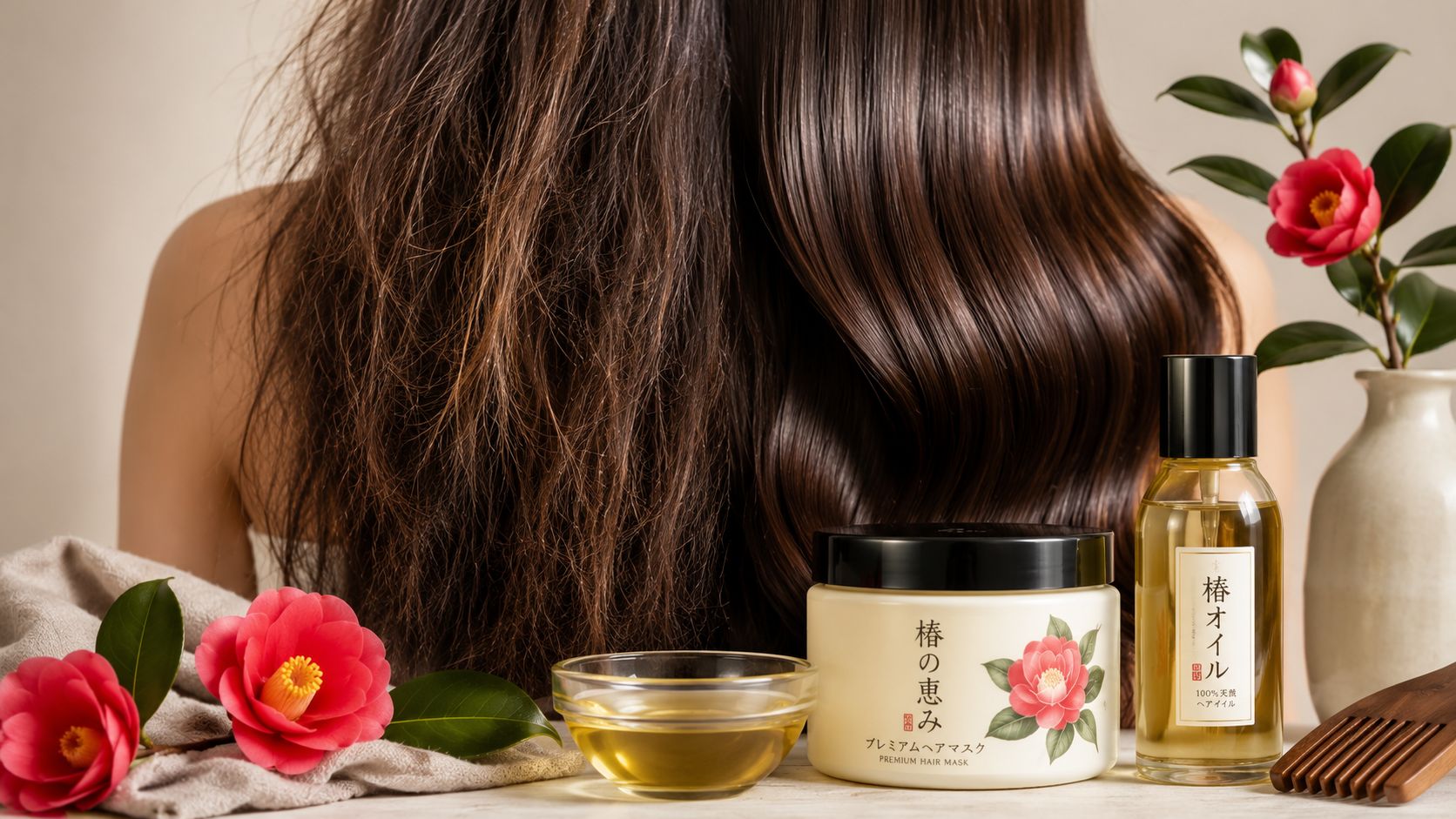
You notice it when your hair stops behaving like your hair. The ends feel rough. The mid-lengths look puffy even after styling. Shine disappears, and the more heat you use to smooth it, the worse it gets.
That's the point where one starts searching for how to repair heat damaged hair and runs into the same frustrating promise. One mask, one serum, one miracle fix. Real recovery doesn't work like that.
Japanese hair care takes a more useful approach. Instead of chasing a fantasy cure, it focuses on prevention, gentle handling, and ingredient-rich care that improves softness, smoothness, and manageability while protecting the healthy hair growing in. That philosophy matters, especially when you're rebuilding hair that's already been pushed too far.
The Reality of Heat Damage and The Japanese Approach to Repair
You finish styling, look in the mirror, and the hair is flatter at the crown, puffier through the mid-lengths, and rough at the ends. That combination is classic heat damage. I see it after months of daily blow-drying, repeated flat-iron passes, or curling hair that was already dehydrated.

Heat-damaged hair does not return to its original internal structure. Once high heat has weakened the cuticle and disrupted the protein structure, the goal shifts to control, softness, and breakage reduction. That distinction matters, because it changes the plan. Chasing reversal usually leads to overloading the hair with too many products, too much protein, or even more styling in an attempt to force a healthy finish.
Japanese hair care takes a steadier approach. The philosophy is preventive and corrective at the same time. Protect the hair you still have, treat damaged areas gently, and use formulas built to improve slip, moisture retention, and surface smoothness without making the hair hard or coated.
That is why Japanese repair products often perform so well on heat-stressed hair.
Instead of relying on a single dramatic treatment, the routine is usually built around a few disciplined steps:
- Low-stripping cleansing: The hair is washed without taking it to a squeaky, brittle state.
- Treatment as a real step: Masks are given time to sit and do their job, especially through porous mid-lengths and ends.
- Daily support: Hair oils, creams, and leave-ins are used to reduce friction, dryness, and re-tangling between washes.
- Ingredient-focused repair: Rich emollients, amino-acid-based conditioning agents, and nourishing oils are used to make damaged hair feel calmer and more flexible.
In practice, that means choosing products with a specific role. Shiseido Fino Premium Touch Hair Mask is popular for a reason. It gives dry, rough hair a softer, more compact feel. Tsubaki Premium Repair Mask works well for hair that has gone dull and coarse from repeated blow-drying. &honey formulas are especially useful when dehydration is the main problem, because they focus heavily on moisture retention and shine.
There is a trade-off. These products can improve feel and appearance dramatically, but they do not erase split ends or rebuild burned sections. Severely damaged lengths may still need to be cut. Good care buys you manageability and helps prevent further loss.
For a product-specific overview, this guide to Japanese hair damage repair products for dry, overprocessed hair is a useful place to start.
First Aid for Your Hair Assessing Damage and Immediate Care
You finish styling, catch your hair in the bathroom light, and notice the warning signs all at once. The ends look fuzzy, the mid-lengths feel rough, and the shine is sitting on top instead of coming from healthy hair. That is the point to stop experimenting and assess the damage properly.

Heat damage does not reverse on its own. Good care can improve softness, reduce breakage, and make the hair look far better, but scorched or split sections do not turn back into healthy hair. Severely damaged ends still need to be cut. That is the honest starting point.
The Japanese approach helps here because it favors calm, precise care over panic. Instead of throwing five rescue products at the problem, strip the routine back, handle the hair gently, and give damaged areas a better surface condition so they stop catching, snapping, and drying out further.
How to assess the damage at home
A useful assessment starts with how the hair behaves, not just how it looks in one mirror check.
Check these areas:
- Wet stretch: Take one shed strand after washing. If it stretches excessively, feels gummy, or fails to return close to its original shape, the internal structure is compromised.
- Surface feel: Slide your fingers down the hair shaft. If the mid-lengths feel uneven or the ends feel rough and crisp, the cuticle is likely lifted or chipped.
- Tangle points: Repeated knotting at the nape, crown, or last few inches usually signals friction and cuticle wear.
- Drying pattern: Hair that dries frizzy, puffy, or strangely dull after careful conditioning often has patchy porosity from heat exposure.
- End condition: Feathered ends, white dots, and obvious splits are not products problems. They are trimming problems.
One more sign matters in the salon. Hair that only looks smooth after repeated passes with a hot tool is already telling you it cannot tolerate that routine anymore.
Your first 48 hours
The first two days should focus on stabilizing the hair.
-
Stop direct heat
Put away the flat iron, curling wand, hot brush, and high-heat dryer setting. Hair that has just been pushed too far needs a break immediately.
-
Cleanse the scalp, not the lengths
Wash gently and keep your hands concentrated at the scalp. Let the lather rinse through the rest of the hair instead of scrubbing fragile ends together.
-
Saturate the damaged areas with conditioner or mask
Apply conditioner from mid-length to ends and give it time to sit. If the hair is especially dry, a Japanese mask such as Fino or Tsubaki can help the hair feel more compact and less straw-like after the first wash.
-
Detangle with slip, not force
Use fingers first, then a wide-tooth comb if needed. Start at the ends and work upward in small sections.
-
Dry with low friction
Press out water with a soft towel or cotton T-shirt. Do not twist, scrub, or pile the hair up roughly. If you need a dryer, use low heat and keep the airflow moving.
The hair that feels weakest when wet needs the most careful handling. Wet, over-heated hair stretches easily and breaks with very little tension.
What to avoid right now
Some habits make damaged hair look better for a few hours and worse over the next few weeks.
| Habit | Why it backfires |
|---|---|
| Reheating rough sections to make them look polished | Extra heat pushes weak areas closer to snapping and makes split ends travel upward |
| Layering heavy oil over dry, brittle hair without conditioning first | Oil can add shine and reduce friction, but it does not replace moisture or repair frayed ends |
| Tight buns, claw clips with tension, or slick ponytails | Mechanical stress concentrates on weak points and causes breakage around the hairline and ends |
| Bleach, permanent color, or aggressive toning | Heat-damaged hair has less margin for chemical stress and can become mushy, stretchy, or severely broken |
If the ends are dry but not yet splitting all the way up, a small amount of camellia oil can help reduce friction between washes. This guide on how to use camellia oil for hair without weighing it down is a practical place to start.
Stay strict in this stage. Recovery usually improves once the hair is no longer being overheated, overhandled, and asked to perform like healthy hair.
Your Weekly Japanese Hair Care Repair Ritual
Heat-damaged hair improves with routine, not product hopping. The Japanese approach is especially useful here because it treats repair as steady maintenance: cleanse without stripping, condition with intent, and use concentrated masks to keep weakened lengths flexible and smooth.

A weekly ritual works best when each step has a clear job. Shampoo keeps the scalp clean. Conditioner adds daily slip. A treatment mask gives damaged mids and ends longer contact with richer ingredients, which is often what dry, overstyled hair is missing.
The core weekly routine
Consistency matters more than having a crowded shelf. One good wash day, done properly each week, can change how damaged hair feels and behaves.
Wash with restraint
Use a gentle shampoo and keep the cleansing focused on the scalp. Let the lather pass through the lengths as you rinse instead of scrubbing the fragile parts directly. Japanese shampoos such as Ichikami and Tsubaki are popular for this stage because they tend to clean without leaving the hair squeaky or stripped.
If your hair is very dry, reduce wash frequency instead of forcing it into a daily cycle. That trade-off matters. A cleaner scalp is helpful, but repeatedly stripping already stressed lengths usually sets back recovery.
Use a true hair mask
Japanese products often stand out here because many are built around rich, conditioning textures and ingredient blends that target dryness, roughness, and loss of shine.
Two products that are widely sought after for this purpose are:
- Shiseido Fino Premium Touch Hair Mask
- Tsubaki Premium Repair Mask
Fino has a dense, smoothing finish that suits rough, porous hair well. Tsubaki Premium Repair Mask usually gives a softer, glossier result, which is why people who like that camellia-oil feel often prefer it.
If you want more background on why this mask has become a repeat purchase for so many people, this closer look at the Fino Premium Touch Hair Mask is useful.
Ingredients that make sense for damaged hair
Japanese hair care tends to focus on ingredients that improve feel and reduce friction instead of promising miracle repair.
- Camellia oil: Common in Tsubaki care. It helps hair feel smoother and look more polished.
- Honey blends: Found in products from &honey. These formulas are often a good fit for dehydrated, puffy hair that loses softness by the end of the day.
- Royal jelly and rich emollients: Often used in masks meant to make coarse, dry lengths feel more supple.
That ingredient-first approach is one reason Japanese repair routines feel more disciplined than generic damage advice. The goal is not to coat the hair with whatever looks shiny. The goal is to use formulas that help the cuticle sit flatter, improve slip, and make weak hair easier to handle between washes.
A good mask will not reverse structural damage. It can make damaged hair far easier to manage while healthier growth comes in.
How to apply the ritual properly
Application changes the result. I see people blame a mask when the actual problem is that they rushed it, diluted it, or used too little.
-
Towel-dry first
Hair should be damp, not soaking wet. Excess water weakens the treatment and makes it slide off the areas that need it most.
-
Apply from mid-length to ends
The oldest hair sits there, and that is usually where heat damage shows up first.
-
Use enough product
Fine hair needs less than thick or highly porous hair, but sparse application is still a common mistake. The hair should feel coated, not barely touched.
-
Let it sit
Give the mask several minutes to do its job. Five to ten minutes is a practical range for most repair masks, and very dry hair often benefits from the longer end of that window.
-
Rinse thoroughly but gently
Rinse until the hair feels smooth, not slippery and heavy. Keep your hands moving downward so you do not rough up the cuticle.
Daily support between treatment days
Weekly repair lasts longer when daily products reduce friction and dryness instead of adding buildup.
Consider:
- Momori Hair Cream
- Ichikami Hair Treatment Serum
- &honey Deep Moist Hair Oil
Hair creams usually suit thick, frizzy, or very dry hair because they give more weight and control. Lightweight oils are often better for fine hair that needs shine and surface protection without collapsing at the roots. The right choice depends on density, porosity, and how much residual dryness you are dealing with after wash day.
The Essential Role of Trimming in Hair Recovery
Clients usually push this step off until the ends are catching on sweaters, knotting in the shower, or turning see-through in the last few inches. By that point, repair products can improve feel, but they cannot fuse a split end back into healthy hair. Once the fiber has frayed, the practical fix is removal.
Heat-damaged ends keep traveling upward. The longer they stay, the more roughness, tangling, and breakage you have to work around during every wash and styling session. If length matters to you, trimming sooner often preserves more usable length than waiting for a major cut.
Trimming supports recovery
A trim removes the oldest, weakest part of the hair so the stronger lengths above it can behave better. Hair looks denser. Detangling gets easier. Styling takes less heat because the ends stop fighting you.
The right amount depends on what you see in the mirror and what you feel between your fingers.
- Dusting: Best for slight dryness and early splitting at the perimeter.
- Standard trim: Better when the bottom edge looks thin, uneven, or frayed.
- Reset cut: Necessary when damage has moved well past the ends and the shape has started collapsing.
I usually tell people to look for the line where the hair changes. Healthy hair feels smoother and has more bounce. Heat-altered hair feels stiff, rough, or oddly limp. Cutting to that transition point, even gradually over a few appointments, gives you a cleaner recovery plan than trying to nurse dead ends for months.
What to do after the cut
Freshly cut ends need less heroic repair and more consistent protection. Japanese hair care stands out in this regard. The goal is not to bury damage under heavy coating. The goal is to keep the cuticle calm, reduce friction, and prevent the new edge from splitting again.
Good options include a light leave-in or serum from lines such as Ichikami, Momori, or &honey. If the mid-lengths still feel dry after trimming, a richer weekly mask like Fino or Tsubaki can support the older hair without overloading the ends every day.
A simple post-trim routine looks like this:
| After-trim step | What it does |
|---|---|
| Leave-in milk or cream | Softens the cut edge and reduces snagging |
| Small amount of oil on the tips | Adds slip and lowers friction from brushing and fabric |
| Gentle styling with limited reworking | Reduces repeated stress on the weakest areas |
| Regular micro-trims | Keeps splits from spreading into the length |
Trim early. Trim small. That approach is easier to maintain than waiting until the last few inches are too damaged to save.
For a closer look at how damaged ends affect the rest of your recovery, read this guide on how to repair split ends.
When a salon appointment makes sense
Home care can maintain hair well. Correcting severe feathering, uneven breakage, or a collapsed shape usually needs a skilled stylist. If one section is snapping more than the rest, or the ends look wispy and translucent, ask for a targeted trim that removes compromised areas without taking unnecessary length elsewhere.
Smart Styling and Long-Term Damage Prevention
Hair usually feels better before it is better. That is the point where relapse happens. A week of softness after masks and leave-ins often convinces people they can go back to daily flat ironing, high dryer heat, and repeated touch-ups on the same pieces. That habit puts fragile hair right back under stress.

The Japanese approach is more disciplined than dramatic. It treats styling as damage control first, beauty second. The goal is to keep the cuticle flat, reduce friction, and use only the amount of heat the hair needs. That is why Japanese styling products tend to focus on light layers, slip, and finish instead of heavy coatings that make hair feel repaired for a few hours.
Set your tools lower and style with a plan
High heat is rarely the only problem. Reheating the same section five times is often worse than one controlled pass at a moderate setting.
Fine, porous, bleached, or already frayed hair should stay on the low end. Thick or resistant hair may need more heat, but still not the highest setting on the tool. If the hair will smooth at a lower temperature, use it. If it will not, improve your prep first by drying more thoroughly, sectioning more cleanly, and applying protection evenly.
A practical rule in the salon is simple:
- Fine or fragile hair: low heat
- Medium density hair: moderate heat
- Coarse or resistant hair: moderate to moderately high heat, only if needed
- Any hair with visible damage: fewer passes matter as much as lower temperature
One slow, deliberate pass on a properly prepared section beats multiple quick passes every time.
Layer products in the right order
The order matters. Damp hair should get a leave-in first, then heat protection, then styling. Applying everything at once or spraying protectant only on the surface leaves dry spots underneath.
Japanese products do this particularly well because many are designed to layer without making the hair stiff. A routine built around a lightweight leave-in and a separate protectant works better than a thick all-in-one cream for many damaged hair types. If your wash routine still feels too stripping, switch to a Japanese shampoo and conditioner for damaged hair that cleans gently and leaves the hair easier to style with less force.
Good options for styling support include lighter lines from Kao Liese, along with leave-ins from &honey or Ichikami if your hair tangles easily before blow-drying. The trade-off is that lighter products feel better and layer better, but very coarse hair may still need a cream or milk underneath for enough slip.
Use this sequence:
- Blot hair until damp, not dripping
- Apply leave-in through mid-lengths and ends
- Add heat protectant evenly
- Comb or brush through gently for distribution
- Dry and style in clean sections
- Limit reworking once the shape is set
Reduce heat exposure between wash days
Long-term prevention depends on what happens on ordinary weekdays, not just treatment day.
Let styled sections cool before brushing them out or pinning them. Air-dry when your schedule allows. Stretch the time between heat sessions instead of refreshing bends and flips every morning. If you use a curling iron, keep each section brief and controlled rather than holding heat in place while you wait for a stronger result. If a style falls quickly, the answer is often better sectioning or a different product balance, not more heat.
This is also the stage where some people notice that the issue is not only breakage. If density changes, a widening part, or shedding concern is entering the picture, that is a separate conversation from heat damage, and treatments such as non-surgical hair restoration may be worth reviewing with a qualified professional.
Choose styles that protect the hair you still have
Recovery hair does best with low tension and low friction. Tight slick styles, frequent teasing, and constant hot-tool refinement keep the cuticle under pressure.
Safer options include:
- Loose braids for sleep or next-day texture
- Soft buns with covered elastics
- Claw clip styles that avoid sharp bending at the ends
- Air-dried looks finished with a small amount of oil or serum
- Blowouts done once well, then maintained instead of redone daily
Japanese hair care philosophy gets this right. Repair is not a single rescue product. It is a series of small protective choices that keep damaged hair from getting worse while healthier growth comes in. Products like Fino, Tsubaki, and &honey fit that model well because they support softness, manageability, and moisture retention, which makes disciplined styling easier to maintain.
Your Path Forward to Strong and Healthy Hair
Heat-damaged hair tests your patience because it rarely changes overnight. What works is the combination of honest expectations, consistent treatment, and better styling decisions. That's the effective answer to how to repair heat damaged hair.
One fact gives people a realistic reason to stay consistent. According to L'Oréal Paris expert guidelines, consistent bond repair and heat protection can restore up to 98% of heat-damaged hair's strength and visible smoothness, even though the damage can't be completely erased.
The three habits that matter most
- Keep trimming strategically: Damaged ends don't become healthy ends through wishful thinking.
- Treat weekly, not randomly: A proper mask routine builds better visible results than occasional panic treatments.
- Protect the hair you still have: The healthiest hair on your head is often the new growth you haven't damaged yet.
Japanese hair care stands out because it treats repair as a practice. Gentle cleansing, rich masks, lighter leave-ins, camellia oil care, and lower-manipulation styling all work together. Products like Shiseido Fino, Tsubaki, &honey, Ichikami, and Momori fit into that philosophy well because they focus on nourishment and finish, not miracle claims.
For some readers, hair concerns go beyond shaft damage and into density or thinning. In those cases, it can help to understand options outside standard cosmetic care, including non-surgical hair restoration when the issue is loss rather than breakage.
If you're rebuilding your routine, a practical next step is comparing formulas that fit your hair type. This guide to the best Japanese shampoo and conditioner makes that easier.
Healthy hair usually comes back in stages. First it tangles less. Then it feels softer. Then it starts holding moisture and behaving more predictably. Stay with those stages. That's how recovery unfolds.
If you're ready to rebuild your routine with authentic Japanese hair care, Buy Me Japan is a reliable place to shop. You can find sought-after products like Shiseido Fino, Tsubaki, &honey, Ichikami, Momori, and other Japanese beauty staples shipped directly from Japan, which makes it easier to choose original formulas with confidence.
Share:
Japanese Vinegar Drink: Your Guide to This Healthy Habit
Japanese Setting Spray: Your 2026 Guide to Flawless Makeup