

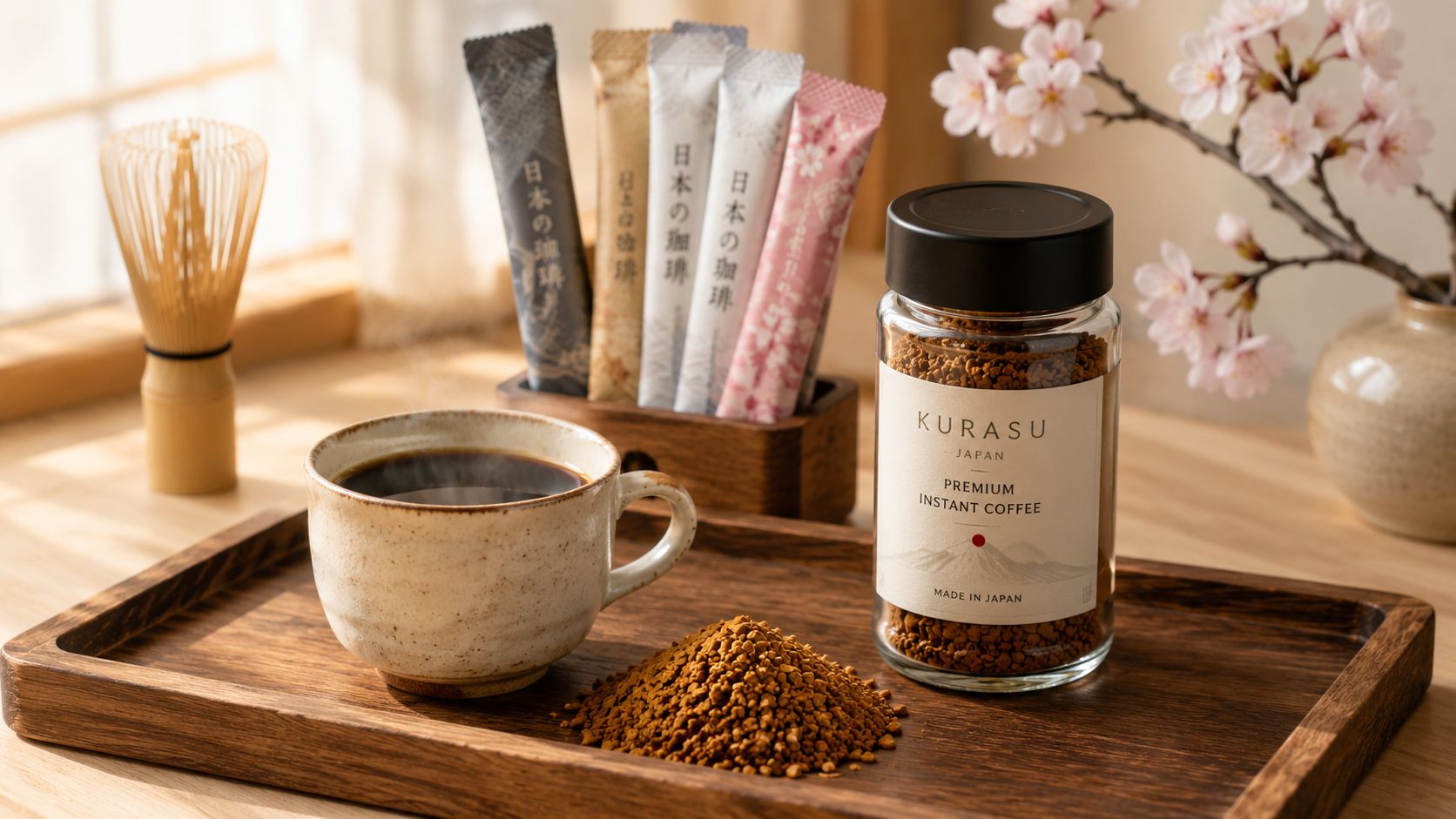
Instant coffee gets dismissed too quickly. Hearing the phrase often brings to mind flat aroma, dull bitterness, and a cup that only exists to deliver caffeine fast.
That advice misses something important. Instant Japanese coffee belongs to a different conversation. In Japan, convenience products often get refined until they feel thoughtful, precise, and surprisingly satisfying. Coffee is no exception.
If you're curious about what makes it different, this guide will help you understand the history behind it, the production choices that shape flavor, the formats worth knowing, and one simple brewing technique that can make your cup taste markedly smoother.
Why You Should Reconsider Instant Coffee
A lot of coffee advice starts with a snobbish rule. Freshly ground is good, instant is bad. That sounds neat, but it isn't very useful if you live a busy life, travel often, or want a reliable cup without equipment.
Japanese instant coffee deserves a second look because it wasn't shaped by the idea of settling. It was shaped by the idea of making everyday routines better. That difference matters in the cup.
The appeal isn't only speed. It's also consistency, portability, and the way many Japanese products are designed to remove friction without making the experience feel cheap. That same mindset shows up in many pantry staples and ready-to-enjoy drinks from Japan, which is one reason broader guides to non-alcoholic Japanese drinks are often such a good entry point for understanding Japanese food culture.
What usually confuses first-time buyers
Many readers assume all instant coffee is made the same way. It isn't.
Some versions chase low cost above all else. Others are built to protect aroma, dissolve cleanly, and give you a repeatable cup. Japanese instant coffee often stands out because it pays close attention to those small details.
Another point of confusion is taste expectation. If you're expecting a perfect pour-over replacement, you'll be disappointed. If you're looking for a fast, balanced, low-hassle cup that can get surprisingly close to a brewed coffee feeling, you'll understand why so many people become loyal to it.
Key idea: Instant Japanese coffee works best when you judge it by what it is trying to do well: quick preparation, stable flavor, and a cleaner everyday coffee ritual.
That's why it has such devoted fans. It's not pretending to be café theater. It's offering practical excellence.
The Culture of Convenience and Quality
Japan didn't adopt coffee yesterday. Coffee culture had already taken root long before instant coffee became a mass habit. According to this history of coffee in Japan, the country's first full-fledged coffeehouse, Kahiichakan, opened in Tokyo's Ueno district in 1888, and coffee had already arrived in Japan in the late 18th century through Dutch trade via Nagasaki.
That history matters because it changes the usual story. Instant coffee in Japan didn't enter a culture with no coffee standards. It entered a culture that already understood coffee as a drink with atmosphere, routine, and taste expectations.
Why convenience didn't lower the bar
Japan is full of products designed for fast daily use, but speed alone doesn't make them successful. People still care about whether something feels neat, dependable, and pleasant. Instant coffee became especially popular because it fit fast-paced, on-the-go habits while still aligning with that preference for order and consistency.
One Japanese coffee source goes further and describes instant coffee as the most popular type of coffee in Japan, particularly among younger consumers who value convenience and low price. That doesn't mean quality became irrelevant. It means quality had to adapt to a different setting.
For many households, offices, and travel situations, the ideal cup isn't one that takes equipment and technique. It's one that fits a short break, a work desk, or a small apartment kitchen.
The Japanese standard for everyday products
This is the part international shoppers often miss. In Japan, everyday products are often refined harder than luxury products in other markets. Packaging is more deliberate. Portioning is more exact. Flavor profiles are often tuned to be smoother and easier to repeat.
That logic helps explain why Japanese instant coffee can feel so polished. It isn't an afterthought. It's a serious convenience product.
A practical example is hot water access. If you're setting up a fast coffee routine at home or in a workplace, a resource on Melbourne instant hot water solutions is useful because it shows how much the overall experience depends on having controlled, immediate hot water available when you need it.
Good Japanese instant coffee makes sense only when you see the whole lifestyle around it. The cup is quick, but the design thinking behind it isn't.
That's why the category feels different. It comes from a culture that asks convenience products to perform well, not just perform fast.
From Bean to Crystal The Production Process
The biggest quality difference in instant coffee usually isn't the label design. It's the drying method.
Once brewed coffee extract is made, manufacturers need to remove water so the coffee can become a stable dry product. In broad terms, Japanese instant coffee is typically produced as either spray-dried powder or freeze-dried granules. According to Wikipedia's overview of instant coffee, freeze-drying generally preserves aroma and volatile flavor compounds better because water is removed by sublimation at low temperature, while spray-drying is faster and cheaper but more likely to strip delicate aromatics.
Spray-dried and freeze-dried in plain English
Spray-dried coffee is made by turning liquid coffee into a fine mist and drying it quickly with hot air. It is efficient. It is widely used. It also tends to be less gentle on aroma.
Freeze-dried coffee starts with brewed coffee that is frozen. The water is then removed at low temperature through sublimation, which means the ice shifts out without passing through a normal liquid stage in the same way. That gentler handling is one reason premium instant coffee often smells more vivid when you open the jar.

Why this changes what you taste
If you've ever noticed that some instant coffees smell sharp and a little dusty while others smell rounder and more coffee-like, drying method is often part of the reason.
Here's a simple comparison:
| Method | What it tends to prioritize | What you may notice in the cup |
|---|---|---|
| Spray-dried | Speed, lower cost, easy large-scale production | Simpler aroma, straightforward body |
| Freeze-dried | Aroma retention, gentler processing, premium positioning | Cleaner aroma, more nuanced flavor, often smoother finish |
That doesn't mean every freeze-dried coffee is automatically excellent. Formulation still matters. But if you're trying to understand why one Japanese instant coffee feels more refined than another, this is one of the first places to look.
The older history behind modern convenience
Instant coffee isn't a new gimmick. A foundational milestone came in 1901, when Japanese-American chemist Satori Kato developed the first successful process for producing a stable soluble coffee powder, a breakthrough widely cited as making modern instant coffee commercially viable. Commercial scaling followed in 1908, when George C. Washington launched the first commercial instant coffee process, as described in this history of instant coffee.
If you'd like a broader industry-facing explanation of blends, production, and practical tradeoffs, Allied Drinks Systems' instant coffee insights are a helpful companion read.
Practical takeaway: If aroma matters most to you, start with freeze-dried Japanese instant coffee before experimenting with other styles.
That one choice will usually give you the clearest picture of why the category has such a strong reputation.
Exploring Popular Japanese Coffee Brands
Once you understand the production side, shopping gets easier. You stop seeing instant Japanese coffee as one generic shelf and start seeing distinct styles, formats, and use cases.
Some drinkers want a black coffee they can make half-asleep before work. Others want a softer café au lait stick for the office. Japanese brands cover both ends well.
The format matters as much as the brand
One of the smartest things about the Japanese market is how often coffee comes in stick packs and other single-serve formats. According to this product-based explanation of Japanese premium instant coffee formats, these are designed for precise dose control, delivering a fixed amount of coffee solids per cup so you get a consistent result for office, travel, or home use.
That sounds simple, but it solves a common problem. A scoop from a jar can vary. A stick pack can't. If your last cup tasted too strong or too weak, dose inconsistency may be the reason.

A few brands worth knowing
Here is how I think about several familiar names in the category.
-
AGF Blendy
Often a very approachable starting point. Blendy is well known for easy-drinking options, including black coffee and milkier café-style sticks. If you're new to Japanese instant coffee and want something forgiving, Blendy is a sensible first step. -
UCC
UCC often appeals to drinkers who want a more coffee-forward identity. The profile can feel a bit more direct and grounded, especially if you usually prefer black coffee over sweetened mixes. -
Nescafé Japan lines such as Gold Blend or premium jars
Japanese-market Nescafé products are often chosen by people who want a polished, balanced cup with little fuss. These tend to fit the "daily reliable jar" role very well.
Which type fits your routine
Rather than chasing a universal best brand, match the format and profile to your habits.
| Coffee style | Best fit | Why it works |
|---|---|---|
| Black freeze-dried jar | Home drinkers | Easy to adjust strength and milk ratio |
| Single-serve black sticks | Office, commuting, travel | Precise portions and no measuring |
| Café au lait or latte sticks | Readers who want comfort and ease | Fast, softer flavor, less preparation |
If you already enjoy Japanese tea culture, it can also help to compare how Japan handles single-origin character versus convenience in other drinks. A guide like this jade leaf matcha review offers a useful contrast in how preparation style shapes taste perception.
The best Japanese instant coffee for you isn't always the most premium one. It's the one whose format matches the way you actually drink coffee.
That may sound obvious, but many buyers get stuck on prestige and ignore practicality. In this category, practicality is part of the quality.
Unlock Ultimate Flavor With This Brewing Secret
Instant coffee is often used the lazy way. Powder in mug, boiling water, quick stir, done. That method works, but it also hides some of the smoothness better Japanese instant coffee can give you.
A far better approach comes from a Tokyo coffee master who recommends dissolving the crystals in one pot, then pouring the coffee back and forth between two pots several times. According to SoraNews24's report on the technique, this aerates the coffee and creates residue that can be skimmed off, reducing bitterness and improving smoothness.

The two-cup method
You don't need special gear. Two cups or small pots are enough.
-
Add your instant coffee first
Put your preferred amount of coffee into one vessel. If you're using a stick pack, the dose is already set, which makes this method especially easy. -
Use hot water, not aggressively boiling water
Add a small amount first and dissolve the coffee fully. You're making a concentrate to start with, not a full cup. -
Add the remaining water
Once the coffee has dissolved cleanly, top it up to drinking strength. -
Pour back and forth several times
Move the coffee between two vessels. This introduces air and encourages residue to collect. -
Skim if needed
If you see residue or rough foam collecting on top, remove it gently.
The result is often smoother than a one-mug stir. The difference is especially noticeable when a coffee tastes slightly harsh in a standard preparation.
Small adjustments that help even more
A few extra habits improve the result without making the process fussy.
-
Warm the cup first
A cold cup can flatten the experience quickly, especially with smaller servings. -
Dissolve completely before adding milk
Undissolved granules can leave muddy bitterness at the bottom. -
Taste before sweetening
Better preparation often reveals that you need less sugar than you thought.
For readers who enjoy comparing brew approaches across brands, expert Nescafe Gold brewing tips offer another useful perspective on getting a cleaner cup from soluble coffee.
Here is the brewing video for a visual reference:
This same mindset applies to other comforting Japanese pantry drinks too. If you enjoy simple preparation with a little technique behind it, this guide to brown sugar ginger tea is a nice parallel.
Don't change brands first. Change technique first. A surprising amount of "bad instant coffee" is actually badly prepared instant coffee.
That is the brewing secret many product roundups skip.
A Buyers Guide to Instant Japanese Coffee
Shopping for instant Japanese coffee gets easier when you stop asking which one is best and start asking which one fits your day.
The category becomes much less confusing when you choose by format, flavor direction, and where you plan to drink it most often.
Jars or sticks
This is the first decision, and it matters more than many label details.

| Format | Best for | Main advantage | Watch out for |
|---|---|---|---|
| Jar | Home kitchens | Flexible strength control | Easy to over- or under-dose |
| Stick packs | Travel, office, routine drinkers | Clean, precise, portable | Less flexibility per serving |
If you drink coffee differently every day, a jar may suit you. If you want zero measuring and no mess, sticks are hard to beat.
Taste words that help
Japanese packaging often uses short flavor cues. Even if you don't read much Japanese, a few repeated ideas are useful.
-
Rich or deep body cues
These often signal a fuller, rounder cup that stands up well to milk. -
Clear or clean taste cues
These usually point toward a lighter finish and less heaviness. -
Aroma-focused wording
This is often a sign the product wants to highlight fragrance over sheer strength.
You don't need to decode every character on the label. You only need to identify the product's general intention.
Which buyer are you
I find these simple profiles more helpful than generic rankings.
-
The busy professional
Choose black stick packs or café au lait sticks. You'll get portion control, speed, and minimal cleanup. -
The home drinker
Choose a freeze-dried jar if you like adjusting cup strength, adding milk, or trying the two-cup pouring method. -
The comfort seeker
Look for mellow café-style sticks rather than intense black coffee. Japanese milk coffee products often shine when you want something soft and undemanding. -
The gift buyer
A premium jar or a neatly boxed stick set works well because packaging quality tends to be excellent and easy to appreciate.
If you're exploring broader pantry staples from Japan at the same time, a guide to Japanese food products online can help you build a more coherent order instead of buying in random categories.
Buying rule: Choose the format first, then the flavor style. Most disappointing purchases happen when people do that in reverse.
That simple sequence usually leads to better decisions.
Common Questions About Japanese Instant Coffee
How should I store it to keep it fresh
Keep it sealed, dry, and away from heat, steam, and strong odors. Instant coffee is a dehydrated product, so moisture is the enemy. If you're using a jar, close it promptly after each use and avoid storing it right next to the kettle if that area gets steamy.
Does it have less caffeine than brewed coffee
Generally, yes. According to the earlier instant coffee reference, instant coffee usually has lower caffeine than brewed coffee on a cup-to-cup basis because the serving size contains less coffee solids than a brewed extraction. The exact amount still depends on how much powder you use.
Can I make iced coffee with it
Yes. The easiest way is to dissolve the coffee fully in a small amount of hot water first, then add cold water, ice, or milk. That prevents clumping and gives you a cleaner flavor.
Is premium Japanese instant coffee always better
Not always. Premium coffee can preserve more aroma and taste more elegant, but technique still matters. A carefully prepared mid-range coffee can be more enjoyable than an expensive one made carelessly.
If caffeine comparison is one of your main concerns, this guide to sencha green tea caffeine is also useful for thinking about how different Japanese drinks fit different times of day.
If you're ready to try authentic instant Japanese coffee, Buy Me Japan is a practical place to start. It offers Japanese products shipped directly from Japan, which matters when you want an authentic domestic-market experience rather than a vague export substitute. For curious shoppers, that makes it easier to explore trusted Japanese coffee formats, compare pantry favorites, and buy with more confidence.


Share:
Master Mirin Sushi Rice: Authentic Recipe & Tips
Oolong and Jasmine Tea: A Guide to Flavor and Brewing