

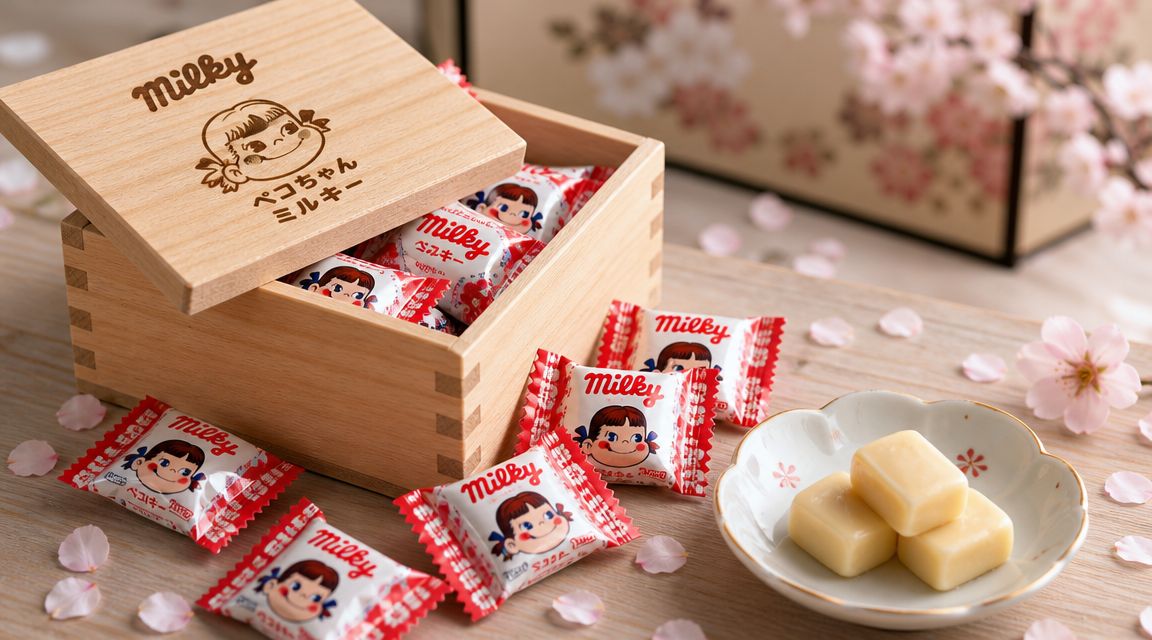
I still remember the first time a friend visiting Japan pointed at Peko-chan on a candy shelf and asked, “What is that, and why is she everywhere?” My answer started with a soft milk candy and turned into a whole story about postwar comfort food, packaging design, and how to shop for Japanese sweets carefully from abroad.
If you've been curious about Milky Candy Fujiya, this is the guide I'd want to hand you before your first order. You'll get the history, the taste, the ingredients, the packaging details people often overlook, and the practical questions international buyers usually have when trying to find genuine Japanese products. If you're exploring more Japanese pantry staples and sweets, this guide to Japanese food products online is also a useful companion.
Your Introduction to Fujiya Milky Candy
Fujiya Milky is one of those Japanese sweets that looks simple at first and becomes more interesting the longer you spend with it. The wrapper is cheerful. The mascot is unforgettable. The candy itself is soft, creamy, and very different from the hard milk candies many international shoppers expect.
For people outside Japan, the confusion usually starts in three places. First, “Milky” sounds like a generic flavor, but it's a specific long-running candy brand. Second, online listings often focus on nostalgia or cute packaging and skip the useful details. Third, buyers often want to know practical things like what it tastes like, what's in it, and how to tell if they're getting an authentic Japanese product.
Practical rule: Treat Fujiya Milky as both a candy and a cultural product. It makes more sense once you look at its history, ingredients, and packaging together.
In Japan, sweets like this aren't only impulse snacks. They're also shareable desk treats, travel souvenirs, small gifts, and comfort foods tied to memory. That wider role helps explain why Milky has stayed so visible for so long.
The Story Behind Japan's Favorite Milk Candy
Fujiya Milky matters because it sits at the meeting point of food history and brand history. According to Fujiya's company history, Fujiya traces its origins back to 1910, and Milky was first launched in 1951. That means the candy didn't appear from a brand-new company trying to invent a trend. It came from a confectionery business that already had a long foundation.

Why the launch timing mattered
The launch date matters more than many buyers realize. Fujiya places Milky in the early postwar period, when milk-based sweets were still unusual and dairy products were relatively scarce in Japan. In that setting, a creamy milk-flavored candy wasn't just another sweet. It carried the appeal of comfort, novelty, and a sense of nourishment.
That helps explain why people in Japan often talk about Milky with affection rather than just preference. It's not only “a candy I like.” For many, it belongs to a wider memory of classic Japanese snacks that feel familiar across generations.
Milky's staying power comes from more than flavor. It comes from timing, symbolism, and repetition in everyday life.
Peko-chan and the face of the brand
Another reason the candy became so recognizable is its mascot system. Fujiya notes that Peko-chan appeared in 1950 and Poko-chan in 1951, right around Milky's debut. That sequence helped create one of Japan's earliest durable confectionery identity systems.
If you're new to Japanese snack culture, this is an important point. Mascots in Japan often do more than decorate a package. They signal trust, familiarity, and continuity. Peko-chan's expression, colors, and playful look made Milky easy to remember even for children who couldn't yet read much text on packaging.
More than 70 years on shelves
Current Fujiya materials describe Milky as having more than 70 years of history. That kind of longevity usually tells you something practical. A candy doesn't remain commercially relevant across decades unless people keep recognizing the taste and buying it again.
For international readers, that's useful context. When you buy Milky, you're not buying a novelty import with a short trend cycle. You're buying a mainstream Japanese classic with deep roots in everyday snack culture.
Tasting Notes and Core Ingredients
Milky Candy Fujiya tastes richer than many people expect from its small size. The first impression is sweetness, but not the burnt depth of caramel or the sharpness of mint candy. It leans creamy, milky, and rounded, with a soft chew that slowly gives way rather than cracking.

What creates the texture
A product listing at Japanese Taste for Fujiya Milky Candy identifies the main ingredients as starch syrup, condensed milk, sugar, raw cream, vegetable oil, milk, and salt. That ingredient list tells you a lot about how the candy behaves in your mouth.
Starch syrup and sugar create the candy's sweet structure. Condensed milk, raw cream, and milk give it the dairy note that makes it feel fuller and softer than a plain fruit chew. The result is a candy that sits somewhere between a classic soft sweet and a creamy chew.
If you enjoy Japanese drinks and desserts with a gentle dairy profile, you'd probably also like the flavor style discussed in this article on strawberry milk tea, which shares that same comfort-food direction even though the format is completely different.
What the nutrition profile suggests
The same product listing gives 15 kcal per candy and reports a composition per 100 g of carbohydrates 81 g, of which sugars 80 g, with fat 8.4 g, protein 2.8 g, and saturated fat 2.3 g. In plain language, this is a sugar-forward candy with dairy ingredients shaping the taste and texture.
That's why Milky feels like a quick sweet rather than a filling snack. Most of its energy comes from carbohydrates, so it works best as a small treat, a shareable candy, or a little pick-me-up.
Buying insight: If you're comparing Milky to actual drinking milk, remember that the word “milky” describes flavor and texture, not a similar nutrition profile. For a useful contrast, you can compare 1% milk nutrition and see how differently a candy and a dairy beverage are built.
How to describe the flavor to a first-time buyer
Here's the easiest way I explain it to friends abroad:
- Closer to cream than caramel: It's sweet, but it doesn't taste heavily toasted.
- Soft rather than brittle: You chew it. You don't crunch it.
- Dairy-forward: The milk note is the main personality, not just a background accent.
- Simple in a good way: Milky isn't trying to be layered or dramatic. Its appeal is consistency.
That simplicity is part of why it has lasted. The flavor is easy to understand, but it's distinct enough that many people recognize it after one or two pieces.
A World of Milky Flavors and Products
One of the fun surprises with Milky is that the brand name doesn't stay trapped in one format. The classic soft candy is the anchor, but shoppers in Japan often encounter Milky across a wider family of sweets and collaborations.

The classic and everything around it
At the center is the familiar individually wrapped soft candy with the creamy milk profile widely associated with Fujiya. Around that core, you may also see hard candy versions, cookies, chocolates, and limited products that borrow the Milky flavor identity.
This matters for buyers because a listing that says “Milky” doesn't always mean the original soft chew. Sometimes it means a spin-off product inspired by the same brand image and flavor idea.
Fujiya Milky product variations
| Product Type | Description | Best For |
|---|---|---|
| Original soft candy | The classic chewy milk candy most people mean when they say “Milky” | First-time buyers |
| Hard candy version | A firmer candy with a longer-lasting sucking candy experience | People who want slower snacking |
| Milky-flavored cookies or chocolate items | Other sweets built around the familiar creamy flavor | Gift boxes and variety seekers |
| Seasonal or special flavors | Limited runs that add a regional or seasonal twist | Repeat buyers who want something different |
A lot of international shoppers also enjoy discovering Japanese sweets by category rather than by brand. If you like the creamy dessert side of Japanese snacks, this post on vanilla mochi ice cream is another good example of how familiar flavors get adapted into distinctly Japanese formats.
What buyers should check on product pages
Because the Milky universe can branch out, check these details before ordering:
- Product format: Soft candy and hard candy create very different eating experiences.
- Flavor wording: “Original” usually points you back to the classic milk profile.
- Pack style: Some packs are everyday snack bags. Others are boxed or positioned more like gifts.
- Photo details: Peko-chan branding is often a helpful visual cue, though packaging can still vary by release.
Shoppers sometimes assume variation means the candy has changed permanently. Usually, it just means the brand has expanded around a very recognizable base product.
Iconic Packaging and Creative Gift Ideas
Milky's packaging is part of the experience. Even before you taste it, the red-and-white design and Peko-chan face tell you this isn't an anonymous sweet. It looks playful, slightly retro, and very Japanese in the way classic snack branding often does.
Why the wrapper matters
Fujiya's English history notes that the classic Milky format features individually wrapped pieces with Peko-chan branding, and that this format supports shelf stability, portion control, and the candy's role in Japan's gift-giving and travel confectionery culture, as described on Fujiya's history page.
That individual wrapping is more useful than it sounds. It makes the candy easier to share at work, tuck into a bag, or add to a souvenir selection without everything sticking together. In Japan, practical packaging often carries as much cultural value as flavor.
A candy that can be shared one piece at a time fits naturally into Japanese everyday gifting habits.
Easy gift ideas that feel local
Milky works well in small, thoughtful gift bundles. In Japan, people often build casual snack gifts around recognizability and charm rather than luxury alone.
Some easy ways to use it:
- Add it to an omiyage-style snack bundle: Omiyage means a souvenir gift, usually food, brought back from a trip.
- Pair it with other classic Japanese sweets: This creates a “taste of Japan” set that feels approachable for first-time snack explorers.
- Use it as a desk or holiday treat: Individually wrapped pieces are easy to distribute without fuss.
If you enjoy this side of Japanese shopping culture, this article on cool gifts from Japan gives more ideas for building a present that feels personal rather than random.
Why collectors like it too
Some people buy Milky for eating. Others buy it partly because the visual identity is so strong. Peko-chan goods, branded tins, and candy assortments have a collectible appeal that goes beyond pure snacking.
That's one reason Milky keeps showing up in gift sets. The packaging carries emotional value before the wrapper is even opened.
Your Guide to Buying Authentic Fujiya Milky Online
Buying Milky from outside Japan can be oddly inconsistent. One shop offers only a single pack. Another uses old product photos. A third tells you almost nothing about pack style or stock freshness. That mismatch is part of the international buying experience described on this Milky product page discussing overseas availability.
What usually causes confusion
The problem isn't that Milky is obscure. It's that Japanese snacks travel through several channels before reaching overseas buyers. You might see them in an Asian supermarket, an anime gift shop, a marketplace listing, or a specialty importer. Each one can present the same candy differently.
That creates a few predictable questions:
- Is this the original soft candy or another Milky product
- Is the packaging current
- How large is the pack
- Will the product arrive in good condition
Those aren't picky questions. They're sensible buyer questions.
Smart checks before you order
When I help friends buy Japanese snacks online, I tell them to focus on clarity rather than hype.
- Read the format carefully: “Soft candy” matters.
- Look for ingredient detail: Sparse listings are harder to trust.
- Check how the seller describes sourcing: Japan-based sourcing usually gives better context.
- Prefer shops that understand Japanese products as products, not as novelty props: That usually leads to better descriptions and fewer surprises.
If you're building a wider snack order, this guide on where to buy Japanese snacks is helpful for understanding what to look for in a reliable store.
Overseas buyers don't just need access. They need clear product information.
A good listing should help you decide whether Milky suits your taste, not just tempt you with a nostalgic photo. That's especially important with candy, where texture and format make a huge difference.
Common Questions About Milky Candy
Does Milky contain milk ingredients
Yes, the ingredient information discussed earlier makes clear that Milky is a dairy-based candy. Listings identify ingredients such as condensed milk, raw cream, and milk. If you avoid dairy, this is not the candy to buy casually.
The bigger issue is that online information often leaves shoppers with incomplete dietary guidance. As noted in this discussion of the information gap around Fujiya Milky ingredient transparency and dietary suitability, practical questions about allergens and specific milk ingredients are often not answered clearly.
Is it vegetarian or allergy-friendly
You shouldn't assume either. The safest approach is to read the ingredient list on the exact product page and product packaging for the specific item you're considering. Different formats or seasonal releases may not match each other perfectly.
If you use shopping tools that help offset the cost of imported goods, you may also want to look into region-specific services such as Cashback Australia's platform when comparing where and how you shop online. That doesn't replace checking ingredients, but it can help with the broader buying decision.
How should you store it
Keep it in a cool, dry place away from direct heat. Because Milky is a soft candy, warmth can affect texture more noticeably than it would with a hard sweet. If your climate is hot, don't leave it in a car or near a sunny kitchen window.
Is Milky good for first-time Japanese snack buyers
Yes, if you like creamy sweets and want something iconic rather than unusual. It's a very approachable entry point into Japanese confectionery because the flavor is familiar enough to understand quickly, even though the texture and branding feel distinctly Japanese.
What if the listing doesn't answer basic questions
Skip it. If a seller doesn't explain format, ingredients, or pack details, you're left guessing. With imported food, guessing usually leads to disappointment.
If you want authentic Japanese sweets from a specialist that ships directly from Japan, browse Buy Me Japan. It's a practical place to explore Fujiya and other well-known Japanese snack brands with the confidence that you're shopping within a Japan-focused store rather than a generic marketplace.
Share:
Red Clay Mask: Benefits, Usage, & Skincare Tips
Ujido Ceremonial Blend Matcha: A Complete Buyer's Guide