


"Clear" does quiet work on this label. On an ordinary cosmetics shelf, the word would signal a lighter take on the same formula, and that instinct is exactly what misleads anyone comparing the two IHADA balms. Both are Japanese quasi-drugs, a regulated category where the carton divides its ingredient list into two legally distinct parts: 有効成分, the declared actives, and その他の成分, the supporting base.
That split is where the comparison lives. Reading IHADA Medicated Balm vs Clear Balm: how to compare the labels fairly means following one order: active panel first, base second, current carton over any older listing. A quasi-drug label declares what was approved for sale, and the English name on the front cannot carry that weight.
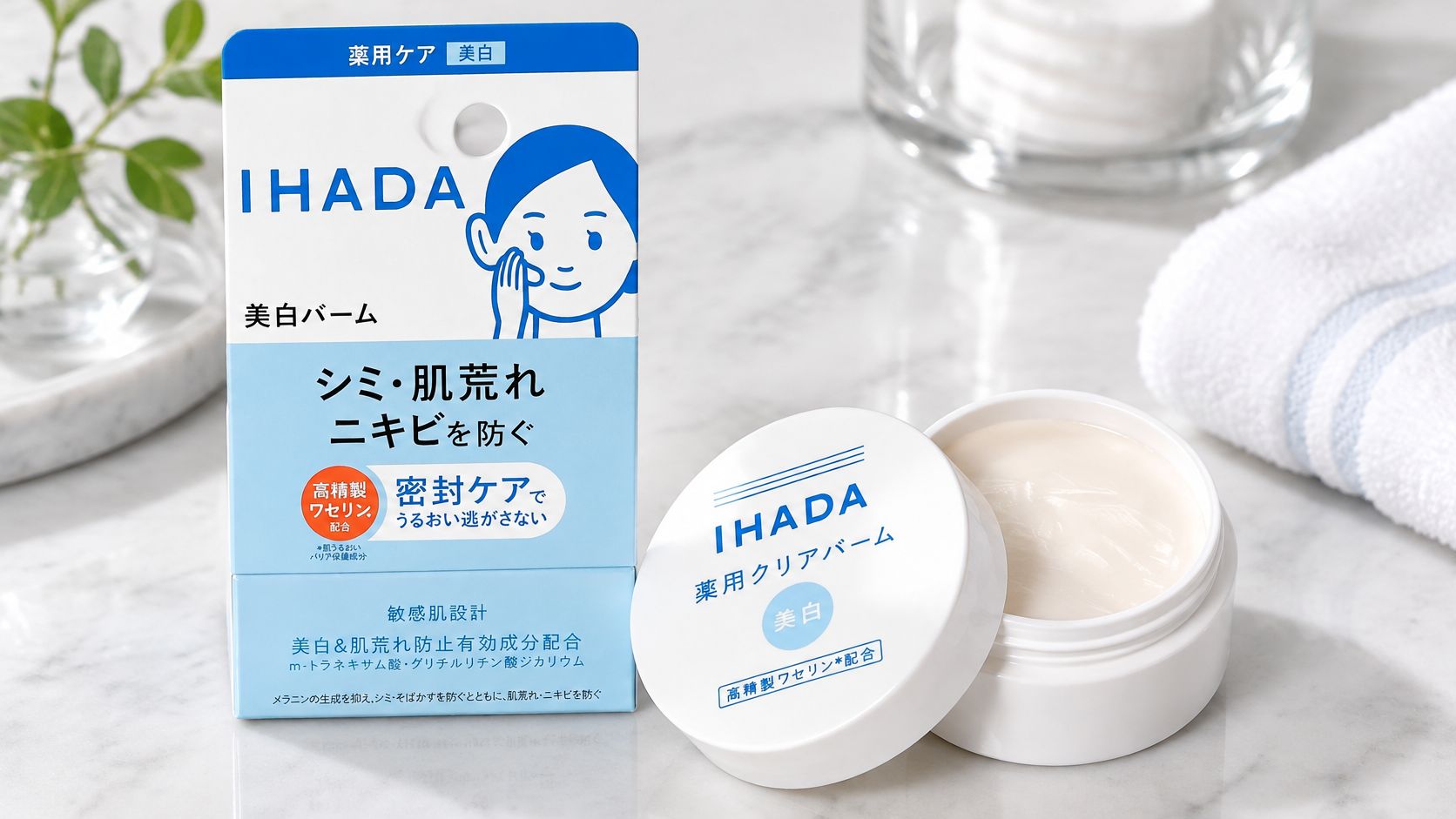
Side by Side Label Facts
IHADA Medicated Balm and Clear Balm label comparison
| Label checkpoint | Medicated Balm | Clear Balm |
|---|---|---|
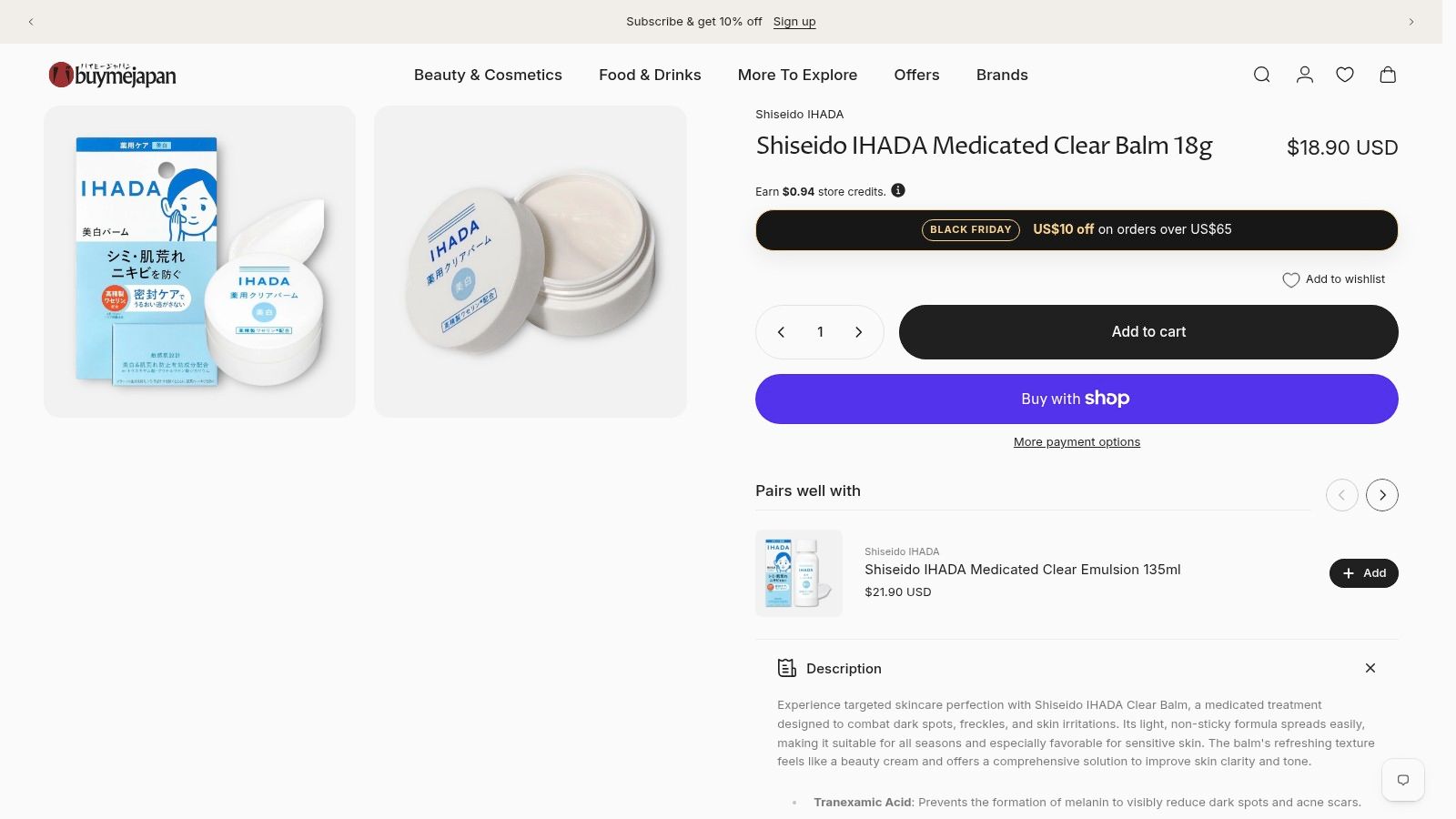
| Full name | Shiseido IHADA Medicated Balm 20g | Shiseido IHADA Medicated Clear Balm 18g |
| Net size | 20 g, confirm on package | 18 g, confirm on package |
| Active ingredients | 1: stearyl glycyrrhetinate | 2: tranexamic acid and dipotassium glycyrrhizinate |
| Other ingredients | Total not confirmed in a comparable official listing; count the printed その他の成分 block on the carton | 24 in the official listing |
| Purified water | Not in the official sequence | Listed |
| Prominent base | Petrolatum, sugar-derived squalane, emollient esters, silicones | Petrolatum, purified water, glycerin, butylene glycol, silicones |
| Phenoxyethanol | Not in the official sequence | Listed |
| Free-from wording | Catalog describes no parabens, alcohol, fragrance, or coloring; verify the carton | Not confirmed; phenoxyethanol is listed |
| Listing date | 21 February 2018 | 21 March 2020 |
The product pages linked in the table give the package sizes and catalog wording. Shiseido's official Clear Balm information identifies 2 active ingredients and 24 other ingredients for Clear Balm, and it shows the different active line and base used for the standard balm. No comparable official total is confirmed for the standard balm's supporting ingredients, so treat any item count in a shop declaration as a working note while you check the carton.
Read the Named Ingredients Before the Totals
Stearyl glycyrrhetinate and glycyrrhetinic acid stearyl are alternative ways you may see the standard balm's active named. Clear Balm instead identifies tranexamic acid and dipotassium glycyrrhizinate. The two jars carry different approved actives, so the active block deserves a closer read than any ingredient total.
Ingredient totals need more care. Online declarations don't all reproduce the supporting ingredients in the same way, and a short excerpt isn't necessarily a complete formula. Don't subtract items from a retailer's summary and assume you've discovered a reformulation.
The practical comparison is to copy the active block exactly, then make a separate record of the other-ingredient block. If an online count disagrees with the carton, keep the carton's complete wording rather than combining both lists.
What the Table Shows
The water entry is a useful structural clue. The standard balm's published sequence doesn't list purified water, while Clear Balm includes it alongside petrolatum and moisturizing ingredients. That points to two different base styles, but it doesn't establish which will feel better on your skin.
Likewise, a listed preservative is a concrete fact; an assumed preservative-free claim isn't. Record what the package says, not what its name seems to imply. Shiseido cautions that improvements and labeling changes can make the physical product differ from online information, so the current package takes priority.
How to Read Both Packages in Order
Keep the carton beside the shop page rather than relying on the jar's front label. A clear photo of the side or back panel is often more useful than a beautifully lit product photograph.
The Japanese quasi-drug regulation overview explains the distinction between approved quasi-drug actives and ordinary cosmetic ingredient labeling. Quasi-drug status supports a defined approved function, not a guarantee of better moisturization, faster results, or better tolerance.
Japanese Label Terms to Find on the Carton
| Japanese term | English meaning | What to check |
|---|---|---|
| 医薬部外品 | Quasi-drug mark | Confirms quasi-drug status, so approved actives and warnings apply |
| 有効成分 | Active ingredients | The approved actives, listed separately from the rest |
| その他の成分 | Other ingredients | The supporting base and additives |
| 使用上の注意 | Precautions for use | Warnings to read before first use |
Use these terms as visual landmarks. You don't need to translate every character before you can establish which block you're reading.
A Repeatable Carton Check
- Copy the full name in English and Japanese. Keeping Clear in the name prevents you from comparing the wrong jar.
- Find the quasi-drug mark. The English word medicated isn't a substitute for confirming the printed regulatory category.
- Separate active ingredients from other ingredients. This stops a translated ingredient list from hiding the distinction between approved actives and the base.
- Count the declared actives. Count only the entries inside the active block, not familiar soothing ingredients elsewhere.
- Write the first five non-active ingredients in printed order. This gives you a consistent base comparison without mixing in the active panel.
- Record the net weight. A product photo or abbreviated title can look convincing while showing a different package.
- Copy free-from statements, directions, and warnings. These tell you more about intended use than an unsupported sensitive-skin label.
- Resolve disagreements using the current carton. Keep its wording when an older review, translation, or shop description conflicts.
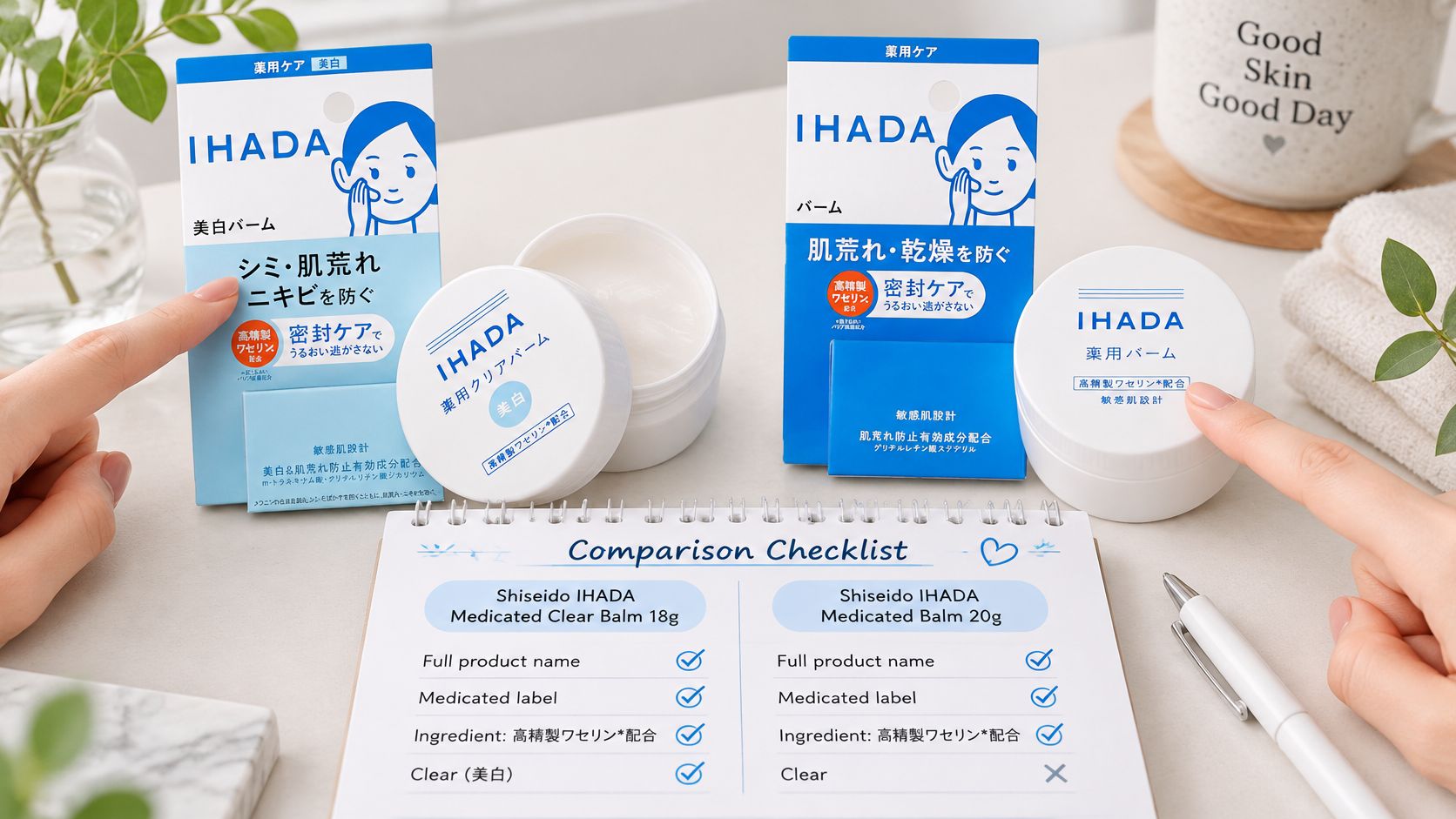
For an international buyer accustomed to a single cosmetic ingredient list, the split panel can initially look unusual. Don't merge the blocks into one imagined concentration ranking, and don't assume an active is weak because it isn't positioned like an ingredient on a conventional cosmetic label.
Practical rule: Translate the approved purpose separately from the ingredient names. Neither the word balm nor the word medicated tells you the complete permitted claim.
Country-specific stickers and translations also deserve attention. Read them alongside the original package rather than treating a shortened overseas title as the definitive product identity.
What Each Active Ingredient Line Means
The two cartons print different active lines. The standard balm lists stearyl glycyrrhetinate as its single 有効成分, the quasi-drug term for an approved active. Clear Balm lists two, tranexamic acid and dipotassium glycyrrhizinate, declared together in its 有効成分 panel while the base ingredients sit separately under その他の成分.
Match the printed function to your goal before weighing anything else. That is the decision rule for this panel.
Dryness and Roughness Are a Different Goal From Spot Prevention
The Japanese pharmacist's IHADA comparison separates the standard balm's dryness-and-roughness positioning from Clear Balm's pairing of anti-inflammatory care with melanin-related dark-spot prevention. Read these as approved product functions inside the Japanese quasi-drug framework.
For the standard balm, the glycyrrhetinate line supports a soothing-care role aimed at dry, rough skin. That wording stays narrow: it describes no skin-tone function, and it cannot tell you whether your skin will tolerate the full base formula.
For Clear Balm, tranexamic acid carries the claim of helping prevent melanin-related dark spots and freckles, while dipotassium glycyrrhizinate covers care for irritation and redness. Prevention language on a quasi-drug carton stops short of promising that existing marks will fade, and neither ingredient makes this an acne treatment.
More Actives Don't Mean a Higher Strength
Two named actives versus one reads like an upgrade until you check what each line is approved to do. Count lines for their declared purpose only.
Say your skin feels tight and dry after cleansing and you want a finishing balm for that. The spot-prevention function addresses a different problem, so picking Clear for that reason adds a purpose you never asked for. The same holds in reverse: if you want the printed melanin-related prevention claim, a dryness-positioned balm does not contain that function. Each panel serves its own goal, and the longer list wins nothing by default.
- Don't add the formulas together on paper. Layering both creates no verified combined benefit.
- Don't translate prevention into correction. A prevention claim promises nothing about an existing mark.
- Don't skip tolerance checks. Patch test a small area before wider use and follow the package precautions.
For a gentler approach to introducing unfamiliar formulas, our Japanese skincare guide for sensitive skin gives broader routine context. If active breakouts are your main concern, XO's clinician-led acne advice for UK adults covers that separately, since neither balm's active line claims acne care.
Water Free Base Versus a Water Phase
The supporting formula explains why the same word balm can cover different application experiences. It's useful to compare that structure after identifying the active panel, without turning texture into a safety ranking.
The standard balm's detailed ingredient declaration includes petrolatum, sugar-derived squalane, pentaerythrityl tetra-2-ethylhexanoate, an alpha-olefin oligomer, dextrin palmitate, and heavy liquid isoparaffin. It also names sorbitan sesquiisostearate, anhydrous silicic acid, silicone resin, a cyclotetrasiloxane, tetradecene, and titanium dioxide.
A Compact Balm Structure
With no purified water in that sequence, the standard formula looks anhydrous, meaning formulated without a listed water phase. Petrolatum, squalane, and emollient materials give you a reasonable basis for expecting a protective balm-style finish.
That's an interpretation of the ingredient architecture, not a guarantee of heaviness or greasiness. Amount applied, the products underneath, and your own texture preferences all affect how a finishing layer feels.
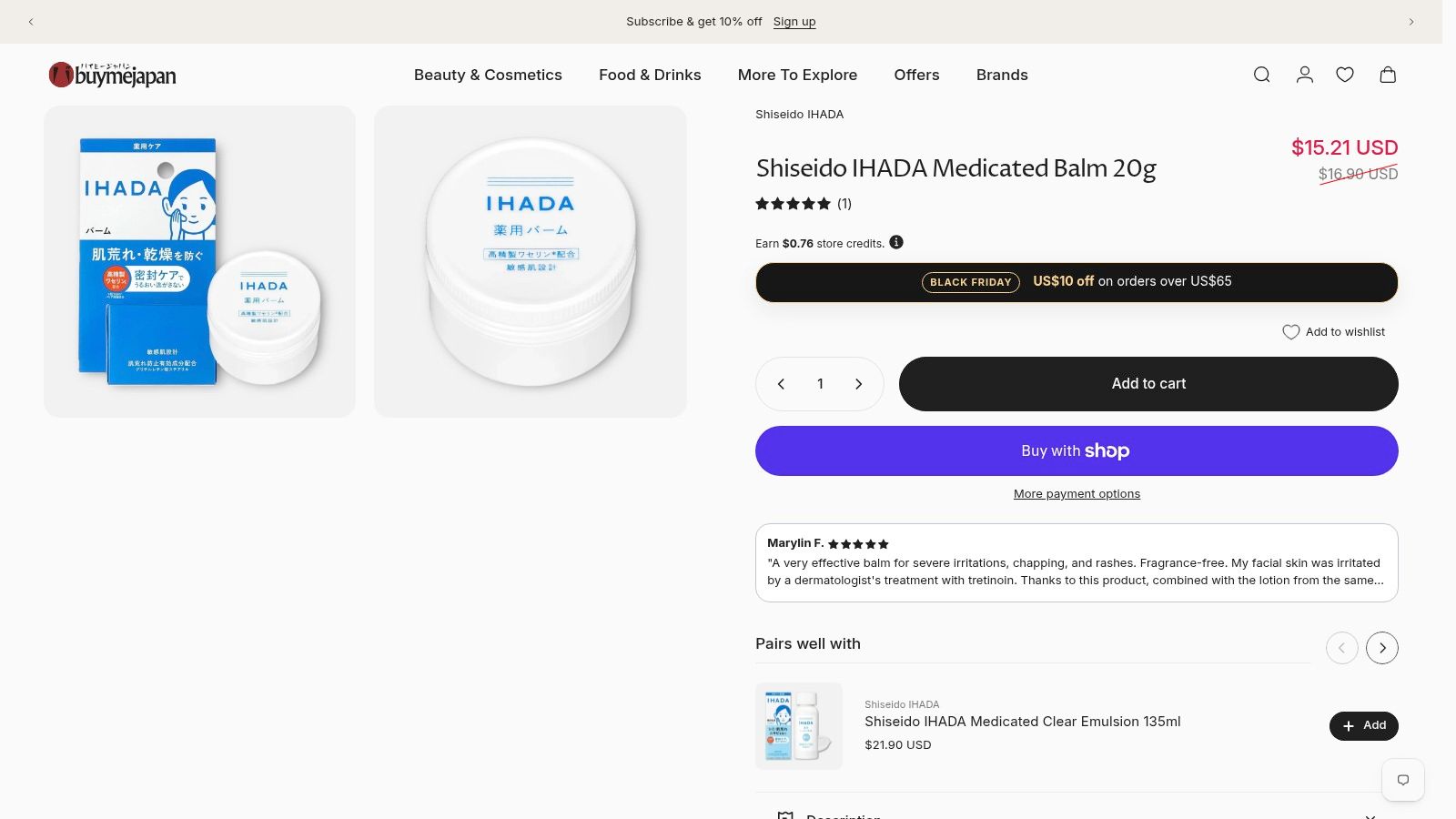
The standard variant's packaging is shown below so it isn't confused with the Clear jar.
A Water-Containing Cream-Balm Structure
Clear Balm still contains petrolatum. Its supporting declaration also includes purified water, cyclopentasiloxane, dimethicone, glycerin, butylene glycol, paraffin, allantoin, salts, sodium glutamate, sodium PCA, phenoxyethanol, and zinc oxide.
Water alongside humectants such as glycerin and butylene glycol can support a more cream-like moisturizing experience. Silicones can contribute slip, but their presence doesn't prove that the finished product will feel weightless to everyone.
| Formula clue | Useful interpretation | Unsupported conclusion |
|---|---|---|
| No purified water listed | An anhydrous-looking balm base | Automatically gentler |
| Water and humectants listed | A water-containing moisturizing structure | Automatically lighter on every skin |
| Petrolatum listed | An occlusive component remains present | A non-occlusive gel |
| Phenoxyethanol listed | Relevant if you avoid that preservative | Automatically irritating |
Ingredient-list length isn't a tolerance score. A compact formula may still contain something you personally avoid, while a longer formula may suit you comfortably.
If you're also exploring Japanese ceramide skincare, keep that comparison separate. Familiar barrier-care ingredients elsewhere in a routine don't establish which IHADA base will suit you, and they don't replace checking the complete package.
Clear Is Not a Strength or Color Grade
Clear sounds like it should mean transparent, lighter, or stripped back. Many shoppers read it as a gentler twin of the medicated balm, and just as many read it as a premium upgrade. Both rankings come from the English word, not from anything printed on either package.
Shiseido's product information dates the standard balm listing to 21 February 2018 and the Clear Balm listing to 21 March 2020. Two separate entries, dated about two years apart, confirm that these are distinct products in the range. A listing date cannot tell you that one formula replaced, revised, or improved on the other.
Write Down What the Name Leaves Out
When an overseas storefront lists only "IHADA balm," the distinguishing word disappears and two different formulas collapse into one search result. The package-note checklist used when reading both packages in order exists for exactly this situation. Copy the complete product name, record the 有効成分 (active ingredients) line separately from the その他の成分 (supporting ingredients) declaration, and keep fragrance, alcohol, colorant, and preservative wording exactly as printed.
Clear describes the product's identity within the range. It isn't a universal strength, color, or comfort rating.
If the name really did encode a strength grade, Shiseido would not need to print a different active panel on each jar. The label's own split between 有効成分 and その他の成分 is where the honest comparison lives, and it outranks anything the English word "Clear" suggests.
Leave the False Rankings Behind
Free-from wording needs the same discipline. A white jar, the word Clear, or a retailer's line about a refreshing feel cannot confirm alcohol-free, colorant-free, or preservative-free status. The printed claims and ingredient list are the only places those answers exist.
"Medicated" creates its own trap. The word sounds like the more clinical option, though the meaningful distinction is the approved purpose and the declared formula. A hierarchy between "medicated" and "clear" is something shoppers bring to the label, not something the label prints.
For another example of why closely related Japanese product names need careful decoding, the guide to Skin Aqua sunscreen types applies the same variant-first approach. Identify the exact package first, then judge the category shorthand.
When a product title stays ambiguous, pause the purchase. A readable label is worth more than a confident guess at the wrong formula.
Skin Tone Claims the Labels Do Not Prove
Neither label can diagnose sensitivity, explain persistent redness, or tell you why a dark mark appeared. Barrier-care language also doesn't establish that the standard balm is automatically right for compromised skin, or that Clear Balm is unsuitable for someone who reacts easily.
The sensitive-skin-care market outlook describes interest in barrier-supporting and microbiome-oriented skincare. That commercial interest isn't product-specific evidence that either IHADA balm repairs a damaged barrier.
Keep Tone Claims Narrow
For Clear Balm, keep the tranexamic acid discussion tied to its printed melanin-related prevention purpose. Don't expand it into a promise to lighten the whole complexion, remove acne scars, or produce visible change on a schedule.
It isn't a substitute for sunscreen. A spot-prevention skincare claim and a sun-protection claim are different things, and the balm name doesn't bridge that gap.
Our guide to Japanese tranexamic acid skincare offers context for reading this ingredient across products. If you're trying to understand products marketed for post-breakout marks, you can also compare acne pigmentation serums through Courier Pharmacy, while keeping pigmentation concerns separate from promises about scar texture or acne treatment.
Comfort Needs Its Own Assessment
Before choosing, make a personal avoidance note alongside the label comparison:
- Known sensitivities. Record ingredients you've previously been advised to avoid.
- Complete formula. Check supporting ingredients, not only the headline active.
- Printed precautions. Read the warning panel before applying the product.
- Your actual goal. Distinguish dryness comfort from a skin-tone prevention claim.
Ingredient order doesn't solve those questions. You can't compare a quasi-drug's separated active panel with an ordinary cosmetic list and calculate relative strength from where a soothing name appears.
The patch-test approach described with the active ingredient lines applies unchanged here: use a small area first, and treat redness or stinging as a stop signal rather than a reason to switch products by nickname. Persistent or concerning symptoms deserve professional advice, not repeated experiments with a different balm.
The labels state an approved purpose and a declared formula; they don't promise treatment of a skin condition or identical results for every shopper.
Pick the Balm That Matches Your Goal
Choose by the purpose you can verify, not by which jar sounds more impressive. A good purchase is one where the active panel, supporting ingredients, directions, and your expectations agree.
When the Standard Balm Makes Sense
Consider the standard balm when you want a dryness-and-roughness-focused finishing product and prefer its compact, water-free-looking base. Check the current free-from wording if avoiding fragrance, alcohol, coloring, or parabens is part of your selection criteria.
That choice doesn't need a skin-tone justification. If your main requirement is a comfortable finishing layer, you can judge the balm against that practical need rather than adding benefits its label doesn't establish.
For a broader way to assess moisturizing products, our barrier-focused moisturizer guide can help organize your priorities. Keep any repair language separate from the permitted claims on the actual IHADA carton.
When Clear Balm Makes Sense
Consider Clear Balm when you specifically want its tranexamic-acid-containing active panel and the corresponding dark-spot-prevention purpose. You should also be comfortable with a water-containing base and its complete supporting declaration, including any preservative you personally avoid.
Don't select it solely because you dislike heavy textures. A texture description can help set expectations, but only trying a suitable amount tells you how it works within your routine.
| Your situation | Sensible next step |
|---|---|
| You want dryness-focused balm care | Check the standard formula's purpose and complete base |
| You want the printed melanin-related prevention function | Examine Clear Balm's active panel and precautions |
| You can't read the active line | Pause until you have a readable package image |
| Your intended variant isn't available | Don't substitute by name alone |
Buy Me Japan is a trusted Japanese online store focused on making authentic Japanese products accessible through a convenient, reliable shopping experience. We offer secure transactions and helpful customer service, without asking you to treat a product description as a guarantee of personal results.
First-time shoppers who sign up get a 10% off coupon. Use that as a shopping convenience, not a reason to rush the label check or buy both formulas unnecessarily.
Your final decision should be simple: confirm the exact name, match the approved purpose to your goal, and read the complete current carton before use.
Buy Me Japan offers authentic Japanese skincare alongside beauty, food, drinks, and lifestyle products, with a convenient shopping experience and secure payments. Visit Buy Me Japan to explore the IHADA options, compare the product information with your package checklist, and choose only when the formula matches your goal.


Share:
Yuskin Sisora Lotion vs Cream: Choosing a Body Moisturizer Format
Canmake Marshmallow Finish Powder vs Abloom: How to Choose