

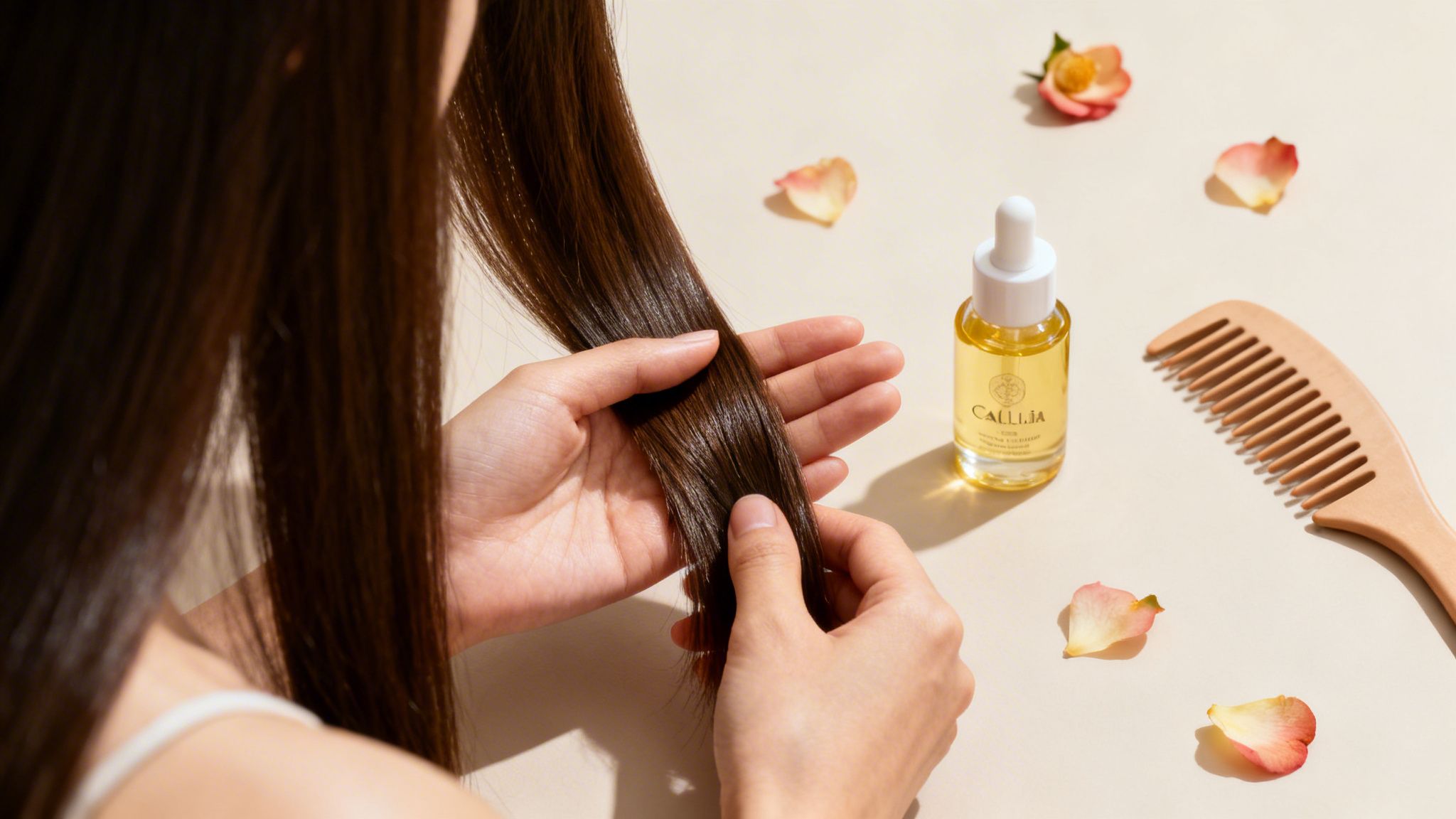
If you want to stop split ends, the strategy is simple: minimize physical, chemical, and heat damage while keeping your hair deeply moisturized. A great routine involves gentle washing, careful detangling, and smart drying habits. Using heat protectants and nourishing treatments from Japan, like masks and oils, is also key.
This guide will show you how to build a hair care routine inspired by Japanese wisdom. You will learn simple, effective steps to protect your hair, keeping it strong, healthy, and free from split ends.
Why Do Split Ends Happen?

Before we can prevent split ends, we need to understand what they are. A split end, known scientifically as trichoptilosis, is a clear sign that your hair is damaged.
Imagine a single strand of your hair is like a rope. It has a tough, protective outer layer called the cuticle, which shields the weaker inner core, the cortex. When the cuticle gets worn down from daily stress, the delicate fibers inside are left exposed. They start to unravel, creating a "split" at the tip.
Once a hair splits, it cannot be permanently fixed. The only real solution is a trim. This is why Japanese hair care focuses so much on prevention. The philosophy is about protecting the hair’s integrity from the start with consistent, mindful habits, not fixing damage after it has occurred.
The Everyday Causes of Hair Damage
Split ends are the result of daily habits that slowly wear down your hair's protective cuticle. Identifying these causes is the first step to defending your hair.
Here are the main culprits:
Mechanical Stress: This refers to physical wear and tear. Aggressive brushing, rubbing hair with a rough towel, or pulling it into a tight ponytail all create friction. This tension slowly weakens and fractures the cuticle. Even sleeping on a cotton pillowcase can cause damage over time.
Heat Styling: Blow dryers, flat irons, and curling wands are major offenders. Extreme heat boils the water inside your hair strands, making the cuticle brittle, dry, and prone to cracking.
Chemical Treatments: Coloring, bleaching, perms, and chemical straighteners all change your hair's internal structure. These processes break down the hair’s natural bonds, leaving it weaker and more susceptible to damage.
Environmental Factors: The sun, wind, and dry air can also cause damage. UV rays degrade the hair’s protein and strength, while dry climates can pull moisture right out of your strands.
Understanding these causes shows that stopping split ends requires a complete approach. This is different from hair breakage, which can happen anywhere along the strand. Learn more in our guide on how to prevent hair breakage.
Healthy, moisturized hair is flexible and resilient. Dry, damaged hair is brittle and prone to splitting. By focusing on gentle handling and deep hydration, you create an environment where hair can thrive.
Build a Gentle Cleansing Routine

Your plan for preventing split ends begins in the shower. The way you wash your hair sets the foundation for its health, making your cleansing routine a critical defense against damage.
A harsh wash can strip away the natural oils that protect your hair, leaving the cuticles raised and your ends vulnerable. A gentler approach, central to Japanese hair care, preserves moisture and reinforces your hair’s protective barrier. Making small changes here will significantly reduce frayed ends over time.
Adjust Your Water Temperature
First, turn down the heat. A steaming hot shower feels great, but hot water is an enemy to healthy hair. It strips your scalp and strands of their natural oils, which keep them hydrated and flexible. This moisture loss leaves your hair dry and brittle.
Wash your hair with lukewarm water. It cleanses effectively without causing dryness. This simple switch helps your hair retain the moisture it needs to stay strong. For an extra benefit, finish with a quick rinse of cool water. This helps seal the hair cuticle, locking in your conditioner and leaving your hair smoother and shinier.
Rethink Your Shampoo Technique
How you use shampoo matters just as much as what you use. Many people pile shampoo on top of their heads and scrub from root to tip. This creates unnecessary friction and tangles, especially on the older, more fragile ends.
A better method is to focus the shampoo on your scalp, where oils and product buildup collect. Put a small amount of shampoo into your palms, lather it, and gently massage it into your scalp with your fingertips. The suds that rinse down the lengths of your hair are enough to clean them without harsh scrubbing.
This targeted approach cleans your scalp thoroughly, which is essential for healthy growth, while protecting the mid-lengths and ends from being stripped of moisture.
A study on hair damage confirmed that harsh washing is a major cause of fragility. It found that surface treatments, like pre-wash oils, were significantly better at stopping damage than shampoos alone. Using sulfate-free formulas and conditioning every wash can reduce the progression of weak points in the hair by up to 60%. Discover more insights on hair strand durability at pmc.ncbi.nlm.nih.gov.
Choose Your Cleanser Wisely
The shampoo you choose is critical. Many common shampoos contain harsh sulfates that create a big lather but can be very stripping. To prevent split ends, look for moisturizing, sulfate-free shampoos that cleanse gently while adding hydration.
Japanese hair care brands excel at this, often using nourishing, natural ingredients. A great example is the Tsubaki Premium Moist & Repair Shampoo. It features camellia oil, a traditional Japanese ingredient known for delivering intense moisture and repairing the hair shaft. Products like this, which you can buy directly from Japan on Buy Me Japan, are designed to truly nourish your hair, not just clean it.
Master Your Conditioning Method
Conditioner is essential for sealing the cuticle and protecting your ends. After rinsing your shampoo, gently squeeze the excess water from your hair. Applying conditioner to soaking wet hair dilutes it and makes it less effective.
Concentrate the conditioner from the mid-lengths to the ends, as this is the oldest part of your hair and needs the most care. Avoid putting it directly on your scalp, which can weigh down your roots. Let it sit for a few minutes before rinsing thoroughly, and finish with a cool water rinse. This leaves your hair clean, hydrated, and protected.
For more insights rooted in traditional Japanese hair care, you might enjoy our guide on the benefits of rice water shampoo.
Master Gentle Detangling and Drying

Right after washing, your hair is at its most fragile. When wet, the internal protein structure of hair softens, making it much more elastic and prone to stretching. Rough handling at this stage leads to breakage and split ends.
One common mistake is rubbing wet hair with a standard cotton towel. The rough fibers create friction against your delicate hair cuticles, causing them to snag and fray. This can undo all the benefits of a careful wash. Adopting a mindful drying and detangling process, a core principle in Japanese hair philosophy, is key to preserving your hair's integrity.
Swap Your Towel for a Softer Alternative
The easiest change you can make is to ditch your harsh towel. A material that absorbs water without roughing up your hair can have a huge impact on your ends.
Your best options are:
A Microfiber Towel: These are made of ultra-fine synthetic fibers that are super absorbent and incredibly gentle. They wick away moisture quickly without creating damaging friction.
An Old Cotton T-shirt: The smooth fabric of a cotton t-shirt is surprisingly effective. It soaks up excess water without the abrasive texture of a terry cloth towel.
Instead of rubbing, gently blot or squeeze your hair. Gather sections of your hair in the towel or t-shirt and press down to remove the water. This method is much kinder to your strands.
Detangle With Patience and the Right Tools
Once your hair is no longer dripping wet, it's time to detangle. Never try to rip a brush through wet, knotted hair. This stretches the strands past their breaking point, causing damage that leads to split ends.
Your most valuable tool is a wide-tooth comb. Its spaced-out teeth glide through hair with minimal resistance, gently separating knots without pulling.
Technique is just as important as the tool. Always start detangling from the bottom up.
- Hold a small section of your hair a few inches from the ends.
- Gently comb through those last few inches until they are knot-free.
- Move your hand a few inches higher and repeat, combing from that new point down to the ends.
- Continue until you reach your roots and can comb smoothly all the way through.
This "ends-first" method prevents you from pushing small tangles into one large knot, stopping breakage before it happens.
If your hair is prone to tangles, a good leave-in conditioner can provide extra slip to help the comb glide through. To learn more, check out our guide on finding the perfect Japanese leave-in conditioner. This small step can make detangling easier while adding moisture and protection.
Protect Your Hair From Heat Styling
Heat styling tools are often the biggest cause of split ends. When you use a hot iron or a high-heat blow dryer, you boil the water inside each hair strand. This intense heat makes the protective outer cuticle brittle and prone to cracking. Over time, this damage weakens the hair until it frays.
Giving up heat tools completely is not realistic for everyone. The secret, a core principle in Japanese beauty, is to style mindfully. It is about getting the look you want without sacrificing your hair's health. This means shielding your hair from damage and using your tools smarter.
Your Non-Negotiable First Step
Before a hot tool touches your hair, you need a heat protectant. A good heat protectant spray or cream creates a thermal shield around each strand, slowing down how quickly your hair heats up and preventing moisture loss.
This protective barrier stops the water inside your hair from turning into damaging steam and helps distribute heat more evenly. Many formulas also add slip, so your styling tool glides through without snagging. Apply it all over damp or dry hair before you start, focusing on the mid-lengths and ends.
Smart Styling Is Gentle Styling
How you use your tools makes a big difference. Always use the least amount of heat necessary. Cranking your flat iron to the highest setting is asking for trouble.
Start by setting your tool to its lowest effective temperature. You might be surprised that a lower heat setting works just as well. For most people, a temperature between 150°C and 175°C (300°F to 350°F) is enough. Only coarse hair might need more heat, but always start low.
Another critical habit is to never go over the same section of hair repeatedly. Make one or two smooth passes, then move on. Frying the same piece of hair over and over is a fast way to cause breakage.
Embrace Air-Drying
Whenever you can, give your hair a break from heat. Letting your hair air-dry is one of the kindest things you can do for your ends. The less often you expose your hair to high temperatures, the stronger it will become.
If you are short on time, try a hybrid approach. Let your hair air-dry until it is about 80% dry, then use your blow dryer on a low-heat, low-speed setting to finish. This reduces direct heat exposure while still achieving a polished look.
Heat styling is a huge factor in hair damage. A global study found that it contributes to split ends in 62% of women who regularly use hot tools without protection. Just cutting back on heat can make a world of difference. Discover more insights from the Dyson Global Hair Science Study.
Protecting your hair is about creating a routine with layers of defense. For more tips, explore our guide on Japanese hair styling. Finding products that blend styling with protection, a hallmark of many Japanese brands available on Buy Me Japan, is the perfect way to keep your hair healthy.
Nourish Your Hair With Masks and Oils

Truly resilient hair is deeply nourished from the inside out. While gentle washing and handling are important, the real secret to building long-term strength lies in intensive treatments like masks and oils.
Think of your daily conditioner as a light stretch, while a hair mask is the deep conditioning workout your hair needs. These treatments deliver concentrated ingredients that penetrate the hair shaft, restoring moisture and sealing the cuticle. A regular nourishment schedule is one of the most powerful ways to make split ends a thing of the past.
The Power of a Weekly Hair Mask
Making a weekly hair mask part of your routine is a game-changer. These treatments are formulated with potent ingredients that need time to work, allowing them to deeply repair and hydrate. Using one consistently helps rebuild your hair's internal structure, making it more flexible and less likely to fray.
For an iconic Japanese treatment, the Shiseido Fino Premium Touch Hair Mask is a beloved product for a reason. It uses royal jelly EX, trehalose, and sorbitol to lock in moisture, turning dry, damaged ends into silky strands. When you get it from Buy Me Japan, you receive the authentic Japanese formula shipped directly to you.
To get the most out of your mask:
- After shampooing, gently squeeze as much water out of your hair as you can.
- Apply the mask generously, focusing on the mid-lengths and ends.
- Use a wide-tooth comb to work it through evenly.
- Leave it on for at least 5 to 10 minutes before rinsing completely.
Sealing the Deal With Hair Oils
While masks are your weekly deep-conditioning heroes, hair oils are your daily protectors. A quality hair oil seals the hair cuticle, locking in moisture from your conditioner and creating a shield against friction. This adds shine and reduces the rubbing that leads to split ends.
Japanese hair oils are famous for their lightweight, effective formulas. The &honey Deep Moist Hair Oil 3.0 is a perfect example. It is made with a blend of honeys and nourishing oils that deliver intense hydration without feeling heavy. Just a couple of drops on damp or dry ends makes a huge difference in keeping your hair smooth and protected.
The key to using oils is to start with a small amount. Warm a tiny bit between your palms and gently press it onto the ends of your hair. This gives you all the benefits without a greasy finish.
Finding The Right Treatment For You
Japanese hair care offers a treatment for every hair type. Choosing the right one for your hair makes all the difference. This simple guide can help you navigate the options.
Your Guide to Japanese Hair Treatments
| Treatment Type | Primary Benefit | Best For | Example Product (Buy Me Japan) | How to Use |
|---|---|---|---|---|
| Deep-Conditioning Mask | Intense repair, moisture, and strengthening. | Dry, damaged, brittle, or chemically-treated hair. | Shiseido Fino Premium Touch Hair Mask | Apply to clean, damp hair from mid-lengths to ends. Leave on for 5-10 minutes, then rinse. Use 1-2 times per week. |
| Nourishing Hair Oil | Seals moisture, reduces frizz, adds shine, and protects from friction. | All hair types, especially those prone to frizz and dryness. | &honey Deep Moist Hair Oil 3.0 | Apply 1-2 drops to damp or dry ends to seal the cuticle and add shine. Use daily or as needed. |
| Leave-In Milk/Cream | Provides daily hydration, detangling, and light heat protection. | Fine to medium hair that needs moisture without being weighed down. | Oshima Tsubaki Hair Cream | Work a small amount through damp hair before styling to moisturize and protect. |
| Hair Essence/Serum | Targeted treatment for specific issues like damage or lack of volume. | Fine hair or hair needing a lightweight, targeted boost. | &honey Melty Moist Repair Hair Essence 4.0 | Apply to specific areas of concern on damp hair before other styling products. |
This is just a starting point. The best way to find your perfect match is to understand what your hair needs, whether it's deep moisture, lightweight protection, or serious repair.
By adding these nourishing treatments to your routine, you are actively building your hair’s defenses against damage. You can learn more about these products in our complete guide to the best Japanese hair masks.
Lifestyle Habits for Stronger Hair
Healthy hair is a reflection of your overall wellness. While targeted treatments and great products are crucial, your daily habits lay the foundation for hair that can resist damage. It is all about building resilience from the inside out.
Your hair's long-term health starts with what you put into your body. Strong hair is built from protein and other nutrients, so ensuring your diet is packed with these building blocks is a powerful step.
Fuel Your Hair From Within
Your hair follicles use nutrients from your bloodstream to create new hair cells. If your diet is lacking, your hair will show it.
Focus on incorporating these key nutrients:
Protein: Hair is mostly made of a protein called keratin. A diet rich in protein is essential. Good sources include lean meats, fish, eggs, lentils, and beans.
Biotin: This B-vitamin helps your body produce keratin. You can find it in eggs, almonds, and sweet potatoes.
Iron: Iron deficiency can cause hair thinning and weakness. Get enough from sources like spinach, red meat, and fortified cereals.
Omega-3 Fatty Acids: Found in fatty fish like salmon, walnuts, and flaxseeds, these healthy fats help keep your scalp and hair hydrated.
A balanced diet provides the raw materials your body needs to grow strong, flexible strands that are less likely to split.
Make Small Changes to Your Daily Routine
Beyond your diet, small tweaks to your everyday habits can reduce the physical stress on your hair. These adjustments protect your strands from friction and tension.
Split ends affect an estimated 2 to 3% of the global population, which is roughly 125 million people. The most effective strategy to manage them is prevention, starting with regular trims. Experts agree that cutting hair every 6 to 8 weeks is the only way to stop split ends from traveling up the hair shaft.
Switching to a silk or satin pillowcase is a perfect example. These smooth fabrics create far less friction than cotton, so your hair glides over the surface as you sleep instead of snagging.
The hairstyles you choose also make a difference. Tight ponytails put constant tension on your hair. Opt for loose, protective styles like braids or low buns more often to give your hair a break. To make these changes stick, it can be helpful to explore strategies for integrating new habits into your routine.
The Golden Rule: Trimming Existing Damage
While every other tip here is about prevention, there is one rule for dealing with existing split ends: you must cut them off.
No serum, mask, or oil can permanently fuse a split end back together. The only real solution is a trim. Getting your hair cut regularly, ideally every 6 to 8 weeks, is the only way to remove the damage and keep your ends healthy. This stops the split from traveling further up the hair shaft, which prevents more breakage.
Got Questions? We've Got Answers
Can you really repair split ends once they happen?
No. Once a hair strand frays and splits, no treatment can permanently fuse it back together. Think of it like a frayed rope; you can smooth it down, but you cannot mend the break.
The only real fix is to cut off the damage. This is why a solid prevention plan is your best strategy for keeping your hair strong and healthy.
So, how often should I be trimming my hair to keep splits away?
For most hair types, a trim every 6 to 8 weeks is ideal. This is not just about maintaining your style; it is a crucial preventative step.
Catching tiny frays at the beginning stops them from traveling up the hair shaft. Letting them go for too long leads to a thin look at the ends and requires you to cut off more length later. A small trim now saves you inches later.
I heard air-drying is best. Is it possible it’s causing my split ends?
Avoiding high heat is always a good idea, but letting your hair stay wet for hours is not harmless either. When hair is saturated with water for a long time, the inner core swells. This constant swelling and shrinking as it dries can strain the outer cuticle, making it weaker over time.
The best approach is a hybrid one. Gently blot your hair with a microfiber towel or an old t-shirt until it is about 80% dry. Then, let the air handle the rest. This gives you the benefit of air-drying without leaving your hair in a vulnerable, swollen state for too long.
At Buy Me Japan, we believe the foundation of great hair is built on authentic, high-quality care. All our products are shipped directly from Japan, ensuring you get the genuine formulas trusted by millions. If you are ready to build a routine that prevents split ends, explore our handpicked selection of Japanese hair treatments.
Find the perfect products to protect your hair here: https://buymejapan.com.


Share:
How to Fade Dark Spots with Japanese Skincare
How to Repair Split Ends with Japanese Hair Care Secrets