


The usual advice for Club Suppin Powder vs Cream vs UV, how to choose the right format, gets the question backwards. You're not picking a favorite texture. You're assigning three different jobs. Standard powder controls shine and finishes the face. Cream adds moisture and makes a smooth base. UV powder adds a labeled sun-protection claim to a powder step, but that doesn't make a light dusting equal to a properly applied sunscreen. I wouldn't build a routine around the name on the box. I'd start with what's bothering your skin at midday, then pick the format that solves it.
Club Suppin Powder, Cream and UV at a Glance
| Format | Main job | Texture on skin | Sun protection label | Best for |
|---|---|---|---|---|
| Club Suppin Powder (standard range) | Oil control and soft-focus finish | Light and translucent, not heavy | None stated | Night use, indoor wear, touch-ups over a sunscreen base |
| Cream base | Moisture and a smooth base | Soft and spreadable | No SPF unless the label states it | Dry-looking skin and applying with the fingers |
| Club Suppin Powder UV, 26g | Powder finish with labeled UV protection | Powder texture, applied with a brush or puff | SPF50+ PA++++ | Reapplication and makeup maintenance over sunscreen |
Midday shine, midday tightness, and midday sun exposure need different answers. Oil calls for a light powder that blots and blurs. Tightness calls for moisture under the finish, not more powder on top. Sun calls for a full sunscreen layer first, with powder only as maintenance. Pick the job before you pick the jar.
Powder, cream and UV sit in separate roles. The original Suppin Powder idea is a lightweight finishing product that cuts visible shine and leaves a bare-skin look. That suits daytime touch-ups, makeup-free days and anyone who dislikes a wet or heavy finish. Cream formats prioritize moisturization and spreadability, so they make more sense when you want a smooth base, need to soften the look of dryness, or prefer a skincare-like texture applied with fingers.
UV versions add a formal sun-protection function to that cosmetic finish. The 26g UV spec comes from the manufacturer source, and the ingredient list includes recognized UV-filter ingredients such as zinc oxide, titanium dioxide and ethylhexyl methoxycinnamate. The UV format is built differently from a purely cosmetic powder. Still, I would treat it as a finishing or reapplication step unless the label directions support it as your primary sunscreen, because lab-rated protection depends on a uniform amount across the skin.
In the Buy Me Japan catalog, the standard range appears as Club Suppin Powder (Milky Blossom) 26g and Club Suppin Powder Whitening (Innocent Floral) 26g. Both sit in the finishing-powder role, focused on oil control and a soft-focus, pore-blurring look rather than a stated SPF rating. That distinction helps when you compare a night or indoor powder with a daytime UV product, since only one carries a sun-protection label.
If you want more background on how finishing powders work in a routine, our guide to Japanese face powder types and finishes covers the texture differences in more detail.
One-minute check: What problem are you solving at midday, oil, dryness or sun exposure? Your answer picks the format faster than any product name will.
Lotion, Emulsion and Cream as Base Layers
Powder only works well when what's underneath it is doing its job. Japanese base layers are usually described by thickness, and once you can tell them apart by touch, the order becomes simple.
Three Textures, Three Jobs
- Lotion, or keshōsui: This is what English speakers usually call toner. It's a light, water-based step applied right after cleansing to add hydration and prepare skin for what follows. You'll commonly see ingredients like glycerin and hyaluronic acid named in this category.
- Emulsion, or nyūeki: Also called milky lotion, it's an oil-in-water blend that feels lighter than cream. It carries a small amount of emollient, so it softens skin without the weight of a rich cream.
- Cream: The richest step, with more oil and butters, used as the final moisture layer in dry weather or at night. Emollients and ceramides are typical here.
You don't need all three every day. Skin that feels comfortable after emulsion doesn't automatically need cream on top, and skin that feels tight by afternoon often needs the cream step more than it needs a second powder.
The Touch Test
Press a small amount between your fingertips. A fast-absorbing, watery layer is lotion. A milky layer that leaves slight softness is emulsion. A thick layer that holds its shape is cream. That test is more reliable than the English word on the bottle, since translations vary.
Powder sits on top of all of this. It doesn't moisturize, and it can't rescue a base that was too thin for dry skin. If powder looks chalky by noon, the fix is usually in your base layers, not in the powder itself. You can see how these layers are sequenced in our Hada Labo lotion, milk and cream routine guide, which uses the same thin-to-thick logic.
Before using any new product across your face, patch test it on a small area of your jawline for a few days. Check ingredient lists on the current packaging rather than assuming a formula hasn't changed.
The Layering Order for Powder, Cream and UV
Order matters more than product count. Thin, watery layers go first, richer layers follow, sunscreen protects during the day, and powder finishes everything.
Morning Sequence
- Cleanse. At night this removes makeup and sunscreen. In the morning, a rinse is enough unless skin feels oily on waking.
- Apply lotion while skin is slightly damp. The water-based layer absorbs more evenly on damp skin than on skin that's fully dried down.
- Apply emulsion. This adds a light layer of emollient and keeps the lotion step from feeling like it evaporates.
- Add cream only if skin feels dry or the day is cold. In humid weather, skip it or keep it to the cheeks.
- Apply sunscreen cream or lotion to face and neck. This is your main daytime protection, applied in a full, even amount before you go out.
- Add powder last. Standard powder gives the finish. UV powder works as a top-up over the sunscreen you've already applied.
Why Powder Goes Last
Powder absorbs oil and sits on the surface, so it performs best on a base that has already set. Pressed onto a wet or tacky layer, it clings in patches and looks uneven. There's no fixed wait time to memorize. Let each layer stop feeling tacky before you move on, and let sunscreen settle before makeup or powder so you don't drag it around. Our notes on layering Japanese sunscreen under makeup without pilling explain that set time in practice.
Evening Sequence
At night, the order shortens. Cleanse, apply lotion, follow with emulsion, then cream if skin needs it. Standard powder is optional if you want a night matte finish and dislike going to bed with a shiny layer of cream on your face. Sunscreen isn't needed indoors at night, and UV powder has no role in an evening routine.
UV powder is a daytime top-up, never a first layer. If it's the only sun step you've applied, the order has gone wrong somewhere.
Reading SPF and PA Before You Rely on Powder
A high number on a UV powder compact creates false confidence. The rating describes controlled lab performance, not the thin veil most brushes leave on skin.
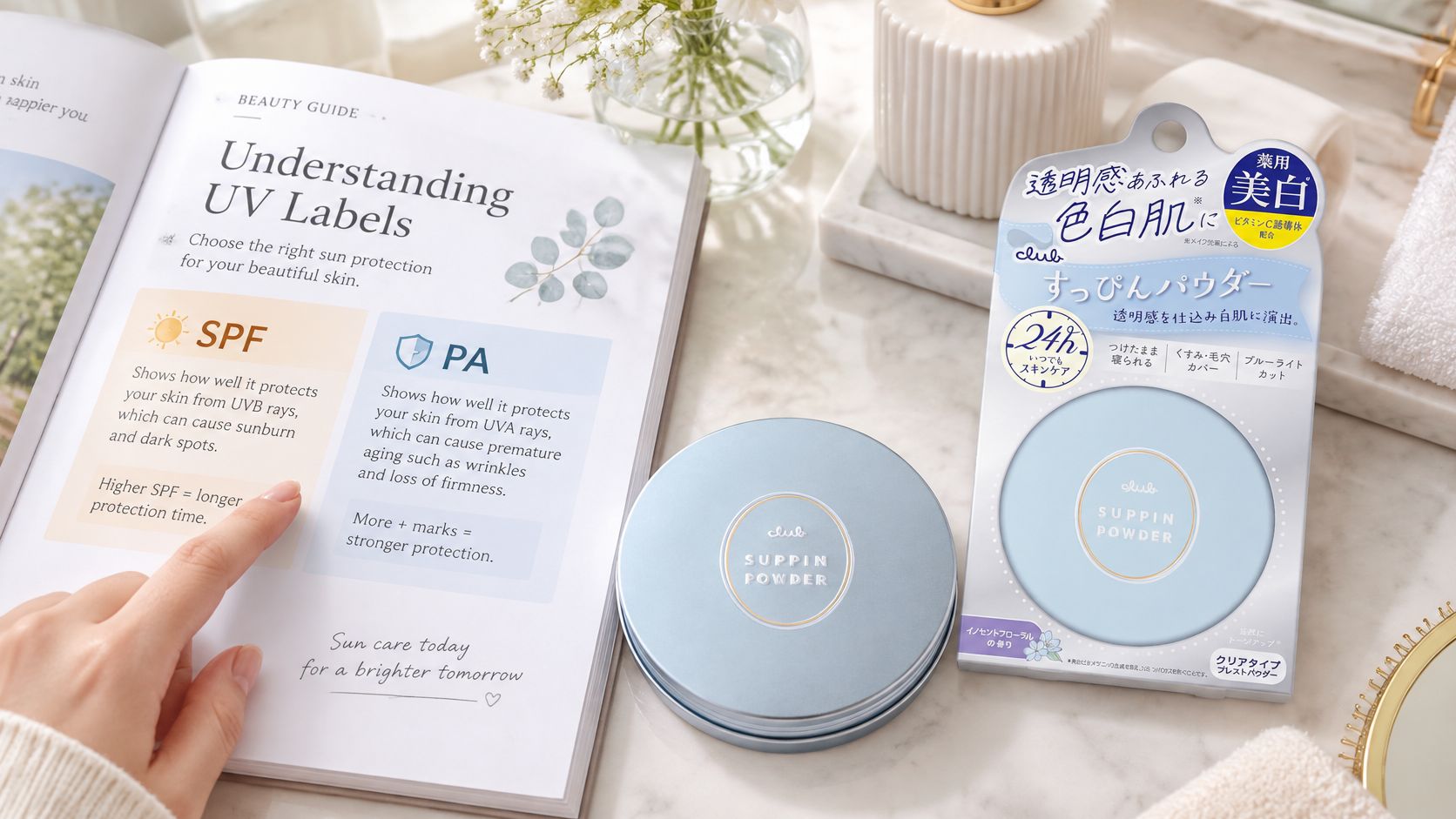
The basics are easier to follow with the packaging in view.
What SPF and PA Measure
Japan uses a two-part system. SPF measures protection against UVB, the radiation most associated with sunburn, and Japanese labeling caps it at SPF50+. PA communicates UVA protection, which links more closely with tanning and photoaging, and it runs from PA+ to PA++++, with more plus signs indicating higher UVA protection. Club Suppin Powder UV is marketed as SPF50+ and PA++++, the highest commonly displayed levels in both categories, as summarized in Kao's explanation of Japan's two-part UV rating system.
Those ratings tell you what the formula can do under controlled conditions. They do not tell you what you applied this morning.
The Gap Between the Label and Your Face
Lab testing uses a thick, even, carefully weighed layer. Daily wear looks different. Brushes and puffs lay down an uneven dusting, strong on the cheeks, sparse around the nose and hairline, and easy to sheer out for a cosmetic finish. Protection drops fast when coverage turns patchy, and a pretty finish gives no clue about the gaps left behind.
Cream or lotion sunscreen solves the dosing problem better because you can see the film and spread it edge to edge. If you are comparing base sunscreens for that first layer, our overview of Biore UV Aqua Rich textures and ratings shows why an essence or cream spreads more evenly than a powder. Choose the format for the job it does on skin. Cream carries the UV load. UV powder refreshes the surface and cuts shine.
This short video walks through the same apply, set and top-up sequence so you can see the order rather than imagine it.
The Practical Check
Apply cream or lotion sunscreen first, let it set until it stops feeling tacky, then press powder over it through the day. Check the package for reapplication guidance for your specific product, since directions are printed there and differ by format. Long outdoor hours call for a real sunscreen reapplication, not only a powder pass. I treat powder as maintenance for a routine that already has protection underneath.
Routines by Skin Type and Season
Winter dryness and summer shine ask for opposite bases, so start from skin and season and assign each Suppin format one clear job. Standard powder finishes, cream adds moisture, UV powder tops up over a properly applied sunscreen.
| Situation | Base layers | Sun step | Powder choice |
|---|---|---|---|
| Dry skin in winter | Lotion, emulsion, then cream | Cream or lotion sunscreen if outdoors | Light dusting of standard powder only |
| Oily skin in humid summer | Lotion and emulsion, no heavy cream | Sunscreen lotion or cream, refreshed at midday outdoors | Standard powder on shiny areas through the day |
| Combination skin in spring | Lotion and emulsion, cream on cheeks only | Daily sunscreen cream | Club Suppin Powder (Milky Blossom) on the T-zone |
| Makeup-free daytime glow | Lotion and emulsion | Daily sunscreen | Club Suppin Powder Whitening (Innocent Floral) |
| Sensitive or reactive skin | Simple lotion and cream, patch tested first | Sunscreen tested on a small area first | Hold powder until the base is tolerated |
| Outdoor work or long days out | Lotion and emulsion | Cream sunscreen as the main layer, reapplied | UV powder as a top-up over sunscreen |
Where People Most Often Guess Wrong
Dry skin gets too much powder. Powder emphasizes dry patches and settles into flaky areas. Winter skin looks better with cream in the base and only a light dusting where shine appears. If the forehead is the only shiny zone, powder only belongs there.
Oily skin gets powder applied too thickly at once. One heavy morning layer cakes by lunch and then slides. Press a thin layer onto shiny areas and repeat lightly through the day. Our guide to Japanese sunscreen for oily, acne-prone skin helps when the base sunscreen adds to that shine.
Combination skin gets an all-over application it does not need. Press powder onto the T-zone and leave the cheeks alone, using cream on the cheeks only if they feel dry. I recommend treating zones separately because one uniform layer turns cheeks flat while the forehead still shines.
The Makeup-Free Daytime Option
For a no-makeup look, Club Suppin Powder Whitening (Innocent Floral) 26g works best as the last step over lotion, emulsion and sunscreen on a dull morning. Let the sunscreen set until it no longer feels tacky, then press the powder lightly across the center of the face and blend outward. It softens the look of pores and uneven tone while the base underneath supplies the moisture.
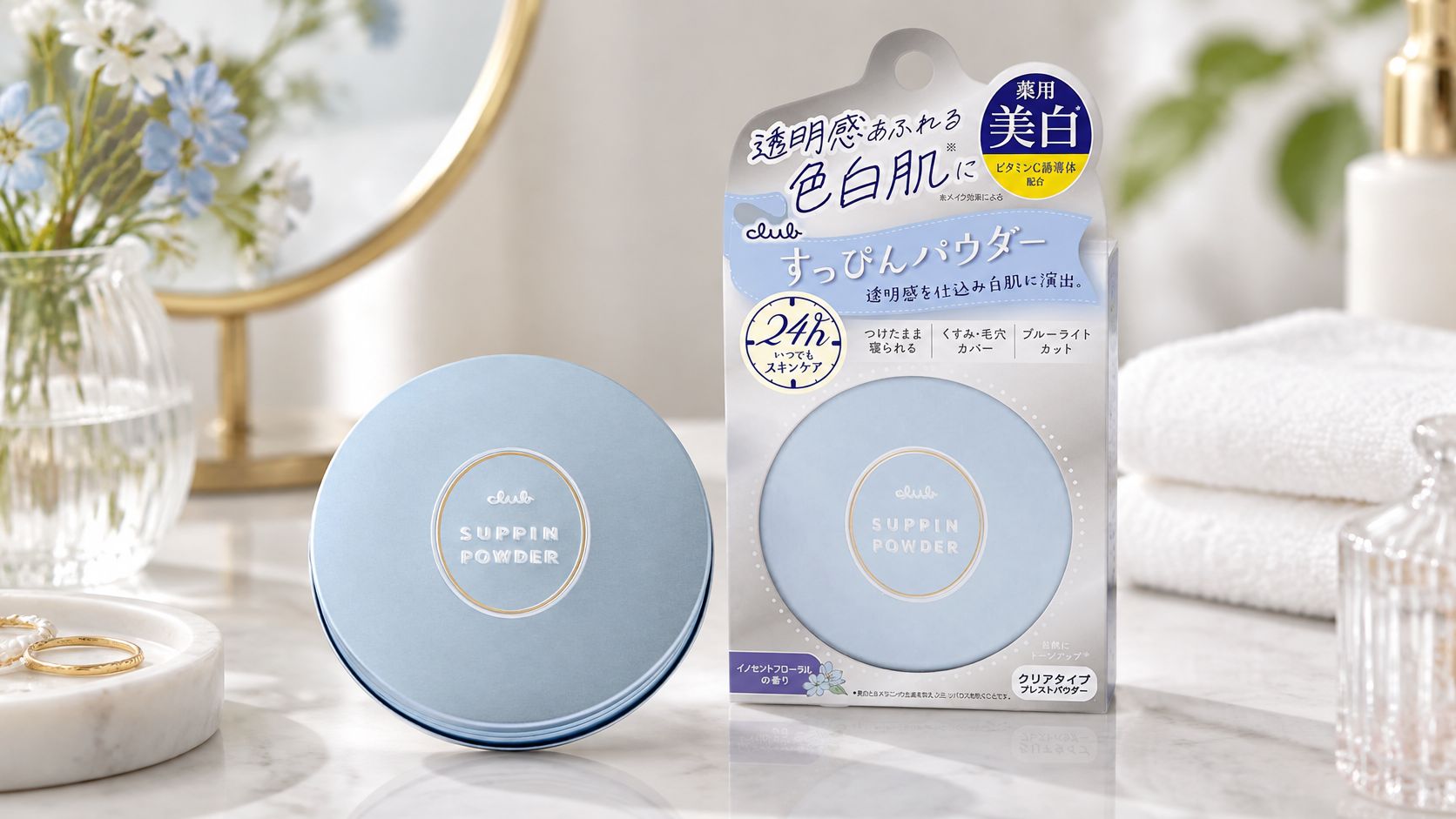
Keep sunscreen in the routine even on cloudy days when you go outside. For outdoor work or long days out, a cream sunscreen stays the main layer, reapplied properly, with UV powder only maintaining the finish between those applications.
Mistakes That Undermine Powder and UV Layers
Powder fails when it gets hired for work it was never made to do. Standard powder sets finish. Cream holds moisture. UV powder refreshes the look over sunscreen that was already applied correctly.
- Expecting powder to change pores permanently: Blurring is a soft focus finish from mica and titanium dioxide. It lasts while the powder sits on skin. Pores look smaller for the day, then return to normal after cleansing.
- Assuming a fixed reapplication interval transfers between products: The official Club Cosmetics product listing for Suppin Powder UV specifies SPF50+ and PA++++. Check the reapplication directions on your own package and follow that timing.
- Changing three steps after one bad afternoon: New powder plus new cream plus new sunscreen leaves no clear cause when shine or irritation appears. Change one variable at a time and keep brief notes for a week.
A 6-hour beach day shows the limit clearly. One dusting of UV powder at 9 a.m. will not carry through sweat, towel contact, and midday sun to 3 p.m. I recommend a cream or lotion sunscreen as the base layer for that kind of exposure, reapplied on schedule, with UV powder used only to cut shine and keep the finish comfortable between sunscreen applications.
Buying Checklist Before You Choose
Start with the problem you want solved that day. Standard powder handles shine and finish, cream adds moisture under makeup, and UV powder works as a daytime top-up over sunscreen that was applied in the right amount first.
Check the listing before you order. Confirm the variant name, spelling and size on the product page, since close names can mean different finishes. Usage guidance can also change between versions, so follow the directions printed on the package you receive.
For skin that reacts easily, test a new powder, cream or sunscreen on a small area for a few days before full use. Ordering one format first makes it easier to tell which step helped. You can confirm current names and sizes by browsing the full Buy Me Japan product catalog before you order. Shoppers who sign up get a 10% off coupon, which is worth claiming before checkout rather than after.

Pick the format that solves your main midday problem, then build the rest of the routine from the tables above. Browse the current powders and base products at Buy Me Japan and add the one that fits that need.
Share:
ReFa Lock Oil vs Light: Which Styling Oil Should You Choose?
Yuskin Cream vs Hana Hand Cream: Choosing for Everyday Hand Care