


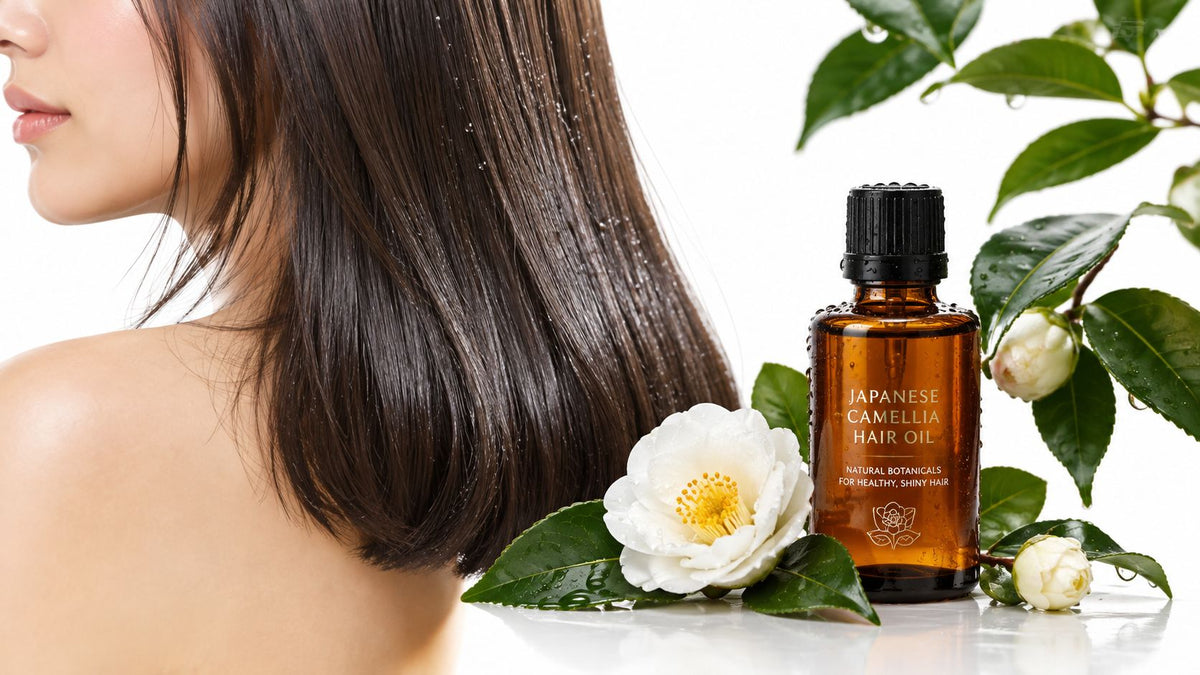
You've spent time smoothing your hair, step outside into warm, damp air, and the finish changes before you reach your destination. Stray strands lift, straight hair bends, waves expand, and dry ends seem to attract moisture from everywhere. A Japanese hair oil for humid weather can help, but only when you treat it as a controlled finishing layer rather than a waterproof shield.
The practical difference comes from formula, porosity, placement, and dosage. Lightweight oils and serum textures can support a smoother surface, while too much product may flatten the roots, attract residue, or make strands look separated. The routine below focuses on what humidity does mechanically and how to use Japanese hair oils without expecting them to defeat the weather completely.
Why Humidity Causes Hair Frizz
Hair is mainly made of keratin, a protein whose shape is influenced by temporary hydrogen bonds. Heat styling rearranges those bonds, which is why a blow-dry or flat-iron can make hair appear straighter and more aligned for a time. Humid air introduces more water molecules, and absorbed water interacts with keratin, helping the fibre bend, expand, or move back toward its natural pattern. Smithsonian Magazine's explanation of humidity and hair shape provides a useful plain-language overview of this process.
Porosity determines how quickly that exchange happens. Bleaching, oxidation, and chemical processing can leave the cuticle more open, so moisture moves into and out of the fibre more readily. Laboratory frizz testing commonly compares hair styled around 30% relative humidity with exposure around 80% relative humidity, while another approach compares styling at 40% with exposure to 80% to 90%. These figures are linked to their respective testing descriptions in this humidity and porosity analysis.
What the oil can actually change
A finishing oil doesn't permanently waterproof hair. Its more realistic role is to create a hydrophobic surface film that slows moisture exchange, improves slip, and helps strands remain aligned for longer. A peer-reviewed study found that hair water regain increased approximately linearly as relative humidity rose from 40% to 85%, while remaining elasticity decreased approximately linearly between 50% and 80% relative humidity. The study also introduced a Hair Humidity Resistance Factor, where a value above 1 indicates improved resistance to humidity-driven water uptake. See the PubMed-indexed hair humidity study for the research context.
Practical rule: Oil can slow the visible effects of moisture, but it can't stop the internal keratin fibre from responding to a humid environment.
That distinction helps explain why a finishing product may improve smoothness without delivering perfectly frizz-free hair. For broader routine ideas, reduce frizzy hair naturally offers additional low-intervention approaches, while Buy Me Japan's guide to Japanese shampoo for frizzy hair is useful when the cleansing step also needs attention.
Choosing the Right Japanese Hair Oil Formula
The richest-looking oil isn't automatically the strongest choice for humid weather. A thick layer can make fine or straight hair appear greasy, reduce movement, and hold onto environmental residue. In practice, texture matters as much as the ingredient story. Lightweight serum oils tend to suit hair that needs surface control without losing volume, while richer oils are more appropriate for coarse, dry, or porous lengths that can absorb and distribute more product.
Traditional oils and modern serum textures
Camellia oil, also called tsubaki oil, is a familiar Japanese botanical choice for smoothing and shine. Its appeal is straightforward: it can provide lubrication and a polished feel, but a pure oil also demands careful dosing. The cataloged Kurobara 100% Pure Tsubaki Hair Oil 72ml suits shoppers who prefer a traditional, single-ingredient approach and are comfortable starting with a very small amount.
Modern products offer a different balance. Shiseido Fino Hair Serum Treatment 70ml is a serum-style option for shoppers who want a smoother treatment finish, while & Honey Pixie Moist Silky Hair Oil 100ml is a lighter choice for hair that needs silkiness without obvious heaviness. The Buy Me Japan collection also lists & Honey Deep Moist Hair Oil 100ml, & Honey Melty Moist Repair Hair Oil 100ml, & Honey EX Deep Moist Hair Oil 100ml, & Honey Moist Shine Hair Oil 100ml, the & Honey Deep Moist Hair Oil refill in a 75ml size, and Bisho Akari D Plus Rich Hair Oil Repair Treatment 150ml. These are catalog details, not proof that every product performs identically in extreme humidity.
The difference between a hair milk and an oil also matters. A water-based leave-in can support conditioning before the final barrier step, whereas an oil primarily improves surface feel and reduces moisture transfer. Buy Me Japan's comparison of Japanese hair milk versus hair oil can help you decide which texture belongs earlier in your routine. If you're also researching what aloe vera does for hair, remember that a hydrating ingredient and an occlusive finishing oil serve different purposes.
A short visual guide can help you compare application and finish:
Application Protocol for High Moisture Climates
Application errors often look like formula problems. Oil spread over dripping-wet hair can dilute unevenly, while oil applied to dry hair in a large amount can sit visibly on the surface. In humid weather, use the product as a finishing barrier, and build the result gradually.
- Wash and condition first. Cleanse the scalp and condition the lengths. If your hair feels rough or porous, use a water-based leave-in before oil. A suitable Japanese hair conditioner can provide the conditioning base that an oil alone can't replace.
- Remove excess water. Press hair gently with a towel until it's damp, not dripping. Hair should still have flexibility, but water shouldn't run from the ends. This gives the oil a more even surface to spread across.
- Start with a minimal amount. For fine or shoulder-length hair, begin with one or two drops. Put the oil into your palms, rub them together to distribute it thinly, then press and smooth through the mid-lengths and ends.
- Keep the scalp clear. Work below the earline when possible. The roots already encounter sweat and natural sebum in hot climates, so adding leave-in oil there can reduce volume and create a heavy appearance.
- Dry with directional airflow. Point the dryer downward along the shaft rather than blowing upward into the cuticle. This supports a flatter, smoother surface and reduces the number of lifted areas that can catch moisture.
- Finish only where needed. Once the hair is completely dry, use a trace amount on your fingertips for flyaways. Don't add a full second application. If the first pass made the ends look separated, the answer is usually less product, not more.
Controlled testing supports the barrier concept. When oils were applied at 0.1 millilitres per gram of hair and humidity increased in 10-percentage-point steps to 95%, every tested oil reduced moisture sorption compared with untreated hair. At 95% relative humidity, maximum moisture regain was 23.65% for coconut oil, 22.53% for sunflower oil, and 22.05% for mineral oil. These results come from the reported cosmetic-science testing protocol, and they don't establish that every Japanese formula will behave in exactly the same way.
Matching Oil Dosage to Hair Porosity and Texture
Two people can use the same oil and get opposite results. Fine, low-porosity hair often resists absorption, so a rich coating remains on the outside and makes strands look stringy. Bleached or highly porous hair usually has greater moisture sensitivity and may need more careful coverage, but “more” still has to be tested rather than assumed.
A useful starting framework is to combine strand thickness, porosity, and where the hair needs control. Apply the smallest amount that gives slip and separation, then reassess after several hours in humid air.
Hair Oil Dosage and Selection Guide
| Hair Type and Porosity | Recommended Formula Type | Suggested Dosage |
|---|---|---|
| Fine, straight, low-porosity hair | Lightweight serum oil, such as & Honey Pixie Moist Silky Hair Oil | One drop, or half a pump if the dispenser releases a very small amount. Apply to the bottom two inches. |
| Medium, wavy, or color-treated hair | Medium-weight moisturizing oil, such as & Honey Deep Moist Hair Oil | One to two pumps, distributed from the ears down. |
| Thick, coarse, or highly porous curls | Rich repair-focused treatment, such as Bisho Akari D Plus Rich Hair Oil Repair Treatment | Two to three pumps, applied in sections through the lengths and ends. |
These amounts are starting points, not universal prescriptions. A tropical-climate test reported that eight or more drops increased frizz compared with three drops, apparently because excess surface oil encouraged environmental moisture adhesion. The low-porosity Japanese hair-care guide is particularly relevant if your hair becomes coated quickly or loses volume after leave-in products.
Adjust the placement before increasing the dose
For fine straight hair, keep the product away from the upper lengths and concentrate on the ends. Medium or wavy hair may benefit from even distribution from the ears downward, especially when the surface feels rough after coloring. Thick curls often need sectioning so the oil reaches the inner layers instead of creating a glossy coating only on the outside.
Porosity also affects what should come before oil. If bleached hair feels dry, stiff, or absorbent, apply a water-based conditioner first. The oil can then support surface smoothness, but it shouldn't be expected to replace conditioning inside a porous fibre.
A good dose leaves the strands flexible and separate. If your hair looks darker, clumps together, or loses movement, reduce the amount at the next application.
Troubleshooting Greasiness and Scalp Buildup
More oil can create more visible frizz. That sounds counterintuitive, but a heavy surface layer can increase clumping, attract moisture and residue, and make individual strands separate unevenly. Independent cosmetic-science testing found that thicker oil films changed moisture behaviour, with thicker surface films increasing moisture regain while decreasing diffusion rates. Removing the surface film reversed those effects, which is why layering product without reassessing the finish can backfire. The findings are discussed in this review of natural hair oils and their cosmetic behaviour.
Diagnose the finish, not just the frizz
If the roots look flat by midday, the oil has probably travelled too high or the formula is too rich. If the ends look shiny but stringy, the dose is excessive for your strand thickness. If the hair feels dry underneath a greasy surface, the routine may need better conditioning before oil rather than another layer of oil.
Use these corrections:
- Stringy lengths: Wash, condition, and restart with half the previous amount.
- Flat roots: Keep all leave-in oil below the earline and avoid brushing it upward.
- Rough ends: Add a water-based leave-in before the oil instead of increasing the oil immediately.
- Residue or dullness: Use a clarifying wash when buildup is noticeable, then return to a lighter dose.
- Scalp discomfort: Stop applying oil near the scalp and focus on gentle cleansing and thorough rinsing.
An oily scalp with dry ends needs two separate strategies. Keep cleansing directed at the scalp and reserve richer products, such as & Honey Melty Moist Repair Hair Oil 100ml, for the fragile lengths and ends if the texture suits them. Buy Me Japan's collection of Japanese scalp-care products can help you explore scalp-focused options without treating a hair oil as a scalp treatment.
Oil doesn't diagnose or treat hair loss, shedding, irritation, or scalp disease. If you have persistent discomfort or a significant change in density, cosmetic finishing products aren't a substitute for professional advice. Patch testing is sensible for new products, especially if your skin is sensitive.
Building a Sustainable Humid Weather Routine
A workable humid-weather routine usually looks less dramatic than a shelf full of products. Start with cleansing and conditioning that leave the hair comfortable, add a water-based leave-in when porosity demands it, and use a lightweight Japanese hair oil as the final surface step. Dry downward, keep the roots clear, and adjust the quantity by texture rather than copying someone else's routine.
For fine hair, that may mean a single drop on the ends. For porous curls, it may mean sectioning and a richer treatment, followed by a careful check for clumping. Traditional camellia oil can suit someone who prefers a simple botanical finish, while a modern serum texture may be easier to control on hair that loses volume quickly. Neither category is automatically superior.
The important expectation is realistic: oil may support smoother appearance, better manageability, and slower moisture exchange, but humid air can still alter the internal keratin structure. Buy Me Japan presents cataloged Japanese hair oils and serums, including standard bottles and a listed refill format, for international shoppers comparing authentic Japanese hair-care options through a convenient online store.
Explore the range, choose a formula that matches your porosity, and test it on one section before making it part of your daily routine.
Buy Me Japan offers authentic Japanese beauty products, including the cataloged hair oils and serums discussed here, through a convenient shopping experience for international shoppers. Visit Buy Me Japan to explore the Japanese hair-care collection and choose a lightweight finishing formula suited to your hair and climate.


Share:
Japanese Hair Milk vs Hair Oil: A Practical Guide