


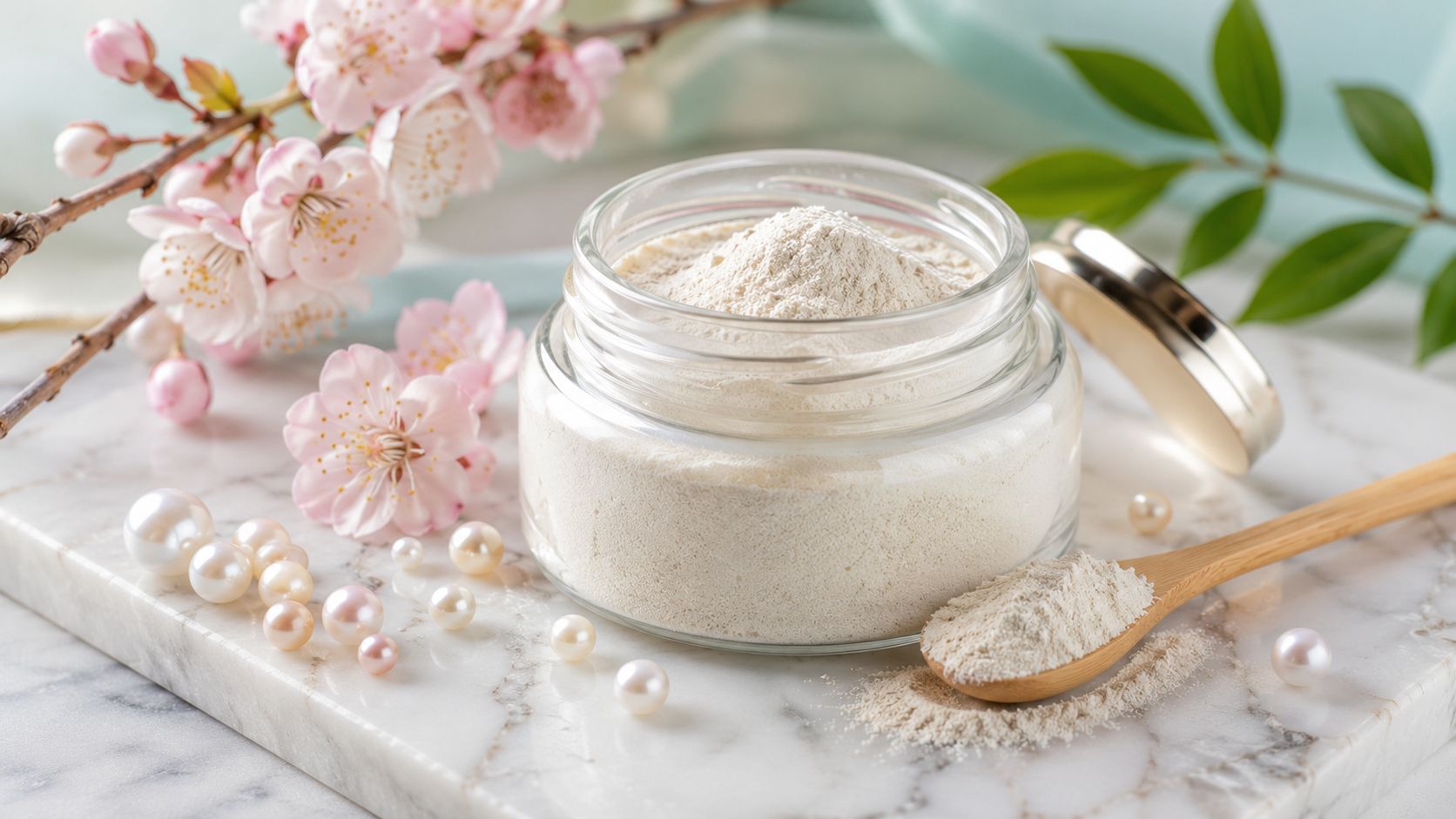
What if pearl powder skincare isn't really about chasing a luxury trend, but about understanding why a very old ingredient still shows up in modern Japanese beauty routines? The answer starts with what pearl powder is, what the lab data does and doesn't support, and how to choose a product that fits real skin needs instead of marketing promises.
If you've seen pearl powder in masks, powders, or brightening products and wondered whether it's a tradition worth trusting, this guide walks through the ingredient step by step. You'll see where its history is genuine, where the evidence is solid, where the claims get overstated, and how Japanese sourcing fits into the bigger picture.
What Pearl Powder Skincare Really Means Today
Pearl powder skincare starts with a simple idea, the pearl isn't worn whole on the face. It's finely milled nacre, the layered material inside a pearl, and it's used because of its mineral structure and organic fraction, not because anyone is rubbing a jewel fragment onto skin.
That difference matters. People often hear “pearl” and think luxury first, formula second. In reality, pearl powder is just one cosmetic ingredient among many, and it works best when you think of it as a supporting material in a routine, not the main event. It often shows up in masks, loose powders, and leave-on products that aim for a smoother, brighter-looking finish.
Japanese sourcing gives this ingredient extra weight in beauty conversations because pearl culture has deep roots in East Asia, and Japan developed a serious pearl-farming industry that made pearl-derived ingredients more commercially reliable. For shoppers, that means the story behind the ingredient isn't random branding. It's tied to real production history, quality expectations, and a long regional relationship with nacre-based cosmetics.
Practical rule: if a pearl powder product sounds like it can replace sunscreen, retinoids, or a good moisturizer, the claim has gone too far.
You'll get the most value from pearl powder skincare when you know what problem you're trying to solve. If your goal is a ritual product, a gentle mask, or a formula that supports hydration and radiance, pearl powder can make sense. If you want a dramatic active treatment, the evidence points you toward other ingredients.
For readers already exploring Japanese skincare more broadly, Japanese skincare revolution gives useful context for why heritage ingredients keep returning in modern routines.
A Brief Heritage of Pearl in Beauty Rituals
What gives pearl powder its staying power in beauty rituals? Part of the answer is history, part is the way that history was tied to real use. Historical sources place pearl powder in Chinese beauty culture by around A.D. 320, and archaeological evidence shows pearl-based facial powder in the Northern Song Dynasty, so its cosmetic role was already established by the 10th to 13th centuries PMC historical review.
That timeline explains why pearl powder still carries cultural weight. It did not become a beauty ingredient because of a recent trend cycle. It moved through medicine, court beauty practices, and ordinary skincare over centuries, and it later became linked with whitening and brightening rituals in elite households. The prestige built slowly, not overnight.
Japan adds another layer to the story. Mikimoto Kokichi successfully bred a seawater pearl in 1905, and freshwater pearl-breeding expanded after 1940 and 1968 technological improvements, which helped stabilize supply for pearl-derived cosmetic ingredients in East Asia PMC historical review. That industrial background helps explain why pearl powder still appears in Japanese beauty as a heritage ingredient rather than a random decorative add-on.
Heritage shapes how an ingredient is presented, but it does not prove how well it performs on skin. The history tells you why pearl powder has status. It does not answer the practical questions, such as how finely it is milled, what the formula contains, or whether the product suits the skin goal you have.
A dermatology review also notes that pearl powder has been used for thousands of years in traditional Chinese medicine and cosmetics, while pearl-farming in Japan has existed for more than a century MDedge dermatology review. That mix of cultural use and manufacturing history is why pearl powder still reads as a heritage material in modern skincare.
For readers who want the wider Japanese context, ancient Japanese beauty secrets offers a useful companion to this ingredient history. For a related clinical concern, NYC Laser Hair Removal pigmentation advice is a practical reference when the goal is addressing uneven tone rather than relying on a cosmetic ritual alone.
The Composition and Proposed Skin Benefits
What makes pearl powder interesting to formulators is not just its story, but its material makeup. The ingredient is mainly calcium carbonate, with conchiolin protein, trace minerals, and small amounts of amino acids. In practical terms, that gives it a mineral-heavy base with a modest organic fraction, which is different from a simple isolated mineral salt.
What those components are supposed to do
The calcium-rich structure is one reason pearl powder is linked with surface refinement and a brighter-looking finish. The amino acid and protein fraction is one reason it is also described as a soothing or supporting ingredient. Those ideas do not make it a strong treatment active, but they do explain why pearl powder can fit into gentle cosmetic formulas.
A controlled human study found that topical pearl-powder formulations improved skin hydration and reduced transepidermal water loss, or TEWL PubMed study. That matters because TEWL is a barrier marker, not a vanity metric. If a product helps skin hold water better, dryness and rough-looking texture may improve over time. The same study also reported reduced tyrosinase activation and stronger free-radical scavenging versus a comparison pearl powder, which gives pearl powder a plausible role in brightening support and oxidative stress defense. It does not prove dramatic whitening, and it does not make pearl powder a substitute for sunscreen or vitamin C.
For readers comparing pearl powder with pigmentation routines, the practical lesson is similar to what is often said in NYC Laser Hair Removal pigmentation advice. Discoloration care usually depends on a broader routine, not one ingredient acting alone.

Pearl powder makes the most sense in formulas that already include humectants, emollients, and sun protection. On its own, it is a support ingredient, not a full routine.
The cleanest way to read the ingredient is this, pearl powder is a mildly active cosmetic material with real barrier-support evidence and some antioxidant signals. The stronger the claim moves toward “miracle whitening” or “anti-aging cure,” the more skeptical you should be.
Readers who like comparing ingredients may also want to see Japanese collagen powder, because it shows a similar gap between heritage marketing and actual cosmetic function.
What the Evidence Supports
The evidence base for pearl powder is more interesting than the hype, but narrower than many product pages suggest. The strongest practical finding in topical skincare is better hydration and lower TEWL, which points to barrier support rather than a purely decorative shimmer effect.
That is the part worth trusting. If skin loses less water, it can look less dry, less flaky, and less rough. That does not mean pearl powder “repairs” skin in a medical sense. It means the ingredient may help a formula feel more supportive on the surface.
What marketing often oversells
Claims about instant whitening, collagen boosting, and broad anti-aging transformation go beyond what the human evidence in this brief can firmly support. The data here does not justify treating pearl powder as a stand-alone brightening treatment, and it certainly does not support calling it a replacement for proven basics like sunscreen, moisturizers, or retinoids.
A cosmetics-focused study also reported that pearl powder improved skin hydration and TEWL, and that one formulation, P-μ, had a stronger moisturizing effect than another version, P-w SCC Online study. That is useful because it shows formula design matters. Pearl powder is not a magic ingredient in isolation, the vehicle around it affects what skin experiences.
Bottom line: pearl powder is most credible as a barrier-support + antioxidant ingredient, especially in calm, hydrating routines.
The evidence is still limited by the kind of studies available. Larger, longer human trials are not part of the verified data here, so the smartest buyer stance is cautious optimism. Use pearl powder for what it can plausibly do, not for what a glossy label wants it to promise.
That is also why it fits better in a routine built around moisture and consistency than in an aggressive correction plan. If your skin concern needs a stronger, more targeted treatment, pearl powder can sit beside that routine, but it should not be asked to carry the whole job.
Types, Grades, and Sourcing to Know
Buyers often focus on the word “pearl” and assume every powder behaves the same way. It doesn't. The source, processing, and particle size change how a product feels, how it disperses, and which kind of routine it fits.

Pearl Powder Types at a Glance
| Type | Source | Particle Size | Best Use | Price Band |
|---|---|---|---|---|
| Freshwater pearl powder | Freshwater pearls | Usually fine, depends on processing | Masks, leave-on blends, gentle cosmetic routines | Often lower to mid |
| Seawater pearl powder | Marine pearls | Usually fine, depends on processing | Premium skincare, heritage-positioned formulas | Often mid to higher |
| Hydrolyzed pearl powder | Pearl material broken into smaller components | Very small, formula-dependent | Serums, emulsions, modern cosmetic systems | Often higher |
| Micronized pearl powder | Pearl powder milled to fine particles | Fine, often label described by mesh or micronization | Masks, powders, leave-on cosmetics | Often mid |
| Nano pearl powder | Very small particle processing | Very fine, formulation-dependent | Advanced cosmetic formulas, specialty products | Often higher |
Particle size affects feel and dispersion. A finely milled powder is easier to blend into a mask or cream, while a coarser material can feel gritty or sit on top of the skin. Cosmetic-grade labels matter too, because they tell you the material was intended for topical use, not just general mineral handling.
Japanese-sourced pearl powder often carries a premium because the region has a long cultivation history and a strong reputation for cosmetic quality control. That does not make every imported powder inferior, but it does make origin transparency important. If a label is vague about source, micronization, or testing, the buying decision gets harder.
The same caution applies when you compare pearl powder with other Japanese skincare formats. For example, a product like Kose Clear Turn Rice Extract and Cica Moisturizing Skincare Mask shows how Japanese formulas often pair soothing ingredients with a hydrating texture, which is useful context if you are building a routine around barrier support rather than quick-fix promises.
If you want a neutral retail reference point while comparing how pearl powder is presented alongside other natural-feeling ingredients, you can browse natural skincare products. The habit that helps most is simple, read the sourcing details, the processing notes, and the intended use, not just the front label.
A beginner-friendly way to sort through those details is to start with your routine goal. If you are trying to keep things calm and low risk, a fine, cosmetic-grade powder in a simple formula makes more sense than a specialty product with a lot of extra actives. If your routine already has a morning skincare routine in place, fit pearl powder into the calmest step rather than adding it on top of everything else.
How to Use Pearl Powder in Your Routine
How you use pearl powder matters as much as the ingredient itself. A calm, low-friction routine lets you see whether your skin likes it, instead of burying the result under too many other products.
Three practical ways to use it
For an everyday blend, mix a small pinch of pearl powder into a moisturizer or serum you already tolerate well. Keep the amount modest so it disperses evenly, because clumping can leave the application patchy and make the texture feel rough. If your skin is reactive, start at night. Evening routines are easier to control, and you can watch for dryness, redness, or stinging before repeating it.
For a weekly mask, blend pearl powder with honey or plain yogurt into a spreadable paste. Apply a thin layer for about 10 minutes, then rinse with lukewarm water. That kind of use is closer to a short conditioning treatment than an aggressive exfoliation step, so the goal is a smoother surface feel, not a scrubby polish.
For a brightening DIY, some users mix pearl powder with rice water or niacinamide-based products, but that only works if the base formula is already gentle and compatible. If your routine already includes acids or retinoids, keep them on separate nights. Pearl powder works better as a supporting ingredient than as the center of a crowded active routine.
Use it like this: one pearl powder product, one calm application method, and one skin goal at a time.
If you prefer a ready-made Japanese format instead of mixing your own, a sheet mask or toner can be easier to handle. A product such as Kose Clear Turn Rice Extract and Cica Moisturizing Skincare Mask fits that kind of routine well, especially if your focus is moisture and comfort rather than customization.
For broader daily routine structure, morning skincare routine steps is a useful companion guide. Pearl powder usually makes the most sense after cleansing and before heavier occlusives, or inside a wash-off treatment where you can keep the rest of the routine simple.
Patch testing is the safest habit. Apply a small amount near the jaw or behind the ear, leave it alone, and watch for irritation before using it more widely. That small check is the easiest way to keep a traditional ingredient from becoming an avoidable skin problem.
Safety, Side Effects, and Who Should Skip It
Pearl powder is often described as gentle, but gentle doesn't mean universal. The most important caution is allergy risk, especially for people with shellfish or mollusc allergies, because residual shell proteins can still matter for predisposed users.
Who should be careful
People with fragrance-sensitive skin should choose fragrance-free formulas or simple vehicles, because the pearl powder itself isn't always the only variable in the product. Acne-prone users who already rely on scrubs need extra caution too, since pairing pearl powder with harsh physical exfoliants can increase micro-irritation.
Patch testing is the practical answer. Apply a small amount once, keep the area clean and untouched, and check for redness, stinging, or bumps before using the product on the whole face. If your skin is already inflamed, the safest move is to keep the routine calmer, not more complex.
Avoid layering pearl powder with strong exfoliants on the same night. That includes abrasive scrubs and other high-friction treatments. Daily use is often tolerated, but people generally don't need it every day, and a simpler schedule is easier to evaluate.
For people managing sensitive routines, Japanese skincare for sensitive skin is a relevant place to compare how calm formulas are structured. The same logic applies here, fewer irritants, fewer surprises.
If you're considering ingestible pearl powder, don't assume topical and oral use are interchangeable. Cosmetic use and oral use follow different product standards, and the safety conversation changes with each form.
How to Choose and Buy Quality Pearl Powder
A good pearl powder product should be easy to read, not hard to decode. Start with cosmetic-grade labeling, then check micronization level, origin transparency, third-party heavy-metal testing, and moisture-protective packaging. Those details do the quiet work of separating a usable powder from one that only sounds traditional.
What a smart buyer checks first
- Cosmetic-grade certification: This tells you the product is intended for topical use.
- Fine particle processing: Look for micronized or similarly fine milling if you want smoother blending.
- Clear origin information: Freshwater, seawater, and country of source should be visible.
- Testing transparency: Heavy-metal testing should be disclosed when possible.
- Packaging quality: Moisture and light protection help preserve powder stability.
Start with the label, then move to the supplier. A powder that is clearly meant for skin, with a visible origin and testing details, is easier to evaluate than a vague jar with little context.
Direct-from-Japan sourcing through a curated retailer like Buy Me Japan can add useful traceability for shoppers who want Japanese-origin products with clearer selection standards. The point is not hype, it is a narrower product pool and more visible product details. If you want to browse natural skincare products, a curated source can make comparison simpler, especially when you are trying to match pearl powder with other gentle staples.
Pearl powder also sits comfortably beside hydration-focused Japanese items, which matters because brightening routines work better when the skin barrier stays calm. The product type matters more than the promise. A finely milled cosmetic powder is one tool, while a soothing sheet mask is another, and they serve different jobs in the routine.
Start small and choose the least complicated option that still gives you the information you need. A practical buyer looks for cosmetic-grade powder, pays attention to how fine it is, and treats pearl powder skincare as a support ingredient rather than a cure-all.
Share:
EMS Beauty Device Guide: How It Works and What to Buy
Sugi Bee Honey: A Complete Guide to This Japanese Favorite