


You're comparing sunscreen bottles before a trip, or trying to find something that won't feel heavy under makeup. The Biore UV Aqua Rich name looks familiar, but the bottles, textures and ingredient lists don't quite match. Even the same protection rating doesn't tell you whether a particular version suits a sweaty commute, a beach afternoon or sensitive skin.
The useful question isn't just whether this is a good sunscreen. It's whether you can apply the exact formula generously, wear it comfortably and renew the protective film when your day demands it. Treat the label as a set of test conditions, not a promise that a quick morning application will last until evening.
Specs Side by Side
Biore UV Aqua Rich catalog products compared
| Attribute | Biore UV Aqua Rich Protect Lotion SPF 50+ PA++++ 70ml | Biore UV Aqua Rich Light Up Essence SPF 50+ PA++++ 70g |
|---|---|---|
| Protection rating | SPF 50+ PA++++ | SPF 50+ PA++++ |
| Format | Lotion | Lightweight water-based essence |
| Size as listed | 70ml | 70g in title; confirm on the product page |
| Water resistance | Up to 80 minutes | Not stated in the catalog description |
| Texture | Melts into skin like water; glossy finish | Non-greasy; absorbs quickly |
| Fragrance | Not stated in the catalog description | Delicate white floral fragrance |
| Hydrating ingredients | Hyaluronic acid and royal jelly extract | Hyaluronic acid and royal jelly extract |
| Makeup use | Described as enhancing makeup application | Not stated in the catalog description |
The lotion's product image helps distinguish its bottle from other similarly named versions.
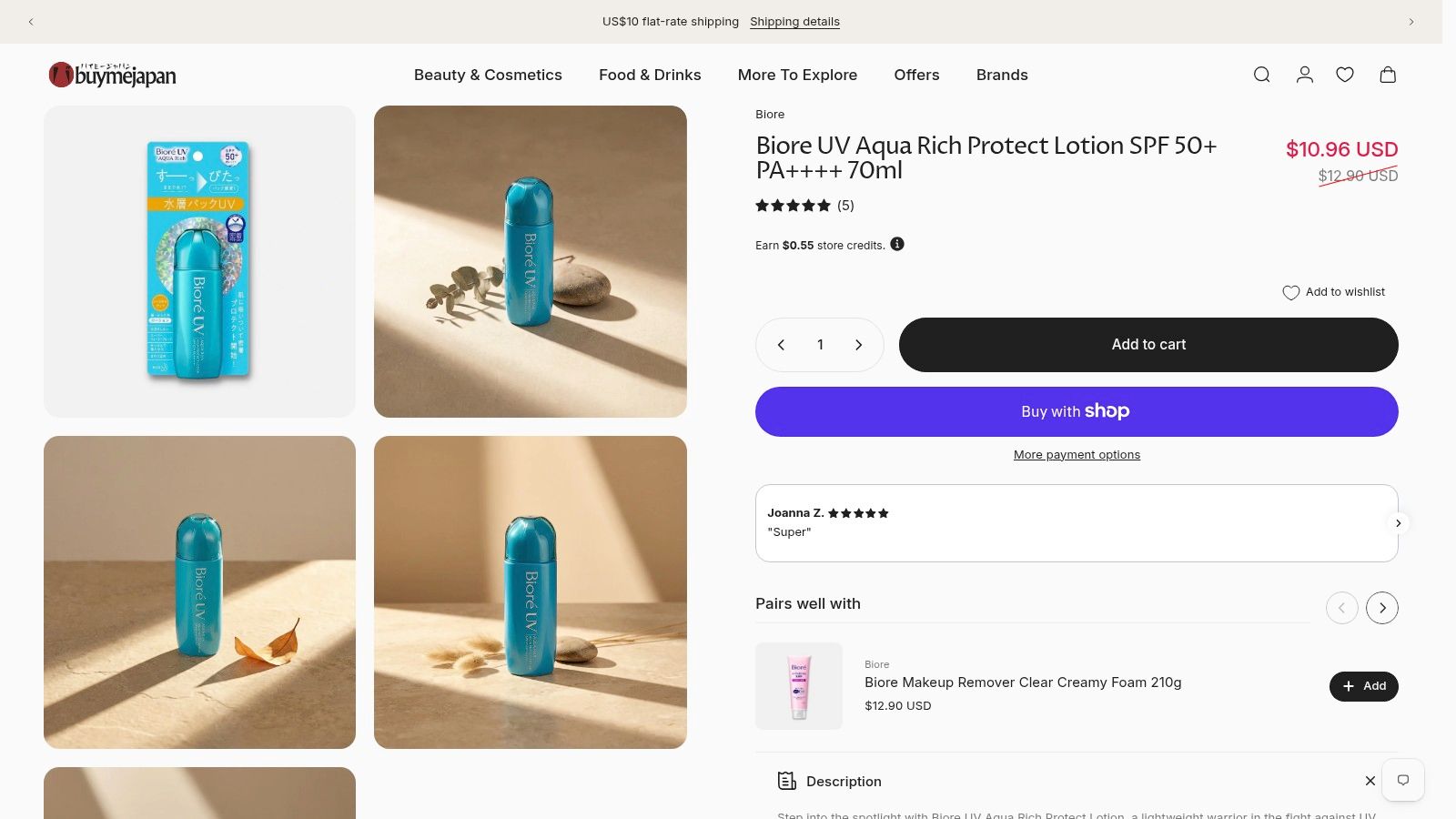
There's a size discrepancy worth resolving before ordering: the essence's title states 70g, while its product-page URL contains 110g. Confirm the selected item and pack size on the current page rather than treating the URL as a product specification.
SPF describes protection mainly against UVB-related sunburn, while PA describes UVA protection. The plus signs identify the UVA category, not how long you can leave the sunscreen untouched; the label discussion below explains the distinction.
What the shared family name tells you
Kao's Watery Gel product information describes high-protection daily sunscreen labelled SPF50+ and PA++++, using micro-sized UV-cut technology intended to distribute protection across skin texture. Its formulation information also identifies conditioning or moisture-supporting ingredients such as hyaluronic acid and royal jelly extract.
That background explains the range's emphasis on comfortable daily wear. It doesn't establish the complete ingredient list, water resistance or finish of every other bottle bearing the Aqua Rich name.
A guide to gel-based sunscreen can help clarify texture terminology, but packaging remains the final check for the specific version and market. The catalog options share a protection rating, so the useful distinction is texture, fragrance and intended use, not a presumed difference in strength.
Origin and Versions of the Biore UV Aqua Rich Line
Kao's development history explains why shoppers encounter so many related names on one shelf. According to Kao's Aqua Rich background document, Bioré UV launched in 1996, Aqua Rich followed in 2011, and upgraded Watery Essence and Watery Gel products reached Japan nationwide in February 2019.
The first Watery Essence mattered because it paired a water-like feel with strong ultraviolet protection. That combination moved sunscreen toward everyday facial skincare and away from a product reserved for outdoor activities.
The texture shift is easy to test at home: apply a small amount to one cheek and check how it feels after 30 seconds. The water-based formats sit closer to a serum than to a traditional sunscreen cream. Comfort earns its place in performance terms, because the rating on the label assumes a generous layer that gets worn in real life. Someone applying sunscreen before work each morning, or reapplying it at midday, follows through far more reliably with a formula that feels pleasant than with one they dread putting on.
What Micro Defense means
Kao describes Micro Defense as a formulation approach in which UV-defense agents are enclosed in microscopic capsules to help distribute protection evenly. In use, the design helps the film spread across the skin's small contours rather than pooling only on the high points.
Even distribution has limits. A hurried wipe still leaves bare areas, so the sides of the nose, the hairline and the jaw need deliberate spreading on every application.
A practical lookup for the family
- Watery Gel and Watery Essence: The two familiar formats in the line, each requiring its own label check.
- Aqua Protect Lotion: A lotion format and a reminder that consistency varies across Aqua Rich products.
- Aqua Protect Mist: Kao Singapore's range information identifies a separate mist containing squalene, an oily conditioning ingredient.
- Mild, tone-up and light-up versions: Names that distinguish formulations and intended finishes, not interchangeable substitutes.
Ingredients, fragrance, alcohol status and finish can all change across these versions. Replacing an old favourite by matching only the large Aqua Rich lettering is a poor buying method; the individual version description carries more weight than the shared branding.
What the SPF and PA Labels Measure and Where They Stop
SPF mainly measures protection against UVB, the rays most associated with sunburn. PA indicates UVA protection, which matters when considering tanning and visible photoageing. Check both: a high SPF does not describe UVA protection, and the PA grade does not indicate how the formula will sit under foundation.
PA rating scale for UVA protection
| PA grade | What it signals |
|---|---|
| PA+ | Some UVA protection |
| PA++ | Moderate UVA protection |
| PA+++ | High UVA protection |
| PA++++ | Highest UVA category used on Japanese labels |
The application amount behind the rating
Kao's formulation announcement states that SPF and PA values are based on applying 2 mg/cm². That is the test amount per area of skin. A thinner or uneven layer does not deliver the labeled test condition, and dividing the SPF number by the amount applied cannot calculate your actual protection.
The practical issue is coverage. A layer can look invisible and still be continuous, while a hurried wipe may leave gaps around facial contours or at the edges of application.
Practical rule: Choose a sunscreen you can wear at a generous application amount. If a formula feels uncomfortable, using less makes the label a poorer guide to your protection.
What the rating leaves unanswered
The labels do not tell you whether your application covers every exposed area, when activity calls for fresh application, or whether sweat, rubbing, makeup or clothing has disturbed the film. They also cannot tell you whether your skin will tolerate the formula without persistent discomfort.
Water resistance is a separate label claim, not a guarantee that coverage will remain intact through every swim, sweat session or towel rub. For oily skin, finish matters because shine or discomfort can tempt you to apply less. The guide to Japanese sunscreen for oily and acne-prone skin offers further selection considerations.
Read the label in order: check the UVB rating, then the UVA grade, then the directions and the conditions you expect to wear it in.
How to Apply, Reapply and Handle Water Resistance
- Start with clean, dry skin. Let moisturiser and other skincare settle before applying sunscreen. If the underlying layers roll into little flakes, simplify them rather than rubbing harder or reducing sunscreen.
- Shake the lotion before dispensing, as its catalog directions describe. Spread a generous amount across the face, neck and ears instead of stretching a small dab over every area.
- Work around contours deliberately. Use your fingertips to spread outward, then check the hairline, sides of the nose, jawline and behind the ears where exposed. Gentle pressing can help finish the application, but it shouldn't replace spreading the product into a continuous layer.
- Give the film time to settle before exposure. Bioré's published Watery Essence directions specify generous, even application 15 minutes before sun exposure and reapplication at least every two hours.
- Renew coverage after activity. Reapply promptly after swimming, heavy sweating or towel drying, and follow the exact package directions if they call for more frequent application.
- Cleanse thoroughly at night. Work the cleanser across the areas where you applied sunscreen, including the hairline and neck, then rinse rather than scrubbing the skin.
Use light fingertip movements rather than prolonged, forceful rubbing.
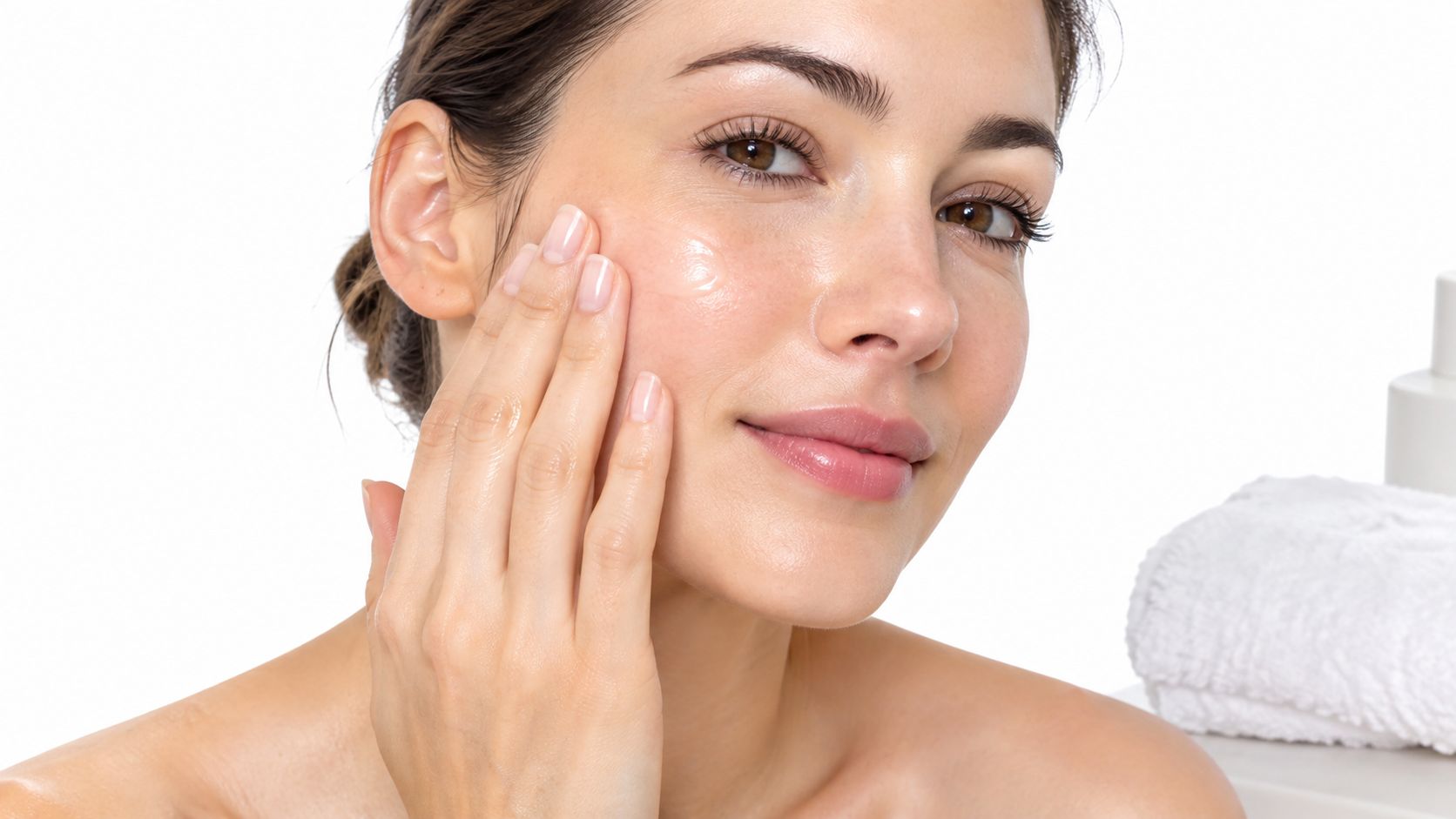
Getting enough coverage without guessing
A universal dab size isn't reliable across different faces, body areas and dispenser openings. The tested amount is based on skin area, so a finger-length shortcut can't establish an exact dose for every person or formula.
Instead, dispense deliberately for each region. Cover the face thoroughly, then add product for the neck and ears rather than using whatever remains on your hands. For exposed body skin, work in sections so you can track where you've applied it.
If a generous application feels difficult to spread, distribute it in successive passes over the same area. The aim is the full application amount with even coverage, not a nearly invisible cosmetic wipe.
Don't mix sunscreen with moisturiser or foundation in your palm. Apply it as its own layer so you're not deliberately diluting the formulation or changing how it forms a film.
What water resistance actually buys you
Kao's Singapore Watery Gel information describes the Watery Gel and Watery Essence as very water resistant for up to 80 minutes, while also stating that they can be removed with ordinary soap or face/body wash. That claim belongs to those specified products, not automatically to every Aqua Rich version.
Treat water resistance as a defined window under water-exposure testing, not permanent adhesion. A rain jacket can resist a shower, yet abrasion can still damage its coating. Similarly, towels, clothing, masks and hands can remove sunscreen even when the remaining film resists perspiration.
Towel drying is a reason to reapply, regardless of how recently you put sunscreen on.
At the pool, keep sunscreen somewhere accessible rather than buried beneath your belongings. After swimming, dry off gently, renew coverage and let it settle before returning to exposure. Use shade and clothing too, particularly when maintaining an intact film is difficult.
Reapplying around makeup
Makeup makes reapplication less convenient, but it doesn't change the need for it. Blot away excess moisture gently, then apply sunscreen without repeatedly dragging a sponge or fingers across the same area.
If makeup prevents a generous, even top-up, consider a simpler base for outdoor days. The guide to Japanese sunscreen under makeup discusses layering without relying on a reduced sunscreen amount.
For a visual supplement, this application video can accompany the written routine.
Finally, check face and body labelling before extending a facial routine to your arms or legs. A familiar range name doesn't establish the intended application areas of the exact bottle you bought.
Skin Types, Ingredients and Patch Testing
Testing is useful evidence, but it isn't a personal guarantee. Kao Thailand's Watery Essence catalogue states that the product has undergone allergy and non-comedogenic testing, while explicitly qualifying that not every user will avoid irritation, allergy or breakouts.
Non-comedogenic testing concerns the tendency to cause blocked pores under the test conditions. It doesn't mean a product will suit every acne-prone person, nor does it establish that another version has undergone the same testing.
Skin situations and what to check before using Biore UV Aqua Rich
| Skin situation | What to check on the label | Patch test advised |
|---|---|---|
| Dry or dehydrated skin | Hyaluronic acid and royal jelly extract are listed moisture-supporting ingredients | Optional before broader use if you have no reaction history |
| Oily or combination skin | Water-based texture; confirm testing claims on the exact product page | Recommended before full-face use |
| Sensitive skin | Fragrance and alcohol status; read the full ingredient list | Yes, over several days on a small area |
| Eczema-prone or fragrance-allergic skin | Floral fragrance in the essence description and the lotion's complete ingredients | Yes; ask a dermatologist if unsure |
| Skin around the eyes | Eye-contact warnings and personal comfort | Small-area tolerance doesn't establish eye-area comfort |
Understand the ingredient jobs
UV filters do the sun-protection work. Moisturising ingredients support the feel of the formula, but they don't replace those filters or increase protection just because the skin feels hydrated.
Hyaluronic acid is a humectant, meaning it helps the skin's surface retain water. Glycerin performs a similar moisture-attracting role when present, while royal jelly extract is included as a conditioning ingredient.
Don't assume glycerin appears in both catalog choices just because it occurs elsewhere in the range. Read the complete ingredient list for the particular product, especially if you're avoiding a known trigger.
The essence description includes a floral fragrance. For someone with a known fragrance allergy, that isn't a minor sensory detail to overlook because the texture sounds appealing.
A cautious introduction routine
Apply a small amount to a small area, such as the inner forearm or behind the ear. Repeat over several days and watch for stinging, redness or itching before progressing to broader use.
- Stop for a reaction: Wash the product off if it causes persistent discomfort rather than trying to acclimatise through irritation.
- Protect the eyes: Don't apply into the eyes or along the wet lash line. Rinse with water if accidental contact occurs.
- Get individual advice: Ask a dermatologist about a history of reactions, eczema or other skin conditions.
A home patch test can't diagnose allergy or guarantee future tolerance. The sensitive-skin sunscreen guide provides additional selection context, but your known sensitivities should take priority over a general recommendation.
Comparing and Choosing the Right Biore UV Aqua Rich
Two products can share the Aqua Rich name and still belong to different days in your routine. A sunscreen that feels effortless at a desk can be the wrong match for a swimming afternoon, and a durable formula is wasted money if its finish makes you apply it too thinly.
Judge each bottle by the same set of label questions. Start with what your day really involves: sitting under makeup, walking in humid weather and swimming all place different demands on the product and on your ability to renew it.
Criteria for comparing Japanese sunscreens
| Criterion | What to look for | Why it matters |
|---|---|---|
| Protection rating | SPF and PA grades on the label | Shows UVB and UVA strength under test conditions |
| Water resistance | A stated duration and clear renewal directions | Relevant to sweat, swimming and humid days |
| Texture and finish | Water-based, lotion, gel or essence descriptions | Affects layering and daily comfort |
| Fragrance and alcohol | Ingredients on the exact version | Relevant to known sensitivities |
| Hydrating ingredients | Hyaluronic acid, glycerin, royal jelly extract or similar ingredients | Helps judge likely comfort on drier skin |
| Face and body labelling | Explicit application areas | Establishes whether the product fits the intended routine |
| Testing claims | Allergy or non-comedogenic wording and qualifications | Identifies what was tested without promising personal results |
Choose for the situation
For sweat-heavy days or beach trips, pick the lotion. Its catalog description states a water-resistance claim; the essence's description doesn't establish one. With nothing stated, you have no documented basis for choosing the essence specifically for swimming, even though the absence of a claim falls short of proving it would fail.
For daily makeup, decide on finish. A glossy sunscreen can complement a luminous look but works against you if you spend the morning reducing shine. Try it with your usual moisturiser and foundation on an ordinary day before relying on the combination for an important one.
For sensitive skin, read the ingredient list rather than the format name. An essence isn't automatically gentler than a lotion, and a quick-drying texture doesn't establish alcohol status. The essence lists a floral fragrance; where another version's fragrance status or ingredient list is incomplete, treat the gap as a question to resolve before purchase.
For body use, check explicit labelling and pack size. Confirm the stated application areas, then consider whether the pack is practical for the amount of skin you'll cover, rather than buying a small facial product and rationing it across exposed limbs.
For humid commutes, weigh spreadability against finish. A readily spreadable texture may matter more than a rich skincare feel on a warm morning. Still, think about your destination: a finish that feels comfortable outdoors can look glossier once you arrive in a warm office.
Both catalog choices start from a similar base of high stated protection, moisture-supporting ingredients and textures intended to avoid a heavy feel. The key differences lie in what each description documents, and both share the same condition: a pleasant texture doesn't make up for missed areas or coverage disrupted by friction. Applied more thinly than the amount SPF testing assumes, even a strong rating delivers less than the label promises.
Buy the version whose important claims you can confirm. Don't fill gaps in its description with facts borrowed from another Aqua Rich product.
Popularity carries a cost the ticket price doesn't show: a bottle you only tolerate in small amounts gives you less protection than you paid for.
A label-first buying checklist
- Match the format to your routine: Use lotion and essence as starting descriptions, then read the actual finish claims, since the format name alone doesn't establish richness.
- Confirm the exact item: Match the name, selected variant, pack photograph and size before checkout.
- Resolve important omissions: Ask about water resistance, fragrance or application areas when those details decide whether you'll use the product.
- Read the package on arrival: Check directions and ingredients before replacing your current sunscreen.
- Plan the introduction: Test makeup compatibility and personal tolerance before travel or extended outdoor use.
A broader Anessa and Biore sunscreen comparison adds context if you're shopping across Japanese brands. Within the Aqua Rich line, the picks are concrete: I'd take the lotion for a swim day because its water-resistance claim is stated, the essence for a fragranced daily texture built around radiance, and the checklist above for everything in between.
Frequently Asked Questions About Biore UV Aqua Rich
Can I wear it under makeup?
The lotion is the safer documented pick: its catalog description says it enhances makeup application, while the essence does not state makeup use. Keep the sunscreen amount intact and let each layer settle before base; the side-by-side specifications are the reference, then your own combination confirms pilling risk.
Can it handle swimming, and will I need a special remover?
Treat only a pack with explicit water-resistance directions as suitable for water, and plan renewed coverage after towel drying or friction. For the Watery products Kao describes, ordinary soap or face/body wash is the stated removal route, with any makeup removed separately; the application and water-resistance guidance covers the limits behind that routine.
Will it cause breakouts?
A light feel or a non-comedogenic claim cannot rule that out for your skin. Introduce it on a small area first and stop if repeated use brings clogged pores, stinging or redness; the skin-type and testing guidance explains why tolerance is individual.
Is it suitable for the body?
Only when the specific pack says face and body. Some Aqua Rich versions carry that wording and others do not, so the label for the exact item decides the application area rather than the family name; the comparison checklist is the quick cross-check.
Should I choose lotion or essence?
Choose from documented finish, fragrance, activity needs and tolerance, not from format names alone. Lotion has the clearer makeup-related claim; essence makes sense only when its listed finish and scent fit the same routine.
Buy Me Japan is a Japanese online store for skincare and everyday items, with product pages, tracked shipping, secure payments and customer support. Visit Buy Me Japan to check current pack details before choosing.

Share:
Mirin vs Rice Vinegar: Uses and Swaps