


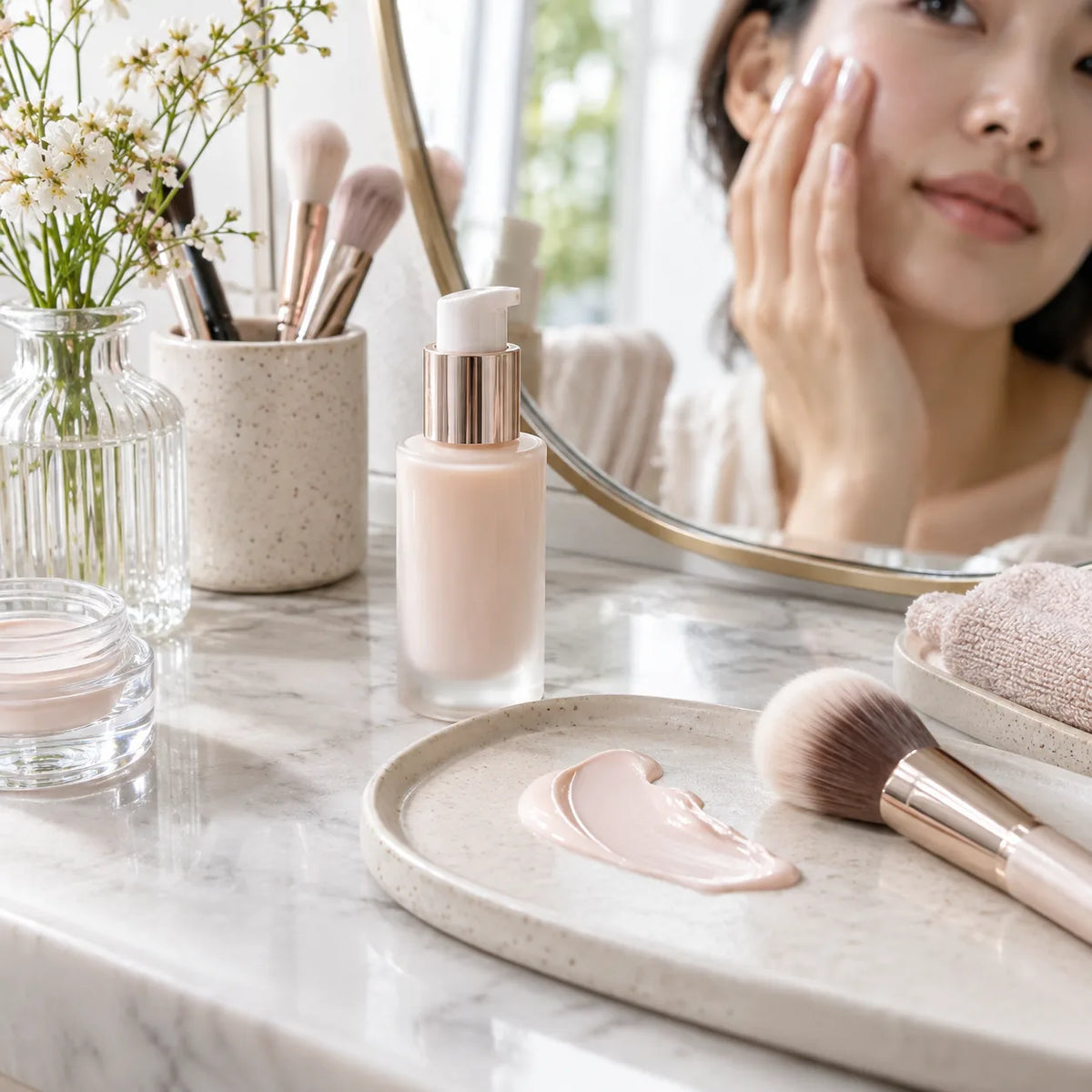
Face primer is easy to overcomplicate. You finish skincare and sunscreen, add foundation, and then wonder why the base has slipped around the nose or settled into lines by lunchtime. Primer is simply the preparation layer that sits between those steps. It can make the surface feel more even, help makeup spread, reduce shine, add a little grip, or give the skin a softer-looking finish. It is useful when it solves a specific problem; it is not compulsory for every routine.
Japanese makeup often treats primer as a targeted tool. One person may want a matte base for a humid commute. Another may want a comfortable glow that stops a foundation looking dry. The right formula depends on the finish you want and on what is already underneath it.
What primer can—and cannot—do
A primer creates a cosmetic film on the skin. That film can smooth the way foundation sits, help pigment apply more evenly, or slow the look of fading and excess shine. Blurring primers scatter light so pores and fine texture appear less obvious; gripping primers feel slightly tacky so makeup has something to hold onto; hydrating primers add a more comfortable slip; tone-up primers adjust the look of colour.
These effects are temporary and surface-level. Primer does not change pore size, repair the skin barrier, or replace sunscreen and moisturizer. If your skin is irritated or very dry, a simpler skincare routine may help more than adding another base product.
Choose the function before the finish
For oil and humidity: look for a light, oil-controlling primer and apply it only where the base tends to move. A full-face matte layer can make cheeks look dull or emphasize dry texture.
For visible pores: press a small amount over the area instead of rubbing it back and forth. Too much product can collect in the very texture you are trying to soften.
For dryness: choose a comfortable, flexible formula and let your moisturizer settle first. A primer cannot compensate for skin that is still thirsty underneath.
For tone: use a subtle tint where it is needed and keep the rest of the base thin. Tone-up products are not a substitute for choosing a foundation shade that matches your neck.
Three Japanese primers from the catalog
These active listings cover different makeup situations. Shade, finish, and current packaging can vary, so check the live product page before ordering. Each product below has its own exact Shopify catalog image.
Primavista Long-Lasting Primer For Very Oily Skin 25ml
This is the clearest match for a shopper whose main complaint is shine and makeup movement. Use a thin layer through the T-zone first rather than automatically covering the whole face. If the cheeks feel tight, keep the primer local and let a more comfortable base handle the rest.

Kose Esprique Triple Lasting Primer SPF 45 PA++++ 30g
The “triple lasting” positioning makes this a useful option to compare when you care about a base that stays present through a longer day. Treat the SPF and PA on the label as additional information, not a reason to skip your normal sunscreen application. The listing includes various shades, so choose the current shade carefully.

Canmake Moist Prism Primer Light Beige SPF28/PA++ 25g
Canmake’s Moist Prism Primer is a softer direction for someone who wants a comfortable, light-beige preparation step rather than a strongly mattifying layer. The shade gives the product a little more visible tone than a clear gel, so check how it sits against your jaw and neck before adding foundation.

The order that usually works
- Finish skincare and sunscreen. Give heavier layers a few minutes to settle.
- Use less than you think. Start with a pea-sized amount for the face and add only where needed.
- Press or smooth in one direction. Repeated rubbing can disturb the skincare underneath.
- Wait briefly, then apply foundation. A short pause helps you see whether the primer is still wet or tacky.
- Set selectively. Powder the areas that crease or shine instead of flattening the whole face.
Pilling usually means the layers are incompatible, too generous, or being rubbed too much. Change one variable at a time: reduce the amount of serum underneath, wait longer, or try a thinner foundation. If the base already wears well without primer, there is no prize for adding it.
When to skip primer
You may not need primer on a short day, with a light skin tint, or when your moisturizer and sunscreen already leave a smooth finish. You may also prefer a small amount of concealer only where you need coverage. Makeup should make the morning easier, not turn it into a stack of steps that all need troubleshooting.
For more practical guidance, see our Japanese setting spray guide and Japanese BB cream guide. The best answer to “what is face primer used for?” is personal but simple: use it where it improves the way your makeup behaves, and leave it out where it does not.
Primer and sunscreen are not interchangeable
Some Japanese primers include SPF or PA in the product name, which can be useful information when you compare formulas. The rating does not remove the need for a dedicated sunscreen layer when you are relying on consistent outdoor protection. Apply sunscreen evenly first, allow it to settle, and then use primer only where it improves the base.
The same rule applies to skincare claims. A primer may feel moisturizing or include familiar skincare ingredients, but its job in the routine is still cosmetic preparation. If your skin is uncomfortable before makeup, adjust the cleanser, moisturizer, or sunscreen rather than expecting primer to correct the cause.
A ten-second mirror test
- Look at the area that fails first. Is it the nose, forehead, cheeks, or under-eyes?
- Choose one function. Pick oil control, blur, grip, glow, or tone adjustment—not every function at once.
- Use a small amount. Stop when the surface feels even; more product is not automatically smoother.
- Check after foundation. If the base looks better without the primer, leave the step out.
Primer is most convincing when you can name the problem it solved. On a short day, a well-matched moisturizer, sunscreen, and thin complexion product may be all you need. On a long or humid day, a targeted primer can make the same makeup easier to wear.
Make a note of the finish you prefer: soft and luminous, quietly matte, or almost invisible. That one sentence is more useful than a long list of trend words. It also gives you a simple way to compare a new Japanese primer with the product you already own.
Make a note of the finish you prefer: soft and luminous, quietly matte, or almost invisible. That one sentence is more useful than a long list of trend words. It also gives you a simple way to compare a new Japanese primer with the product you already own. A good primer should disappear into the routine once the makeup is on.


Share:
Hyaluronic Moisture Boost Serum: How It Works
Japanese Soy Sauce for Sushi Types Flavors and How to Use