


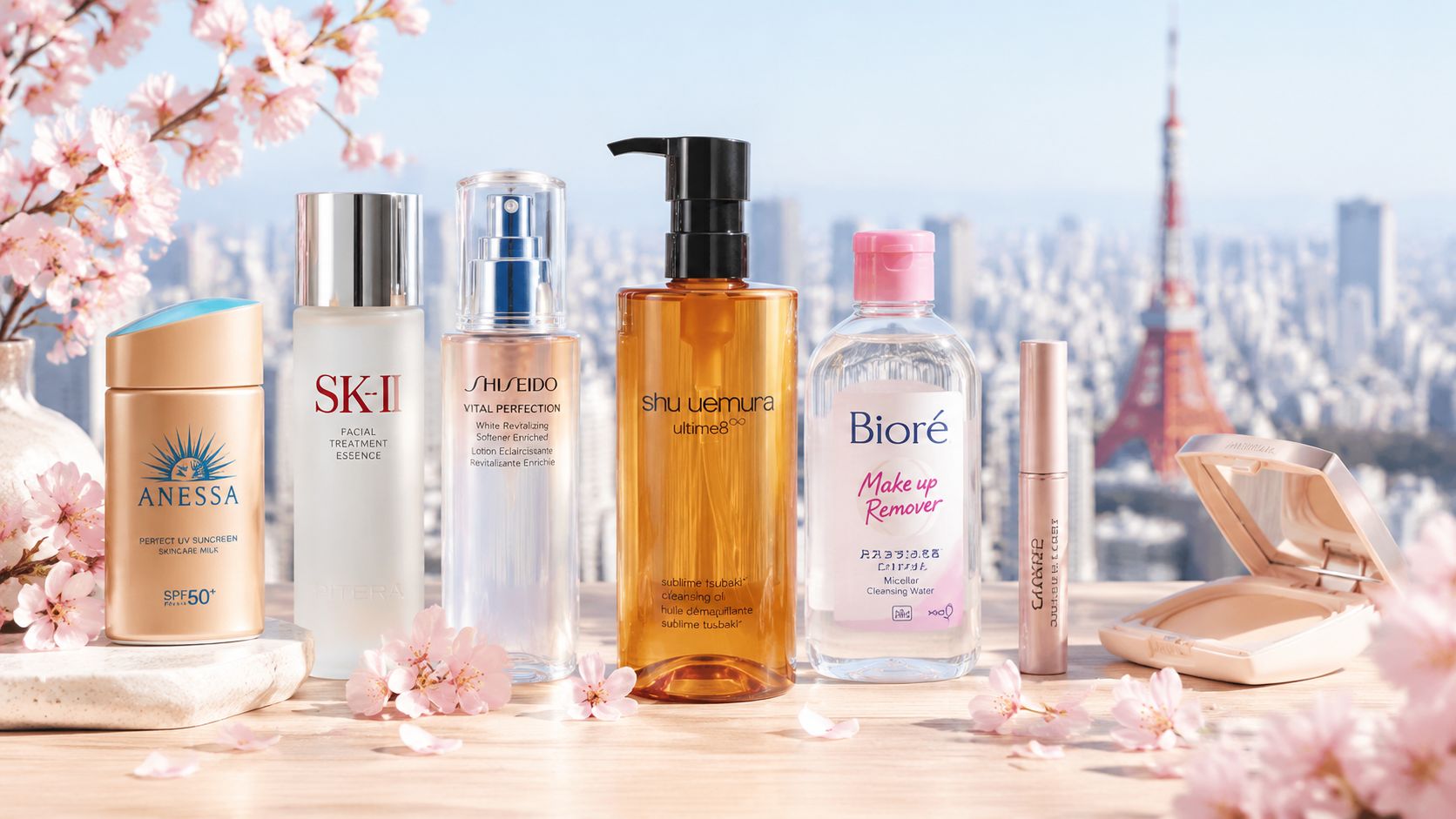
Tokyo beauty aisles can scramble your judgment fast. You go in for one sunscreen and walk out staring at shelves of lotions, milks, essences, gels, balms, UV mists, refill packs, and five versions of the same product name that all look nearly identical.
That's why a generic “top 10” list usually isn't enough. The fundamental question isn't just what to buy in Japan cosmetics. It's what's worth buying for your skin, your climate, and your tolerance for fragrance, finish, and trial-and-error.
Japanese cosmetics are at their best when you shop by function. Think featherlight sunscreen you'll wear every day, barrier-focused hydration that doesn't irritate, makeup that survives humidity, and hair care that smooths without making everything limp. If you want a practical shortlist instead of hype, start here.
Your Guide to Navigating the World of J-Beauty
The first mistake most shoppers make is buying only the products that go viral. In Tokyo, that usually means the sunscreen everyone posts, the mascara everyone swears by, and the cute blush compact that looks perfect under convenience store lighting. Some of those products are excellent. Some are just excellent on someone else's face.
Japanese beauty rewards a more disciplined approach. You get better results when you shop by category first, then texture, then skin need. That's especially true because Japanese formulas often look simple on the surface but are tuned very carefully for finish, layering, and daily comfort.
What usually works better than trend shopping
A smarter basket usually includes a few less glamorous staples.
- Daily UV protection: The category Japan does exceptionally well, especially elegant formulas that encourage consistent use
- Barrier-first hydration: Lotions, emulsions, and creams built for dehydration and sensitivity rather than aggressive resurfacing
- Low-fuss makeup: Products that refine, brighten, define, and stay neat through long days
- Repair-focused hair care: Smoother textures, less puffiness, more shine, and better manageability
The best Japanese cosmetic purchase is often the product you finish, repurchase, and stop thinking about because it simply works.
That's also why authenticity matters. Product names can stay the same while formulas shift, finishes change, or market versions differ. If you're shopping from outside Japan, it helps to buy with a current-product mindset instead of assuming an old recommendation is still identical.
A better way to build your list
Use this filter before you buy anything:
| Question | Why it matters |
|---|---|
| What climate do you live in? | Humid weather changes what feels comfortable on skin and hair |
| Is your barrier compromised? | If yes, gentle hydration often beats strong actives |
| Do you wear makeup daily? | This changes cleanser, sunscreen, and base makeup choices |
| Do you hate sticky textures? | Texture dislike is one of the main reasons people stop using good products |
Once you shop that way, J-beauty becomes much easier to understand. The shelves stop looking chaotic and start looking useful.
Why Japanese Cosmetics Are Worth Buying
Japanese cosmetics aren't worth buying because they're trendy. They're worth buying because many of them solve ordinary beauty problems with unusual precision. The best formulas feel easier to use, layer more cleanly, and fit into daily life without drama.
That philosophy shows up most clearly in skincare. Japan's beauty market continues to place heavy emphasis on products people will use consistently, especially categories tied to moisture, clarity, and long-term skin comfort. There's also a clear move toward ingredient transparency and gentler formulations. The Japanese natural and organic cosmetics market is projected to grow from USD 1,328.75 million in 2023 to USD 2,264.03 million by 2032, according to Credence Research's Japan natural and organic cosmetics market analysis.
The real strength is elegant restraint
A lot of Western beauty still leans on intensity. Strong acids. Heavy creams. Dramatic payoff. Japanese cosmetics often take the opposite route. You'll find more emphasis on finishes that disappear into skin, hydration that builds gradually, and formulas that don't make your routine feel like work.
That's why “skinimalism” fits Japan so well, even if the word itself is newer than the practice. One product often does several jobs. A lotion hydrates and preps. A sunscreen protects and sits well under makeup. A base product evens tone without masking the skin.
What you're actually paying for
When a Japanese product earns cult status, it usually isn't because of packaging alone.
You're often paying for things like:
- Texture engineering: Milks, gels, essences, and emulsions that spread thinly and set comfortably
- Routine compatibility: Products that layer without pilling or turning greasy by midday
- Gentler daily use: A focus on skin that stays calm enough to keep using the routine
- Category depth: Multiple versions for dry skin, oily skin, sensitive skin, and seasonal needs
Practical rule: If a product feels high-maintenance, Japanese shoppers usually replace it with something easier.
That practical mindset is one reason Japanese cosmetics travel so well internationally. They make sense for people who want performance but don't want a 10-step routine.
If you want a broader look at the labels worth watching, this guide to Japanese cosmetic brands is a useful next stop. It helps separate legacy names, pharmacy staples, and specialist lines that deserve more attention.
The Must-Buy Japanese Skincare Categories
Skincare is where Japan is strongest. In the Japanese beauty industry, skincare accounts for 53 percent of total cosmetics sales, with anti-aging, brightening, and moisturizing among the most sought-after segments, and online beauty sales making up approximately 25 percent of the market share as of January 2026, according to the Japan cosmetics and personal care industry update from the U.S. International Trade Administration.

That dominance makes sense once you use the products. Japan does daily-use skincare extremely well. The textures are usually light, the product families are easy to layer, and the best formulas solve common problems without feeling medicinal or complicated.
Sunscreen you'll actually wear
If you buy only one category from Japan, make it sunscreen.
The practical rule is simple. Prioritize broad-spectrum, high-PA or high-PPD formulas with modern UV filters and a finish you'll want to wear every day. Japanese sunscreen stands out because comfort drives compliance. Lightweight options from names like Anessa, Skin Aqua, and Biore tend to feel easier under makeup and less burdensome in hot weather. Coveteur's review of Japanese drugstore essentials highlights this exact advantage in products such as Biore UV Aqua Rich.
Strong options to look for include:
- Shiseido Anessa UV formulas: For outdoor days, long wear, and people who want a more durable feel
- Biore UV sunscreens: For everyday city use, especially if you dislike heavy SPF textures
- Kanebo ALLIE UV products: A good lane to explore if you want a balance between protection and cosmetic elegance
A lot of shoppers over-focus on SPF number and under-focus on finish. That's backwards. If a sunscreen pills, stings, or leaves a cast you hate, you won't apply enough and you won't reapply.
Hydrating lotions and barrier support
Japanese “lotions” aren't Western toners in the old stripping sense. They're usually hydration layers. If you've ever wondered where toner ends and essence begins, this explanation of the difference between toner and essence clears up a lot of the naming confusion.
The category worth prioritizing is simple, low-irritation hydration. Hada Labo is the obvious starting point because the formulas are easy to understand and easy to fit into almost any routine. Minon, Curél, IHADA, and d Program also make strong cases when sensitivity is part of the picture.
Look for ingredients and product styles like these:
- Hyaluronic acid lotions: Best when skin feels tight, dull, or dehydrated
- Ceramide-focused moisturizers: Better for redness, barrier stress, or over-exfoliated skin
- Rice-derived skincare: Worth exploring when you want softening hydration with a more traditional J-beauty feel
If your skin is irritated, buying a gentler lotion and moisturizer usually makes more sense than adding another active serum.
For readers who want a compact travel routine to compare textures and layering styles, the Amorite Centella Pink Salt kit is a useful reference point. Not because it replaces Japanese skincare, but because trying a mini set can clarify whether your skin prefers featherlight hydration, pore-focused care, or richer barrier support before you commit to full-size products.
Cleansers that don't pick a fight with your skin
Japanese cleansing is usually strongest in two lanes. First, makeup-removing oils and milks. Second, soft foaming cleansers that don't leave your face squeaky in the bad way.
DHC is a known cleansing-oil staple. Fancl is also worth watching if you prefer a cleaner-rinsing feel. For foam cleansers, Shiseido Senka, Cow Brand, and gentler lines from Curél or Minon are better choices when your barrier is fragile.
Use this simple split:
- Wear heavy sunscreen or makeup. Start with an oil or balm cleanser.
- Wear little makeup and have dry or reactive skin. A mild single cleanse may be enough.
- Feel tight after washing. Your cleanser is probably too aggressive.
A quick visual guide helps if you're sorting product types and textures:
Brightening and anti-aging that fit real routines
This is the part shoppers often overcomplicate. You do not need six treatment serums.
Japanese brightening and age-support products tend to work best when the rest of the routine is stable. Transino, Shiseido Elixir, Shiseido AQUALABEL, Melano CC, and Kanebo DEW are the kinds of ranges to browse when you want targeted support.
A practical way to choose:
- Uneven tone or post-acne marks: Look at Transino or Melano CC
- Dryness plus early signs of aging: Shiseido Elixir or Kanebo DEW
- Sensitive but treatment-curious: d Program or IHADA
The biggest win usually comes from pairing one targeted product with dependable sunscreen and barrier care. That isn't the most glamorous answer, but it's the one that holds up.
Essential Japanese Makeup to Explore
Japanese makeup is less about transformation and more about control. Better lashes. Cleaner lines. Skin that looks smoother, not thicker. Color that sits neatly on the face instead of announcing itself from across the room.

That's why the strongest categories are usually mascara, eyeliner, powders, and base products. They're engineered for neatness, humidity, and long wear without the heavy feeling that can make makeup annoying by lunch.
The categories that deserve cart space
Mascara is the obvious one. Kiss Me Heroine Make remains famous for a reason. It holds curl, resists smudging, and suits straight or stubborn lashes far better than many softer Western formulas. Dejavu is another good brand to know if you want definition with a slightly less dramatic feel.
Then come liners. Kate, Majolica Majorca, and Love Liner style products are where Japanese makeup often feels especially precise. The payoff is usually clean rather than overly glossy or thick, which makes them easier for everyday wear.
Powders are another quiet strength:
- Canmake: Good for soft-focus finishing products and approachable color cosmetics
- Cezanne: Excellent if you want inexpensive basics that don't look cheap on skin
- Chifure and Kirei & co.: Worth exploring when simplicity matters more than hype
What often works better than imported trends
A lot of imported base makeup looks great in studio lighting and feels too heavy in real life. Japanese bases are often more convincing at skin level. They tend to sit closer to the face, especially when you prep well and keep the rest of the routine light.
This matters most if you live somewhere humid or wear SPF daily. Heavy primers and full-coverage foundations can break apart faster than a lighter J-beauty base with powder placed only where you need it.
Japanese makeup usually looks best when you stop one step earlier than you think you should.
That also explains why blushes, brow products, and lip tints from Canmake, Cezanne, Kate, and Majolica Majorca tend to stay popular. They add refinement without demanding a full-face approach.
If you want a broader brand map before choosing, this guide to the best Japanese makeup brands of 2026 is useful for narrowing the field by style and product type.
Japanese Hair and Body Care Champions
A good Japan beauty haul shouldn't stop at the face. Some of the most satisfying purchases are hair oils, repair masks, scalp-friendly shampoos, and body creams that solve dry, rough skin fast.

Hair care that feels immediately better
If your hair is dry, puffy, color-treated, or heat-damaged, Japanese hair care is often a safer bet than trendier “repair” lines that coat heavily and collapse by the next wash.
A few strong lanes:
- &honey: Best if you want moisture, gloss, and a richer finish
- Shiseido Fino: A classic mask for smoothing rough ends and improving softness
- Momori: Useful for softening and taming frizz without making styling too complicated
- Tsubaki and Ichikami: Good options if you want a more balanced mix of shine, repair, and scalp comfort
The trade-off is simple. Some richer formulas can overwhelm very fine hair, especially in hot weather. If your roots flatten easily, choose lighter shampoos and use masks or oils only from mid-length to ends.
Body care worth adding
Japanese body care tends to be practical and comforting rather than flashy. Yuskin is a strong example. It's the kind of hand and body care people keep around because it works on chronic dryness, rough elbows, winter hands, and irritated patches that need persistence more than perfume.
For shoppers building a broader routine, this roundup of Japanese shampoo and conditioner options helps sort moisture-heavy formulas from lighter everyday ones.
Body care is also one of the easiest categories to buy without overthinking. If your skin is dry, buy the cream. If your hands crack, keep one by the sink. Not every great Japanese beauty purchase needs to feel like research.
How to Choose Cosmetics for Your Skin and Climate
A bestseller can still be wrong for you. That's the gap in most advice about what to buy in Japan cosmetics. Lists often focus on popularity, when the more useful question is whether a product suits your skin condition and the weather you live in.
That matters because climate changes performance. As Into The Gloss's look at Japanese drugstore beauty suggests, an underserved angle in J-beauty advice is skin-type and climate-specific shopping, especially for humid weather and barrier repair. Dermatology-oriented lines like Curél, IHADA, and Minon often deliver better value than trendier picks when your skin is reactive or stressed.
If you live somewhere humid
Humidity changes the texture equation. Thick creams, dense primers, and rich hair products can feel suffocating quickly.
In hot or sticky climates, prioritize:
- Light gel or milk sunscreens: Easier to reapply and less likely to slide
- Watery hydrating layers: Better than one heavy cream for many people
- Targeted powder placement: More effective than piling on matte base products
- Hair oils used sparingly: One pump too much can turn shine into flatness
Biore, Anessa, Hada Labo, Cezanne, and Kate often make more sense in humid environments than richer, more occlusive alternatives.
If your skin barrier is struggling
Many shoppers go wrong. They buy brightening serum, peeling pads, acne lotion, spot treatment, and a foaming cleanser all at once. Then they wonder why everything stings.
A better reset looks boring on paper:
- mild cleanser
- hydrating lotion
- ceramide or barrier cream
- daily sunscreen
That's where Curél, Minon, IHADA, and Shiseido d Program shine. They're useful when your skin reacts to fragrance, too many actives, over-cleansing, or weather shifts.
Skip the exciting product for two weeks if your skin is already angry. Calm skin makes every later purchase perform better.
If you're oily, acne-prone, or dealing with marks
“Oily” doesn't always mean you need harsher products. Often it means your routine is too stripping, too fragranced, or too heavy in the wrong places.
Try this framework:
| Skin concern | Better Japanese category choice |
|---|---|
| Surface oil and congestion | Light cleansers, oil-control powder, thin sunscreen textures |
| Post-blemish marks | Brightening products such as Melano CC or Transino-style routines |
| Sensitivity plus breakouts | Low-irritation care from d Program, IHADA, or Minon |
| Dehydrated oiliness | Hada Labo-style hydration with a lighter moisturizer |
The most useful Japanese cosmetics are often not the most photogenic ones. They're the products that survive your weather, suit your skin behavior, and don't punish you for using them every day.
Your Smart Shopping Guide for Authentic J-Beauty
You get home with a sunscreen everyone swore by, only to realize the texture is heavier than expected, the finish pills under makeup, or the formula is not the version people were praising two summers ago. That is a common J-beauty shopping mistake. The product name looks familiar, but the market version, finish, and skin feel can be quite different.
Japanese cosmetics reward careful buyers. Sunscreens get reformulated. Packaging changes. A lotion that feels perfect in humid Tokyo in June can feel underpowered in a dry winter or under constant air conditioning. That is why I tell friends to shop by formula behavior first, then by hype.
As noted by Shiko Beauty's Japanese beauty industry statistics page, low-irritation hydration and barrier-focused care are long-standing strengths in Japanese skincare. That helps explain why lines like Hada Labo, Curél, and Minon keep earning repeat purchases. They are easy to fit into real routines, especially when your skin is reactive or your climate shifts through the year.
What to check before you buy

A few checks prevent the expensive mistakes.
- Confirm the exact version: UV milk, UV gel, essence, cream, and balm can wear very differently on the same skin
- Read the current ingredient list: This matters most with sunscreen, acne treatments, and products for sensitive skin
- Check how recent the recommendation is: Viral favorites often stay famous longer than the formula stays unchanged
- Keep blind buys low-risk: Basic cleansers, lip balms, and basic moisturizers are usually safer than treatment-heavy products
Why source matters
If you are shopping from outside Japan, source matters almost as much as product choice. Buy Me Japan is one factual option that ships Japanese beauty products from Japan, which helps if you want Japan-market stock instead of sorting through mixed marketplace listings, vague seller notes, or old packaging photos.
That matters most with products that get updated often. Sunscreens, base makeup, acne care, and seasonal releases are the categories where I would be pickiest. Mascara, cleansing oils, and standard lotions usually cause less confusion, but I still check product names closely because one extra word can mean a different finish, shade, or strength.
If you want a broader shortlist of retailers, this guide to best online Japanese stores for buying J-beauty internationally gives useful context on the differences between store types.
Freshness matters. In J-beauty, the current formula often matters more than the famous name on the tube.
The safest basket for most first-time shoppers
For a first order, build a basket that lets you test Japanese formulas without overcommitting to actives that may not suit your skin or weather.
- One sunscreen with a finish you will wear daily
- One hydrating lotion matched to your climate
- One barrier cream or gel-cream based on your skin's oil level
- One dependable makeup item such as mascara, liner, or powder
- One hair treatment or oil matched to your hair thickness
That mix gives you a clearer read on what J-beauty does well. You see the textures, finishes, and day-to-day performance without turning your routine into a patchwork of trend purchases.


Share:
Japanese Hair Straightening Products: A Buyer's Guide 2026
Lipstick Shades for Cool Undertones Your Perfect Guide