



The usual advice, choose Original for thick hair and Light for fine hair, is a useful starting point, but it skips the most important check: which bottle are you buying? Similar names can refer to different ReFa formulas, and a comparison won't help if the listing shows a different variant.
For ReFa LOCK OIL vs Light, choose by the finish you want, not hair thickness alone. Fine hair can still need definition at the ends, while dense hair can look better with soft movement rather than a glossy, weighted finish. Confirm the full name first, then decide how much shine, weight and styling control you want.
How ReFa LOCK OIL and LOCK OIL LIGHT Differ at a Glance
| Feature | LOCK OIL | LOCK OIL LIGHT |
|---|---|---|
| Price | 2,640 yen incl. tax at launch in October 2020, according to ReFa's official product range | 2,640 yen incl. tax at launch in October 2020, according to ReFa's official product range |
| Finish | Wet, defined | Natural, soft and nuanced |
| Shine | Richer, more visible | Natural shine |
| Hold and weight | Substantial, heavier | Airy hold, lighter feel |
| Listed ingredient count | 18 plant-derived oils | Full plant-oil count not established in the available specification |
These distinctions describe product positioning, not measured styling performance. The launch prices are historical, so check the product listing for current price and availability. The ReFa LOCK OIL comparison listing describes the standard formula as wet and defined, while Light is positioned for natural shine and airy hold.
What the table means on your hair
Start with the finish row. A wet, defined look makes waves and sections more noticeable; a nuanced finish aims for softer separation, with less visible oil.
Shine is a useful second check. Standard LOCK OIL suits a deliberately glossy look, while Light keeps the finish more subtle, especially around the face.
Hold describes styling control; weight describes how substantial the finish feels. A heavier feel does not automatically mean stiffness, and an airy feel does not establish how long the style will last.
Separate formulas with different positioning
ReFa lists LOCK OIL and LOCK OIL LIGHT as separate products in its official product range. Light is a distinct formula, so do not infer its ingredient balance from the standard oil's listed count.
The ingredient-count row has limits: a stated number of botanical oils does not measure richness, and the absence of a confirmed count for Light says nothing about its usefulness.
Practical rule: Choose LIGHT for a lighter-feeling finish. Choose standard LOCK OIL for more visible shine and definition.
Matching Each Oil to Your Hair and Style
Which oil fits which hair type and style goal
| Hair or style goal | Better pick | Why it fits |
|---|---|---|
| Fine, low-density, straight or easily weighed-down hair | LOCK OIL LIGHT | Positioned as a less visible, more flexible styling base |
| Bangs, baby hairs or small detail sections | LOCK OIL LIGHT | Positioned for nuanced styles and point application |
| Soft movement with a natural, airy finish | LOCK OIL LIGHT | Natural shine with an airy hold |
| Tightly curled hair or waves that need definition | LOCK OIL | Positioned for a wet, defined finish with richer shine |
| Thick, dry, long or often heat-styled hair | LOCK OIL | Positioned for a more substantial, polished hold |
| Ends still rough after LIGHT, or style needs more weight | LOCK OIL | Positioned for stronger control and weight |
These pairings reflect product positioning and practical selection criteria, not guaranteed outcomes. Neither the official product information nor the available retailer specifications establish that Light protects better, that either version keeps curls longer, or that one outperforms the other by a measured percentage.
Match your strongest concern
Find the row that describes the problem you most want to solve. If your bangs separate into oily-looking strands before the lengths look polished, start with Light and keep the application local. Buying the richer oil because your back sections are thick won't necessarily solve the problem at the front.
For long hair, separate length from density. Long, fine hair may need careful distribution rather than a heavier formula. Conversely, short, coarse ends may benefit from the original's more substantial finish even though there isn't much hair to cover.
Say you want loose waves with lift around the face. Light is the more sensible first trial because adding weight works against that particular goal. If you want a compact, glossy wave pattern, the original is the closer match.
Choose for the result you want to wear, not just the hair-type label on the shopping page.
Know when a finishing oil is a different purchase
If the problem is roughness after styling rather than setting a shape before heat, reconsider the product category. Our guide to Japanese hair milk versus hair oil helps distinguish conditioning needs from the surface polish you want at the end of a routine.
A separate finishing option is Ululis Vita C Water Conc EX Repair Hair Oil 100ml, described in the catalog as a lightweight finishing oil for rough, damaged-looking hair that needs polish. That positioning doesn't establish it as an interchangeable pre-iron alternative to ReFa.
The product shown below is that finishing oil, not either ReFa variant.
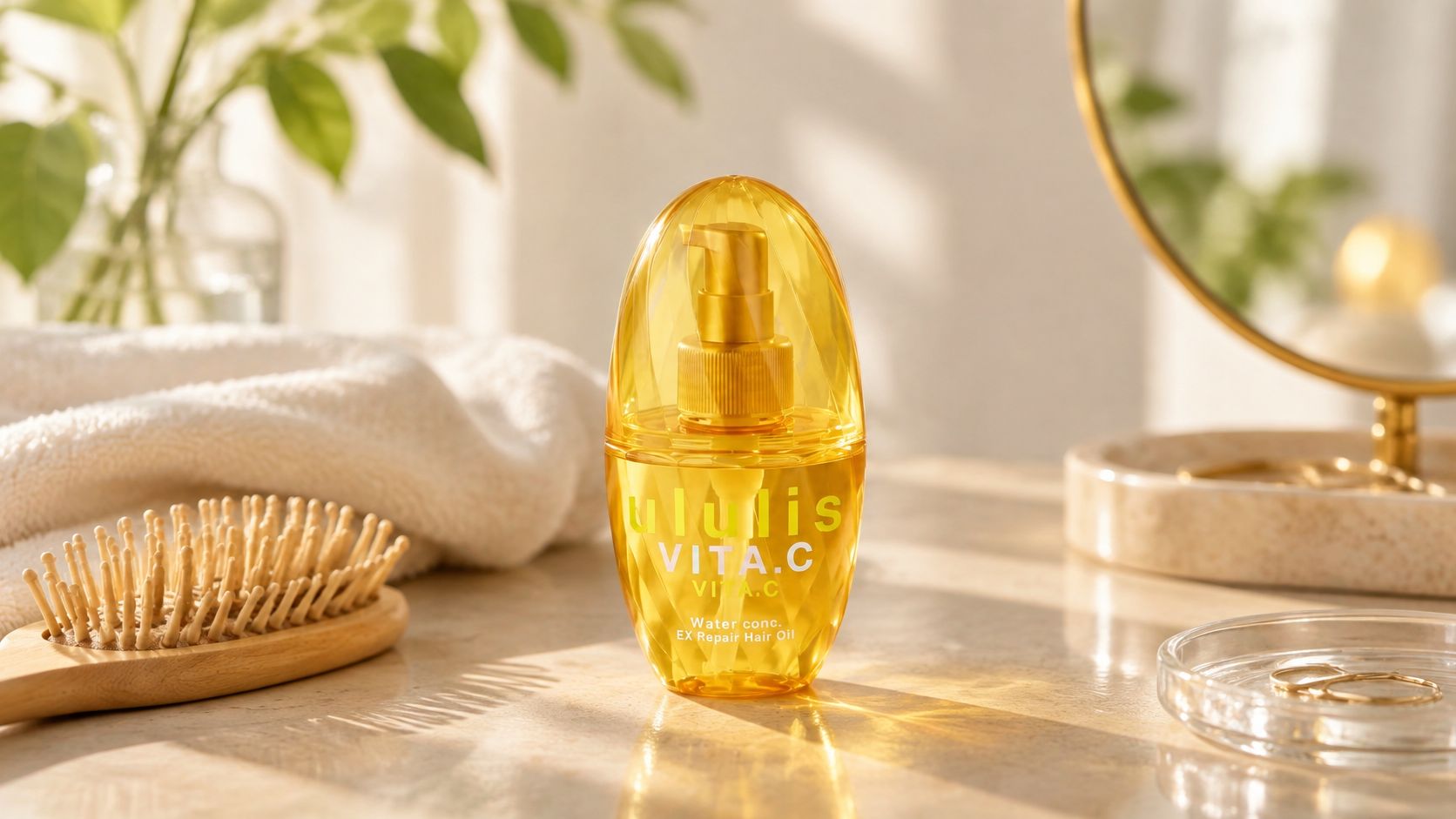
If Light leaves the ends looking insufficiently controlled, trial the original rather than repeatedly coating the whole head. If your real concern is softness, don't assume a heavier styling oil will replace the conditioning step your hair needs.
Check the Exact Bottle Before Checkout
Similar names can point to different ReFa products. Listings may shorten the title, and translated descriptions can omit part of the variant name. Confirm the full name before comparing bottles or placing an order.
According to ReFa's news archive, Lock Oil Bloom and Lock Oil Bloom Light began sales in April 2024, with tamanu oil and new fragrances. ReFa STRAIGHT LOCK was released on April 16, 2025. Its straightening-oriented positioning distinguishes it from the original pre-styling oils.
Run this checkout check
- Read the full product name. Confirm every part, including LIGHT, Bloom or any additional designation. Search-result titles may be shortened.
- Match the packaging. Check that the pictured bottle and written variant agree. A familiar bottle shape alone does not identify the formula.
- Read the ingredient list. Tamanu oil can help flag a Bloom version, but confirm the full product name as well.
- Check the fragrance. The scent description may reveal a version change when the translated title is incomplete.
- Confirm the volume. Compare like-for-like bottles. The product photo may not establish the quantity being sold.
- Check the intended finish. Match the listing's description to your goal, such as airy definition, richer polish or straightening-oriented styling.
Resolve mismatches before paying
The title, photograph and ingredient list should describe the same product. If they conflict, save the listing details and ask for clarification before ordering. Resolving a variant question beforehand helps avoid receiving a bottle that does not match the one you meant to buy.
When replacing a product, compare the listing with your existing bottle rather than relying on memory. Keep a clear photograph of the front label and ingredient panel, particularly when shopping through translated pages.
For international shoppers, the question is whether the exact Japanese product matches the formula and styling purpose they intend to purchase.
Bloom Light and original LIGHT are separate variants, and STRAIGHT LOCK has a straightening-oriented purpose. Check the full name before choosing between them.
This comparison covers standard LOCK OIL and LOCK OIL LIGHT. Treat additional names as a prompt to check the listing details carefully.
What Is Inside Each Formula and Why It Matters
An ingredient list helps identify a formula, but it doesn't tell you exactly how that formula will feel on your hair. Read it alongside the intended finish rather than using the number of botanical oils as a ranking system.
ReFa's Japanese product information identifies the original LOCK OIL as containing 18 plant-derived oils and describes its hydrophilic character. The listed oils are:
- Hybrid safflower seed oil
- Soybean oil
- Linseed oil
- Argan kernel oil
- Cranberry seed oil
- Sacha inchi seed oil
- Macadamia seed oil
- Evening primrose oil
- Rice germ oil
- Hazelnut oil
- Jojoba seed oil
- Camellia seed oil
- Grape seed oil
- Almond oil
- Rosehip fruit oil
- Avocado oil
- Shea butter oil
- Meadowfoam oil
Read the base, not just the botanical names
The published ingredient list on the LOCK OIL LIGHT product page places dodecane and dicaprylyl carbonate near the front. It also lists hybrid safflower, soybean, flaxseed and argan oils alongside other emollient oils, plus the named heat-care ingredients meadowfoam-δ-lactone and γ-docosalactone shared by the formulas.
Those technical names don't mean you need a chemistry background to choose a bottle. Focus on what the terms explain:
- Emollient means an ingredient used to soften or smooth the feel of hair.
- Ester describes a type of ingredient often used to influence slip and texture; dicaprylyl carbonate is an example in Light.
- Hydrophilic means having an affinity for water. Here, ReFa uses it to describe oil designed to mix with water more readily than a typical oil and distribute through the hair.
A front-of-list ingredient can help explain the construction of a formula, but it doesn't reveal the complete proportions. Nor does the presence of a named heat-care ingredient establish a particular level of heat protection.
What the label can't promise
Don't assume that more plant oils automatically mean better conditioning, or that a lighter-feeling base means weaker styling. The finished blend, application amount and your hair's response matter more than an appealing individual ingredient.
Check the current bottle label before use, especially when the name or packaging has changed. If you're sensitive to fragranced cosmetics, patch test according to the product's directions and stop using it if irritation occurs.
The original list includes almond, macadamia and hazelnut oils. If you have a nut allergy, read the current label and check with Buy Me Japan customer service for product details before use; seek advice from your allergy clinician about personal suitability rather than assuming a cosmetic oil is safe.
How to Apply Each Oil Before Using a Hair Iron
Both ReFa oils are positioned for styling before heat. ReFa describes a heat-conduction approach intended to transfer heat quickly and then reduce it quickly, supporting shape formation and hold. The official LOCK OIL instructions explain this approach.
Start at the ends, then spread the oil through the lengths.
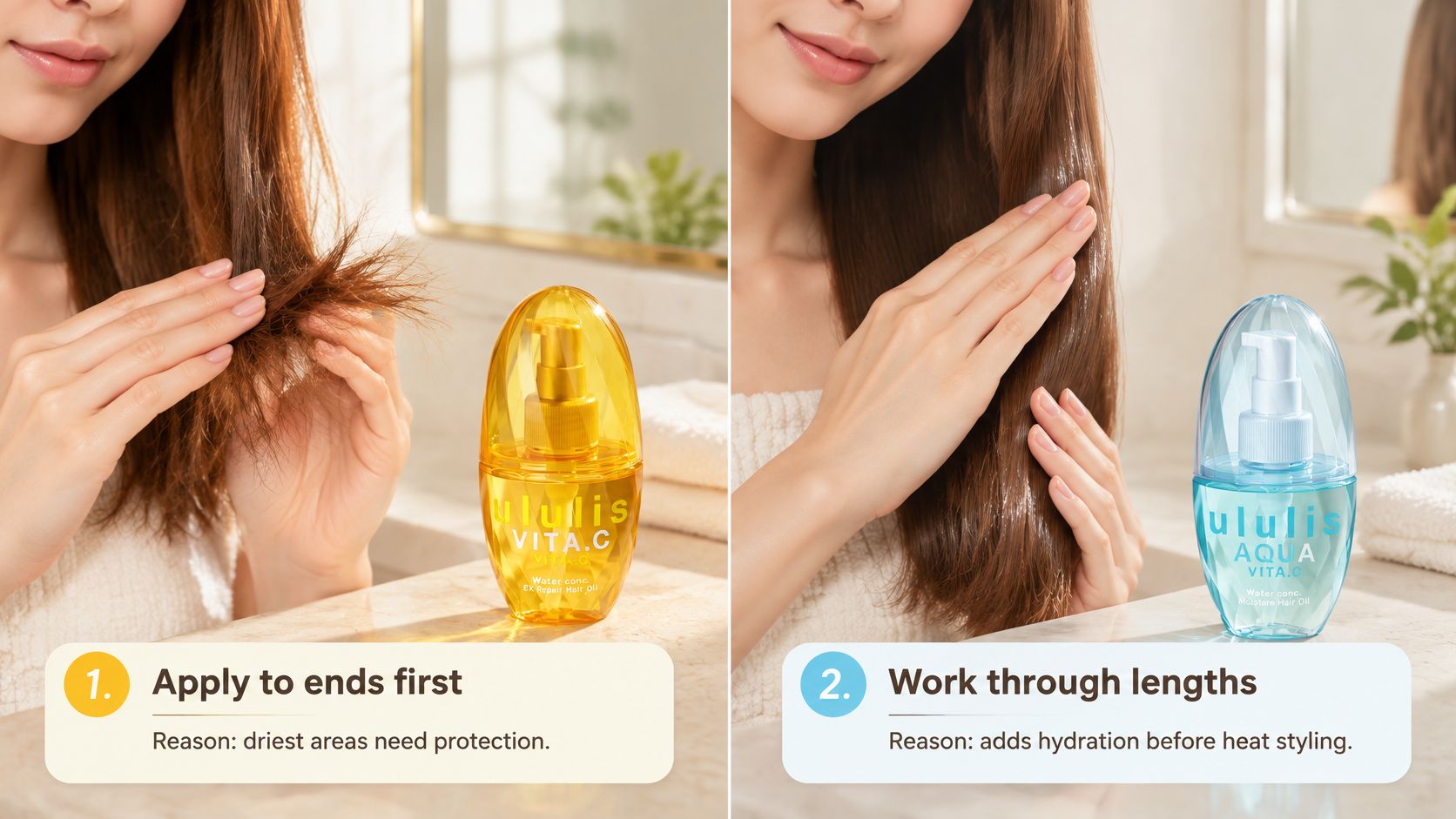
Applying standard LOCK OIL
- Start with dry hair and apply to the ends first. Focus on the areas that need polish, keeping oil away from the scalp.
- Work the oil through the lengths. For long hair, ReFa recommends 3–4 pumps, distributed evenly, in its official LOCK OIL instructions.
- Check the distribution before using the iron. Slowly pass the iron along each section without holding it in one place or touching the scalp.
Common slip: coating the visible top layer while leaving the underside untreated. Separate the hair and work through it with your hands before adding more product.
Treat the long-hair amount as guidance, not a target for every texture. Fine lengths may need less. A glossy patch does not mean the rest of the section is covered.
Applying LOCK OIL LIGHT
- Begin with a pump for dry mid-lengths and ends. Dispense the oil into your palms rather than directly onto the hair.
- Rub your palms together so the product is spread across both hands, not concentrated on the first section you touch.
- Distribute from the underside outward. Work through smaller sections and keep oil away from roots where you want lift.
- If flyaways remain, spread only a half-pump over your hands and touch the specific areas.
- Style once the oil is evenly distributed. Use a dryer or iron as appropriate, and make sure the hair is fully dry before using a hot iron.
Common slips: adding a full extra pump for a few flyaways, or layering a rich oil underneath. Either can leave the finish heavier than intended.
Use the video alongside the written routine, following the instructions on your bottle.
Judge distribution before adding heat
Look for separated strands, even slip and no visible clumps. If you feel a greasy or tacky patch, spread the product through nearby lengths before adding more.
Follow your heat tool's instructions and choose an appropriate setting for your hair. Raising the temperature or repeating passes will not correct uneven application.
If cost is prompting a change in your routine, you can compare budget-friendly hair serum alternatives. A finishing serum may suit a different stage of styling, so check that its directions match the way you plan to use it.
Aim for a defined shape without visible clumps, sticky sections or repeated layering.
Test Your Own Hair Before Reordering
A useful comparison tracks the finish over time, not just the first impression. Check the same areas of your hair after styling and again later.
| Checkpoint | When to check | What it shows |
|---|---|---|
| Root lift | Right after styling | Volume at the roots |
| Shine | After hair dries | Gloss versus dullness |
| Tackiness | When you touch the hair | Residue or sticky feel |
| Curl retention | After 4 and 8 hours | How long the shape holds |
| Next-day oiliness | The next morning | Weight and oil at the ends |
Use those checkpoints as an observation schedule. Since the iron routine starts on dry hair, assess shine after styling; if you use a dryer, wait until your hair is fully dry.
A matched comparison is more informative than comparing results from unrelated days. Weather, conditioning products and section size can all affect how the finish looks and feels.
Keep the comparison repeatable
- Choose matched sections. Compare areas with similar length, thickness and texture. Avoid pairing fragile face-framing hair with a dense section at the back.
- Apply the oil you already own to one section, following its routine. Use an amount you can distribute evenly.
- Repeat with the other oil across three styling sessions. Keep the heat setting, section size and product amount consistent between matched sections. Avoid layering another oil over either side.
- Record each checkpoint. Note whether a curl relaxed, the roots dropped or your fingers detected residue.
- Keep the oil that gives your preferred shape without unwanted tackiness or greasy ends. The result applies to your hair and routine, not to everyone's.
You don't need to buy another bottle just to run a comparison. If you own one oil, first see whether changing how you distribute it addresses the issue. Test another formula when you already have access to it.
Record the trade-off that matters
Make notes specific. For example, write that the front wave flattened while the ends stayed glossy. That tells you whether to reconsider the formula, use less near the roots or reduce the amount overall.
Photograph both sections in similar lighting, and avoid brushing one side more often than the other. If you change the heat setting or conditioning routine, mark that session so you can separate those effects from the oil's finish.
Include the weather in your notes. This guide to Japanese hair oil for humid weather can help you interpret differences between a dry indoor day and time outdoors.
Before reordering: Decide whether you want more polish or less weight, then check whether your notes support that preference.
Choose the exact variant that gives your preferred finish, works at a manageable amount and feels comfortable to touch.
Buy Me Japan offers Japanese beauty, hair care and lifestyle products. Browse the Buy Me Japan hair care selection, then check each product's full name and ingredient list before ordering.


Share:
Biore UV Aqua Rich Guide: SPF, Variants and Application