


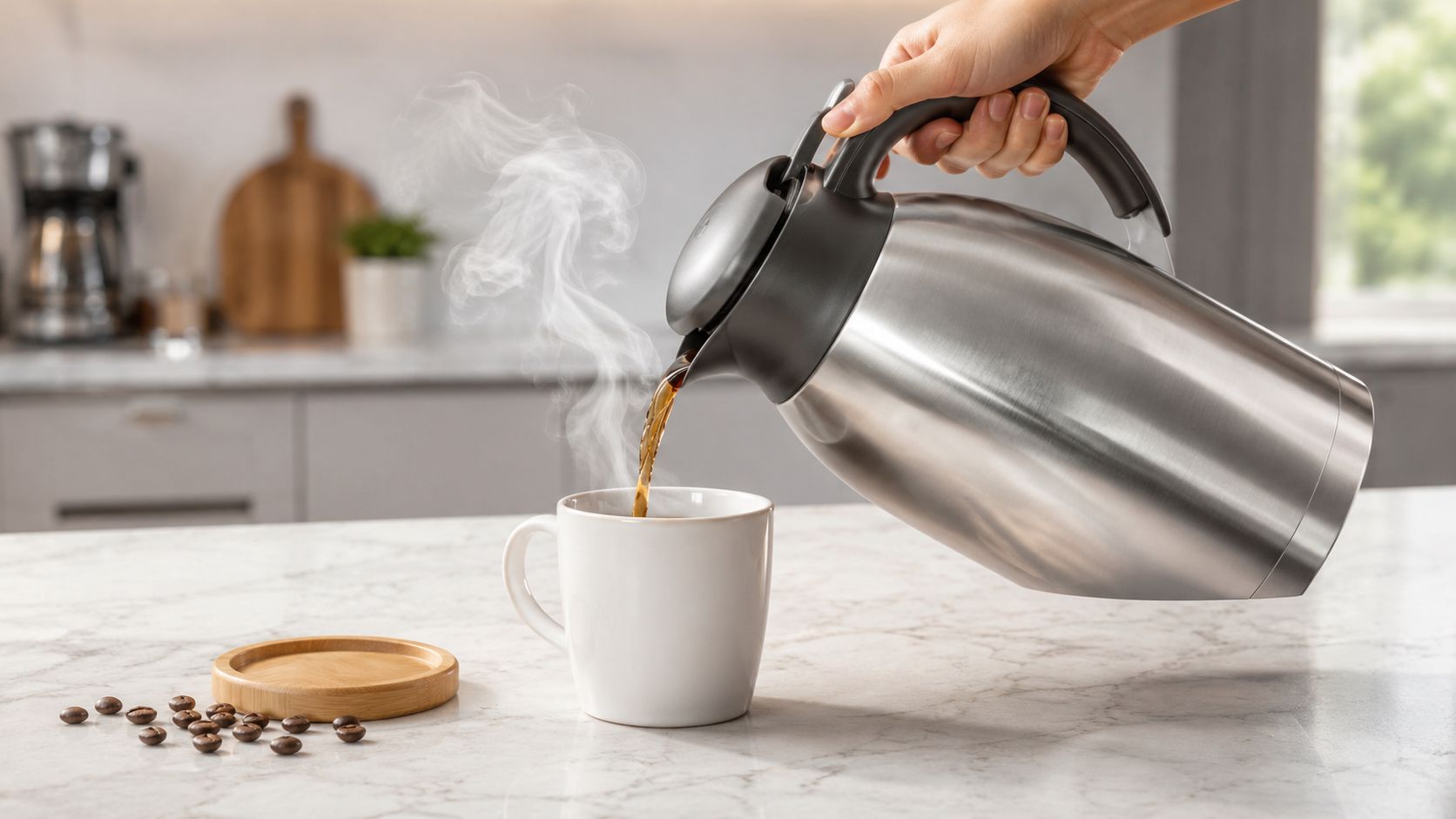
You know the moment. The coffee was hot two minutes ago, then it sat in a pretty glass pot, got forgettable fast, and somebody knocked the whole thing on a counter anyway. That's usually the point where people stop buying cute drinkware and start looking for a stainless steel carafe that behaves like kitchen equipment instead of decoration.
If you care about clean lines, hot coffee, and a counter that doesn't feel cluttered, the right carafe matters more than most buyers admit. Japanese product design gets this right often, because the good versions focus on finish quality, lid engineering, and thermal retention, not just a shiny shell. If you want a sharper way to choose one, and a better sense of what's real performance versus marketing fluff, keep reading.
What a Stainless Steel Carafe Actually Does
A real stainless steel carafe is not just a metal pitcher. It's a thermal vessel built to keep a drink at a usable temperature without a hot plate, and that difference changes how coffee tastes by the hour, not just by the minute. The useful milestone here is material history, not branding. In 1912, German Krupp engineers Eduard Maurer and Benno Strauss patented an austenitic stainless steel later known as 18/8 or AISI 304, and in 1913 Harry Brearley in Sheffield produced the first widely recognized true stainless steel with 12.8% chromium and 0.24% carbon (stainless steel history).
That chromium-rich chemistry is why these vessels moved from fragile glass toward durable metal containers. Coffee, tea, and other drinks needed a surface that could handle repeated use, resist corrosion, and stay food-contact reliable. The material doesn't make the whole carafe good on its own, but it gives the design a real foundation.
The version worth buying is built for routine
The modern carafe evolved from kitchen utility into everyday consumer thermal gear when Thermos introduced its first stainless steel vacuum bottle in 1966 (Thermos history). That matters because it established the form many people now use at breakfast, during meetings, or for slow weekend pours.
Practical rule: if the product looks like a decorative jug but doesn't publish thermal specs, treat it as a serving piece, not a true thermal carafe.
In a Japanese kitchen, that distinction shows up in how carefully the object is finished. Good carafes look calm on the counter, but they're still built for use, not display. That's why the right one feels like part of your coffee routine instead of something you baby.
If you also keep tea in rotation, the same design logic applies, especially for people who like matching drinkware with a clean setup. A useful companion read is Japanese herbal tea, because the same attention to vessel choice shows up there too.
How Double-Wall Vacuum Insulation Works
The engineering is straightforward once you break it into layers. It's a thermos sandwich. You have an inner stainless wall, an airless vacuum gap, an outer stainless wall, and a lid with a gasket that has to seal well enough to stop heat from escaping through the top. The shell matters, but the gap does most of the work.
The layers that actually control temperature
The inner wall holds the drink. The vacuum gap blocks the main paths for heat transfer, especially conduction and convection. The outer wall gives the carafe its shape and protects the insulated core, while the lid is the part most shoppers ignore and then blame later when the coffee cools too fast.
That's why wall construction beats brand name hype. A good-seeming carafe with a sloppy lid will underperform, even if the body is premium steel. A compact example in the market is the Thermos Insulated Mug 600ml, which is described as a convenient insulated mug for keeping drinks hot or cold for an extended period.
The right comparison isn't just between product pages. It's between a well-sealed thermal vessel and a regular pouring jug. If you want another angle on insulated steel drinkware, the breakdown of stainless steel sports bottles is useful because it shows the same insulation logic in a different form factor.
A poorly sealed lid can erase most of the benefit of a good vacuum body.
Commercial examples in this category often show capacities around 1.2 to 1.9 L and retention claims from 6 hours at 171°F (77°C) to 24 hours at 121°F (49°C) (market example). Those numbers are less important than the pattern they reveal. Retention depends on the vacuum quality, the lid seal, and the carafe geometry, not just the fact that it's steel.
For buyer judgment, the best sign is measurable temperature data. If a listing only says “hot for hours” and gives no evidence, assume the performance claim is soft. If it gives actual retention numbers, you can compare it with your own routine instead of guessing.
Stainless Steel Versus Glass and Plastic Carafes
If you're choosing between stainless steel, glass, and plastic, don't start with looks. Start with what happens after the first pour. Stainless steel is the most serious option because it combines durability with thermal control, while glass and plastic each come with trade-offs that matter in real kitchens.
What each material is good at and bad at
Glass keeps flavor neutral, which is why people still like it for serving. The problem is heat loss and fragility. A separate thermal-carafe analysis says vacuum-insulated stainless steel can keep coffee above 175°F for 90 to 240 minutes, while glass carafes typically drop below 140°F within 20 minutes (thermal carafe comparison). That's not a minor difference. It changes whether the last cup tastes fresh or abandoned.
Plastic is lighter and usually cheaper, but it can absorb odors and stain. If you've ever opened a cheap plastic pitcher and caught yesterday's coffee smell, you already know the downside. Plastic can work for casual use, but it rarely feels like a long-term kitchen object.
Stainless steel wins on daily reliability. It doesn't shatter when you bump it, it handles temperature retention far better, and it suits a counter where appearance matters as much as function. A design-forward kitchen often benefits from that exact combination, especially if you like a minimal setup with fewer visible compromises.
One thing to be honest about, though, is that “stainless” doesn't automatically mean every contact point is perfect. The body may be excellent while the lid, gasket, or spout still introduce taste or sealing issues. That's where a closer read of materials becomes necessary.
For a related cookware mindset, the discussion of Japanese cast iron frying pan makes the same point in another category, good tools are chosen for how they behave over time, not how they photograph on day one.
A practical shortlist looks like this:
- Choose stainless steel if you want better heat retention, fewer breakage worries, and a cleaner long-term look.
- Choose glass if you care most about flavor neutrality and don't mind faster cooling.
- Choose plastic if you want light weight and low upfront cost, and you can live with odor risk and weaker thermal performance.
How to Choose the Right Capacity and Features
Start with your routine, not the photo-ready version of your kitchen. A stainless steel carafe should fit the way you brew, pour, and clean up. If you drink alone, a smaller body keeps the counter clear. If coffee sits out for a household, studio, or small office, constant refills become the annoyance.
Pick the size that fits the habit
Capacity should match the pace of use. Many higher-end stainless steel carafes sit around 50 to 67.6 oz (1.5 to 2.0 L) and stay fairly compact, with footprints near 5.5 to 6.4 in wide and 8.7 to 11.5 in tall (spec example). That range works well for everyday home brewing because it gives you enough coffee without turning the carafe into a clumsy object that crowds the counter. If you pour for one or two people, a smaller shape usually feels better in hand. If you host brunch or keep coffee available for a group, go larger and stop worrying about top-ups.
The details that separate good from annoying
Spout design matters more than most buying guides admit. A drip-control lip keeps the counter cleaner, and a smooth pour saves you from wiping coffee rings off the base all week. Lid style matters too. Screw-top lids seal firmly, push-button lids are easier when you keep pouring through the morning, and brew-through lids make sense when the carafe sits under a brewer.
The hidden weak points are the lid seal and the vacuum. A carafe can look solid on day one and still disappoint later if the gasket starts to harden or the insulation loses performance. That slow decline is what most glossy product pages skip. A good fit between lid, seal, and body matters more than a flashy finish.
Handle shape and balance are just as important. A handle that feels steady with one hand is worth more than a sculptural form that looks good and pours awkwardly. Finish comes after function. Matte hides fingerprints, polished steel looks sharper, and colored finishes help a carafe sit neatly in a minimalist kitchen.
If you also care about the brewer setup around it, the Japanese electric kettle guide is useful context because the same attention to daily use, pour control, and countertop fit shows up in Japanese coffee gear.
Pick this if: you make coffee once in the morning and sip it slowly, choose a tight lid and clear retention specs.
Pick this if: you host guests, choose a larger body with a comfortable handle and a pour that stays clean.
Pick this if: you want a cleaner counter, choose a compact matte finish with a low-profile silhouette.
The point is not to chase the fanciest carafe. It is to choose one that disappears into your routine because it pours well, seals well, and does not start smelling tired after a few months.
Daily Care and Long-Term Cleaning Routine
A stainless steel carafe stays good only if you keep oil residue and mineral buildup from piling up. The good news is that the maintenance routine is boring in the best way. You don't need special chemicals. You need consistency.
Keep it simple every day, week, and month
Start with a quick daily rinse after use. That clears coffee oils before they cling to the inner wall and tint the flavor of the next batch. If you let residue dry overnight, you're making the weekly wash do twice the work.
Once a week, wash it with mild soap and a bottle brush. Reach the base, the shoulder, and the underside of the lid if it comes apart. A soft brush is enough for most jobs. Aggressive scrubbing is not a badge of honor here.
For monthly maintenance, do a deep clean with a baking soda soak or a diluted vinegar descaling soak. That helps with hard-water residue and lingering smell. Keep the soak gentle and avoid anything harsh around the seal.

The most important warning is simple. Don't use chlorine bleach or abrasive pads. They can damage the finish, stress the gasket, and shorten the life of the vessel. If you want a structured cleaning rhythm for other Japanese kitchen staples too, the instant matcha tea guide pairs well with the same kind of low-fuss care mindset.
A clean carafe should smell like nothing. If it starts to smell stale, that's usually residue, not mystery wear. Clean it before the odor becomes the habit.
Food Safety and Material Transparency
People say “stainless steel carafe” as if that phrase covers the whole thing. It doesn't. The body may be steel, but the lid, gasket, pour spout, inner liner, and any coating can still be plastic, silicone, or another material the drink touches directly. That's the part buyers should inspect first.
What should touch the drink
Independent safety research found that all seven tested stainless steel grades released only small amounts of metals, with levels below the Council of Europe's Specific Release Limits in every exposure scenario, and the paper concludes stainless steel is safe and acceptable as a food-contact material (safety research). That supports 18/8 food-grade steel as a sound interior material for beverage contact.
The practical issue is transparency. Many listings never say whether the beverage touches the lid plastic, a silicone seal, or a coated interior part. That's why buyers keep asking the same questions and not getting clear answers, especially around inner liner material, gasket grade, and taste transfer (buyer guide notes).
Ask one question before you buy. What parts of the liquid path are actually stainless steel?
Here's the 30-second checklist I use:
- Check the inner liner: confirm it's 18/8 or 304 food-grade stainless steel.
- Check the gasket: look for a food-safe silicone seal rather than vague “sealed lid” language.
- Check the lid path: find out whether coffee or water touches plastic anywhere during pouring.
- Check the claims: if the seller avoids material detail, assume the product is more ambiguous than the photos suggest.
That matters because flavor transfer usually starts in hidden places. A good steel body can still be undermined by a cheap lid assembly. If a listing is transparent about those parts, it's usually a better sign than a glossy product render.
Common Problems and How to Fix Them
The first few months with a carafe usually go fine. Later, three issues show up again and again, and they're easy to misread if you don't know what to look for. Heat retention drops, odors linger, or the lid starts to leak.
Heat loss, smell, and drips each have a cause
If the coffee gets cool too fast, suspect the vacuum seal or the lid seal first. A simple at-home check is to fill the carafe with hot water, close it, and compare how warm the shell feels after a while. If the outside feels unusually warm, the vacuum may no longer be doing its job. At that point, a failed vacuum usually means replacement, not repair.
If odors stay after washing, you're likely dealing with coffee oils or mineral residue. Deep clean with baking soda, then rinse thoroughly. If the smell remains only near the lid, the gasket may be holding residue and should be removed and cleaned separately if the design allows it.
If the lid leaks slowly, the problem is usually the seal, the threads, or a warped insert. First test it with plain water over the sink. If it drips only when tilted, the gasket may need replacement or reseating. If it leaks even while sitting upright, retire the lid or the whole unit.
The decision tree is pretty blunt. Odor usually means cleaning. A drip usually means seal failure. Heat loss usually means the vacuum is compromised. Don't keep using a carafe that's visibly failing and expect it to recover on its own.
Why Buy From Japan and Frequently Asked Questions
A stainless steel carafe can look great on a counter and still disappoint if the lid feels flimsy or the seal wears out early. Japanese carafe design usually gets those small, daily-use details right. The finish is cleaner, the lid action feels more considered, and the shape stays practical instead of trying too hard to look fancy. That matters if you care about coffee flavor, because a carafe that seals well and holds temperature keeps the brew tasting closer to what you meant to make.
Direct sourcing also cuts down on guesswork. Buy Me Japan ships directly from Japan and curates products with that standard in mind, so if you want a coffee setup that balances appearance with real function, it is a sensible place to look. It also fits neatly with a broader kitchen routine, especially for people who already enjoy authentic Japanese home cooking recipes and want the same calm, coordinated feel across the counter.
Quick FAQ
Can a stainless steel carafe work with pour-over or drip coffee makers? Yes, as long as the opening and lid are designed for brew-through use, and the brewer fits the opening cleanly.
Can you put a stainless steel carafe in the microwave? No. Metal and microwaves do not mix.
Does it work for cold brew or iced tea? Yes, and that is one of the practical advantages of a good thermal vessel. It keeps cold drinks from warming up too quickly.
If you want to compare coffee gear more broadly, the Japanese coffee brands guide is a useful next stop before you buy.
Choose the carafe that matches your routine, not the one with the loudest promise. If you want a clean option that fits a Japanese-inspired kitchen and arrives with proper product curation, visit Buy Me Japan and browse the pieces that make daily coffee better.

Share:
Whitening Face Mask Guide: Ingredients, Types & Picks
Where to Buy Pearl Sago Online and In-Store