


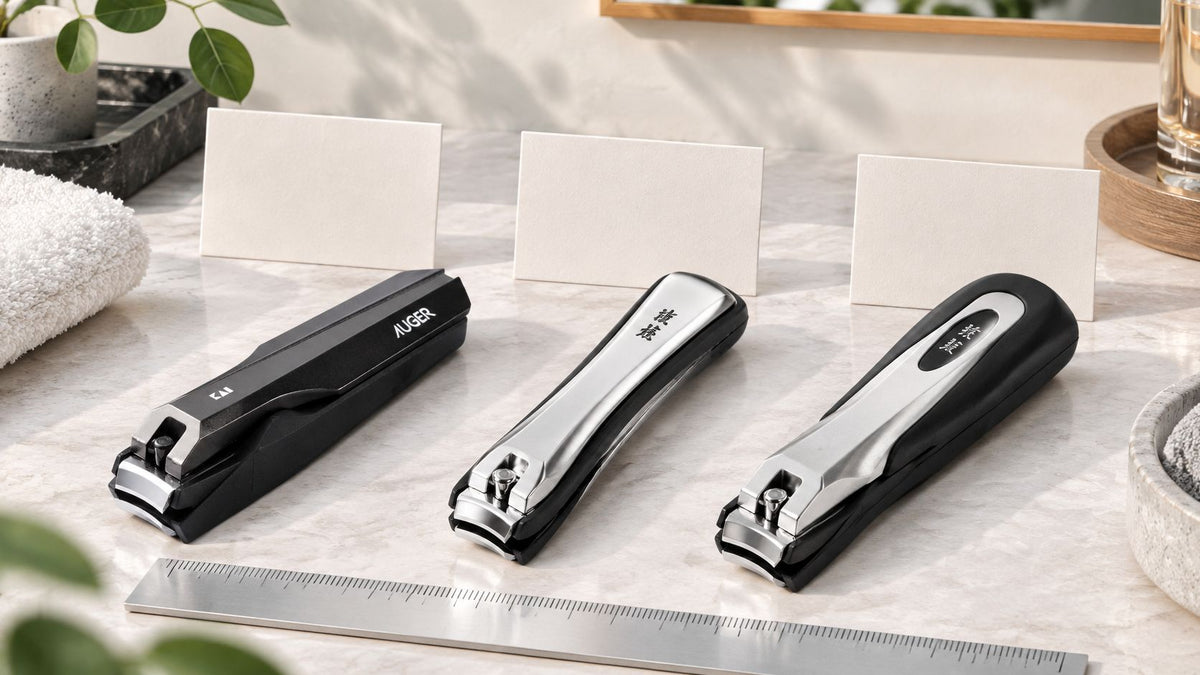
The usual advice is to buy the sharpest clipper you can afford. It sounds sensible until you try to verify it. No KAI listing publishes a cutting-force figure, a sharpness score or a blade-life rating, so the one number most buying guides lead with isn't on the page.
What is on the page turns out to be more useful: product codes, millimetre measurements, weights and the accessories in the box. Those details decide whether a clipper suits your nails, and they expose something the model names hide. The same series name can mean different sizes across regional catalogues, and a higher price doesn't automatically mean a better cut.
This comparison of KAI nail clippers: comparing Auger, Type 101 and Type 102 starts with the code rather than the name, because the code is the only part of the listing that stays fixed wherever you shop.
Side-by-Side Specs for Auger, Type 101 and Type 102
Three families, three cataloguing systems. The table below uses the manufacturers' own published figures, so it starts with what a listing can prove: code, size, construction, accessories and listed price. That matters because the series names hide as much as they reveal.
KAI Auger, Type 101 and Type 102 at a glance
| Model | Product code | Listed size | Construction and accessories | Listed price (tax included) |
|---|---|---|---|---|
| KAI Auger M Standard | HC-2300 | 90 × 22 mm | Stainless steel with plastic components; nail file and nail catcher | Not published in the catalogue entry |
| Seki Magoroku Type 101 | HC3500 | 90 × 18 × 26 mm | Stainless steel and plastic lever clipper with integrated filing or catching features | ¥1,650 |
| Seki Magoroku Type 102 | HC3502 | 94 × 17 × 23 mm | Stainless steel with plastic components; nail file and nail catcher | ¥2,420 |
KAI's Seki Magoroku nail care catalogue identifies Type 101 as product code HC3500, measuring 90 × 18 × 26 mm and priced at ¥1,650 including tax, and Type 102 as HC3502, measuring 94 × 17 × 23 mm at ¥2,420 including tax, as recorded in KAI's Seki Magoroku nail care catalogue. Those figures are useful, but they have limits. None of the entries gives a cutting-force figure, edge angle or blade-life rating, so the numbers support format matching rather than a performance ranking.
Reading the Type 101 and Type 102 numbers
Compare the two entries and the difference is not a simple bigger-and-smaller progression. Type 102 is 4 mm longer, 1 mm narrower and 3 mm shorter than Type 101, using the same catalogue's listed axes. That describes a slimmer, flatter tool, not a scaled-up one, and it is precisely the distinction a product photograph cannot convey.
The price gap carries the bigger signal. At ¥2,420 against ¥1,650, Type 102 costs ¥770 more, roughly 46.7% higher, a derived comparison from the two listed prices in KAI's Seki Magoroku nail care catalogue. Both tools are stainless steel with plastic components, so materials alone do not explain the gap. The safest reading is that KAI separates the two codes commercially. Calling Type 102 a premium specification tier would go beyond the published specs, especially when the measured size difference is modest.
Analyst note: A 46.7% premium over a 4 mm length difference is a merchandising choice, not a manufacturing cost. Buy the format you need, not the code that looks more serious.
Why the same model has two sizes in two catalogues
KAI's European product information gives Type 102 as 94 × 22 mm, not 94 × 17 × 23 mm. That figure appears in the same sentence because the two measurements use different levels of detail: the European entry reduces the body to length and width, while the Seki Magoroku entry adds a third axis. The mismatch is a common source of confusion in cross-border shopping.
The Type 101 row needs the same caution. The table lists Type 101 as 90 × 18 × 26 mm, while later size guidance gives the M format as approximately 90 × 26 × 18 mm. Those are the same three dimensions with the last two axes listed in reverse order, so the body length stays consistent and the width and height labels swap. Read the order printed on each listing before judging one source against another.
The type name stretches in another direction too. KAI's wider Seki Magoroku catalogue records Type 101L at 106 × 22 × 37 mm, so the 101 designation covers a larger variant as well as the standard one. That is why the code matters: HC3500, HC3502 and the L variant are not interchangeable labels for one body.
What the table cannot show matters as much as what it can. None of these listings measures cutting force, edge geometry or blade sharpness, and no independent benchmark for those properties appears alongside them. Treat the comparison as a way to match format to hands and nails, not as a performance ranking, because the performance column has not been published.
Why Type 101 Comes in Three Sizes
Type 101 isn't one clipper. The suffix after the code changes the tool more than the words "Seki Magoroku" on the box do, so the right comparison starts with size rather than series name.
Type 101 typical listed values
| Size | Typical listed size | Typical listed weight | Blade |
|---|---|---|---|
| S | approximately 70 × 20 × 18 mm | 34 g | Blade shape not stated in the listing |
| M | approximately 90 × 26 × 18 mm | about 50 g | Blade shape not stated in the listing |
| L | approximately 10.5 cm long | 68 g | Straight blade about 1.6 cm |
Read the table as a map of use cases, not a ranking. The S format is built around a compact body, the M stays close to the familiar medium clipper, and the L pairs the longest body with the only straight edge described here. Where two shops disagree, treat KAI's own page for that exact suffix as the deciding figure rather than averaging retailer numbers.
Five checks for any Type 101 listing
- Confirm the model code so you know you're looking at a Type 101 and not a neighbouring model.
- Find the size suffix, because S, M and L behave like three different products.
- Compare the listed weight, the spec that most affects how the tool feels in daily use.
- Check the blade shape, curved or straight, since the L format is the one described with a straight blade.
- Check the box contents, meaning whether a file and a stopper case come with it.
When weight is the deciding spec
A 34 g clipper disappears into a wash bag or a jacket pocket. A 68 g clipper feels planted on a bathroom shelf and asks less of your fingers on a thick nail. Choose the 34 g S for travel and the 68 g L for a fixed spot by the sink; pick the middle body only when you want one clipper to cover both jobs.
Weights also disagree between listings because some describe the clipper alone while others fold in the stopper case or packaging. That gap does not make one shop dishonest; it means the measurement boundary is different. Quote weight with the suffix and the configuration, then let the manufacturer figure settle conflicts.
Practical rule: Choose the body you'll actually carry or hold. The lightest model wins for travel; the heavier one wins for a fixed spot beside the sink.
How the AUGER Line Differs from Type 101 and Type 102
Three KAI families, three different ideas about how a hand should hold a clipper. That is still the cleanest split.
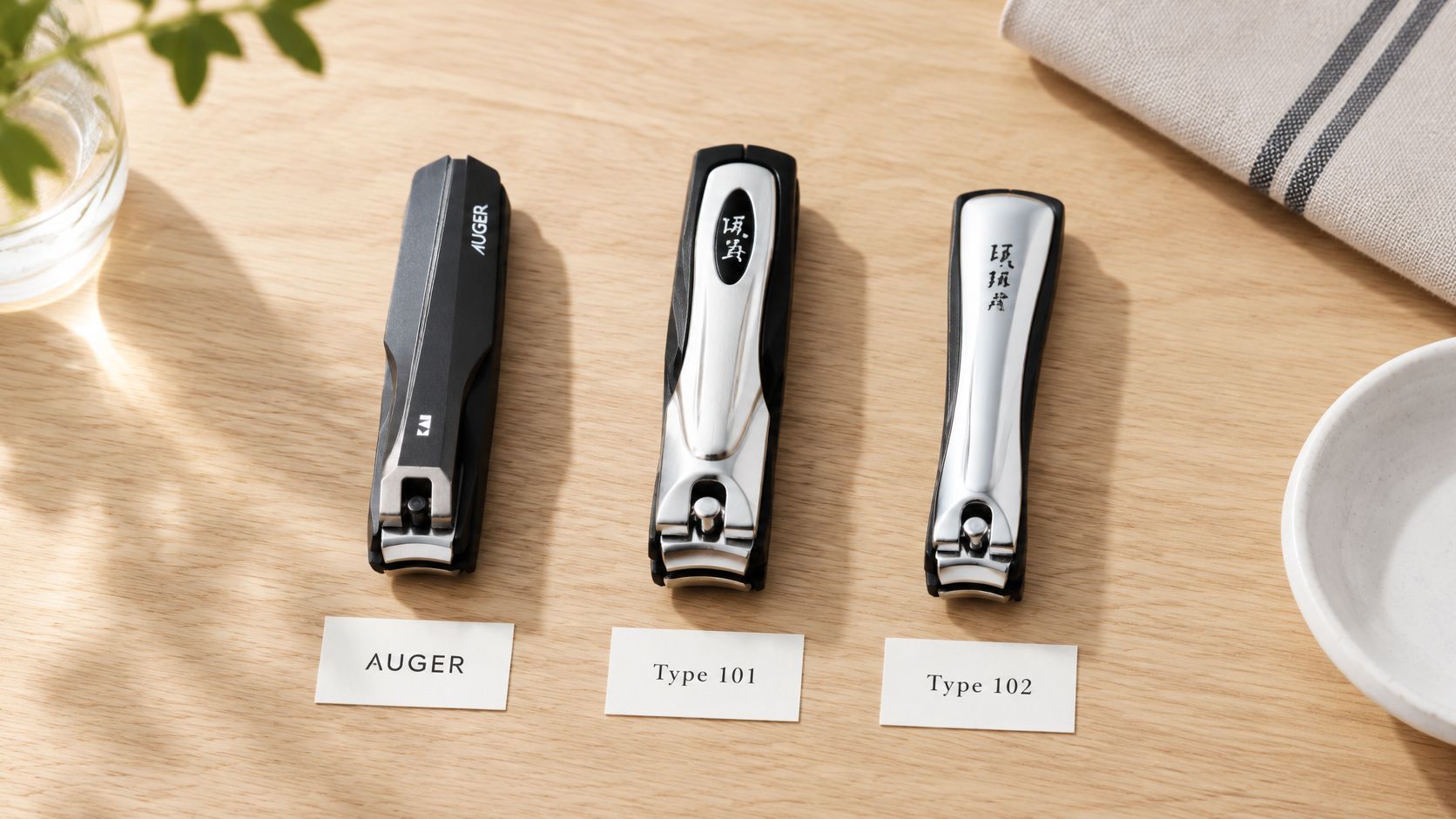
KAI styles the range as AUGER, and the label marks the structural difference: Type 101 and Type 102 are numbered Seki Magoroku models separated by dimensions, weight and box contents, while AUGER is a range built around several design concepts and movement-oriented functionality. KAI Europe said it was scheduled to become available from summer 2025 in KAI Europe's Auger and type nail clipper catalogue.
KAI Europe lists at least three AUGER nail clipper formats: M Standard (HC-2300), M Revolver (HC-2301) and Leaf (HC-2311). Only the M Standard entry shows measurements in the catalogue, 90 × 22 mm in stainless steel with plastic components. Revolver and Leaf are identifiable by code, but their size and construction sit on their own product pages, so a buyer should treat them as different listings rather than cosmetic variants of the Standard.
What a redesigned handle can and cannot change
A different handle or drive mechanism changes how hand force becomes blade closure. Better geometry can lower the pressure needed on a resistant nail and give finer control near the corners, which is the practical reason a new format exists at all.
The catalogue evidence stops at form, materials and codes. It can prove the M Standard's footprint and show that Revolver and Leaf are separate entries; it cannot prove that either mechanism cuts with less effort. KAI presents the blades as part of a long cutting-tool heritage, which explains why AUGER reads as an evolution of an existing capability rather than a novelty line. The same naming logic runs through KAI's wider grooming range, including matching AUGER razor refills to the correct handle and blade count.
Three questions that separate the families
- Which format fits my grip? A range with three designs gives more chances to find one that suits your hand than a single numbered model does.
- Which blade shape suits my nails? KAI's catalogue notes that blade geometry varies by model between rounded and straight stainless-steel forms.
- Does the handle design match how I trim? If you clip a little at a time around the corners, control matters more than raw power.
Matching the Clipper to Your Nail Type
Sharpness is the spec shoppers ask about and the one no listing answers. Technique and nail condition fill that gap, and they matter more than most product pages admit.
Cutting performance gets treated as a synonym for sharpness, with technique as an afterthought. The published record argues otherwise. A surgical case report in the Journal of Cutaneous and Aesthetic Surgery observed that even a fine nail clipper can require enough force to detach a small portion of the nail plate from the nail bed when cutting a raised nail. The failure sat in the mechanics of that particular cut, not in the tool.
Where the standard trimming advice splits
The standard toenail rule is to cut straight across, leave enough length for the corners to rest loosely against the skin, and avoid rounded or very short cuts. The experimental support for that rule as a universal answer is thin, and each trim is better judged by its mechanical effect on the surrounding tissue and on the individual nail. Both positions point a buyer the same way: the shape of the cut and the force behind it matter at least as much as the edge.
Checks by nail condition
As the side-by-side specs showed, no published test separates the three models on cutting force, so condition checks are what a buyer has. None requires a lab.
- Thin or brittle nails: look for a clean, closed cut on the first attempt. Repeated nibbling at the same spot crushes the plate, so a clipper that finishes in one motion is the one you want.
- Thick nails: confirm the blade opening before buying. If the nail will not fit the gap, stop, because forcing the lever is how edges chip and nails split.
- Curved or involuted nails: compare blade shape and opening width rather than price. A flatter cut suits some nail shapes better than a rounded one.
- Limited hand mobility: judge the lever force and the grip surface. A wider body with a longer handle gives more to press against, which matters more than edge quality when hands tire.
Prevention and treatment are different jobs. An inflamed or ingrown nail isn't made safe by switching clippers, and it calls for a clinician rather than a shopping decision. For everyone else, the goal is a controlled cut rather than maximum pressure. Match the tool to your nails, and distrust any claim that the sharpest blade decides the outcome on its own.
An inflamed or ingrown nail is a reason to see a clinician. A new clipper won't make it safe to keep trimming.
Choosing Your KAI Clipper and Caring for It
Fit is the practical filter here. The table below maps common situations to a model and to the one detail worth confirming on the listing before you pay.
Which KAI clipper fits your situation
| Situation | Model | Listing check before buying |
|---|---|---|
| Routine fingernail and toenail care | KAI Auger M Standard (HC-2300) | Confirm 90 × 22 mm and the current price |
| Portable carry | Seki Magoroku Type 101 S | Confirm approximately 70 × 20 × 18 mm and 34 g |
| Broad body with file and stopper | Seki Magoroku Type 101 M | Confirm approximately 90 × 26 × 18 mm and its listed weight |
| Slimmer profile with file and nail catcher | Seki Magoroku Type 102 (HC3502) | Confirm 94 × 17 × 23 mm |
| Thick toenails | Any model above | Confirm the blade opening before buying |
The Auger entry is the one with a full published specification: product code HC-2300, stainless steel with plastic components, a nail file and a nail catcher included, listed at 90 × 22 mm in KAI Europe's Auger M Standard listing. That makes it a compact medium-format clipper for routine care rather than a specialist tool. The numbered models in the table depend more heavily on the listing you are reading, which is why the model code and dimensions matter more than the shared series language.
Care steps and why each one matters
- Wipe the blade and jaws after every use. Trapped clippings stop the edge meeting cleanly, and a blade that never quite closes tears rather than cuts.
- Dry the clipper fully after contact with water. Moisture sitting on steel invites rust, and rust on a sharp edge ruins the geometry.
- Store it dry and away from loose metal. A keyring or a drawer of screws will scratch an edge that's meant to meet its pair precisely.
- Stop when a nail won't fit the opening. Forcing the clipper damages the edge and can split the nail in an uncontrolled direction.
Blade life depends on how much you cut and how hard you press, and no listing gives a service interval. Judge the tool by behaviour instead. A clean close, a controlled stroke and a body that suits your hand are more useful than a feature list you cannot verify from the listing.
Signs your clipper needs attention
Three symptoms are worth acting on. The blade no longer closes cleanly and leaves a ragged edge. Rust doesn't wipe away after drying. The hinge binds or feels gritty through the stroke. Those checks point to replacement as the safer choice in most cases, since a clipper that fights you is harder to control than one that opens and closes smoothly.
A simpler everyday option in the same catalogue is KAI Nail Clippers Standard Selection Type HL0602, listed at a sale price of $8.41 USD. The catalogue snapshot supports the name and price, so treat the model code as the identification point rather than assuming features that are not shown there.
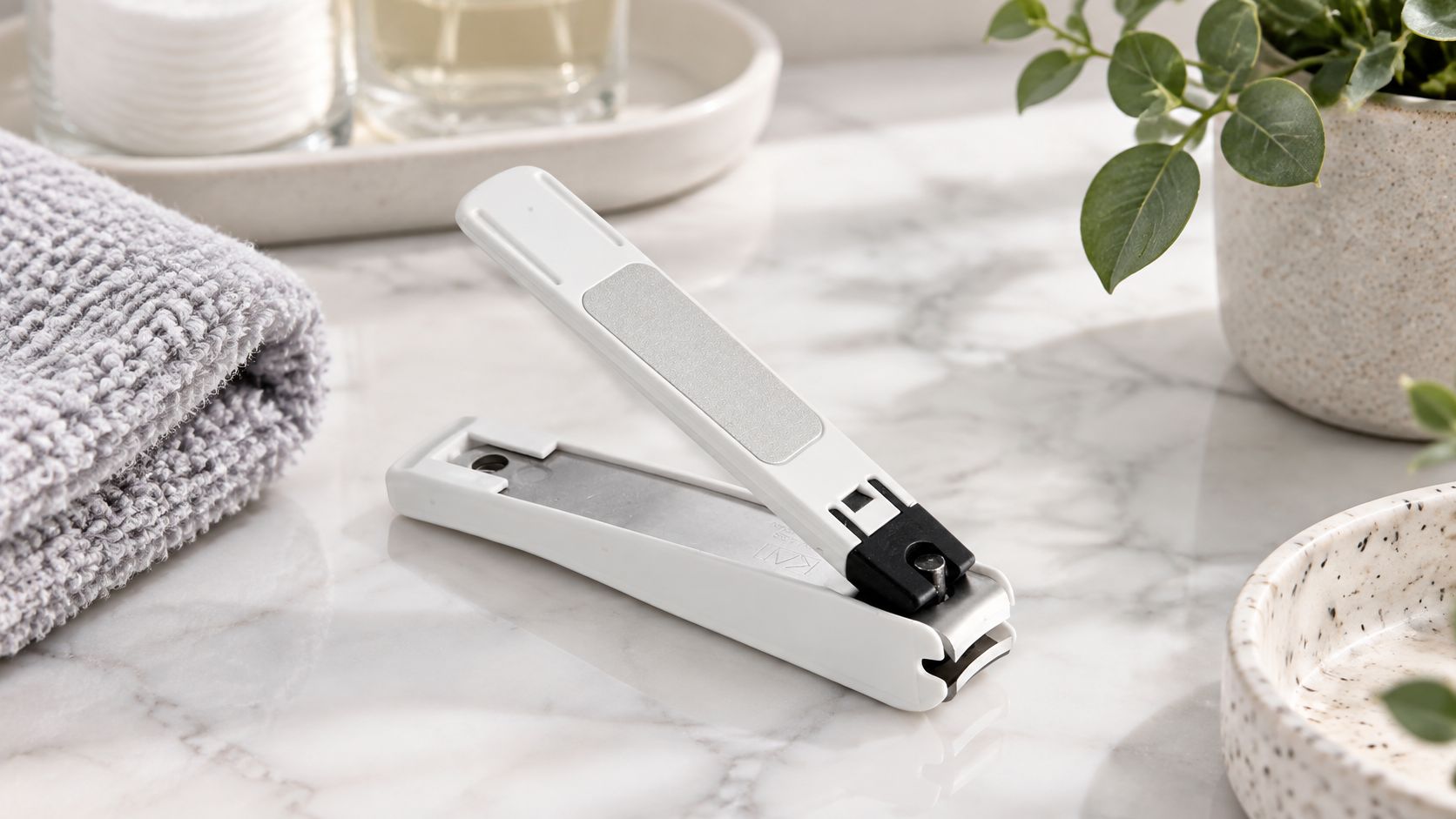
Choose the clipper whose size and opening suit your nails, even over a pricier model. The slimmer Type 102 body with its file and catcher is listed at a sale price of $16.91 USD if that format is the one your nails suit.
Pick Your KAI Clipper and Start Trimming
The decision reduces to three questions. Does the clipper's format suit your nails and grip? Does the handle give you enough force for the nails you have? And does the model code on the listing match the size you think you're buying? The series name alone can point to an S, an M or an L depending on the catalogue, so the printed code is the identifier worth trusting when two listings describe what looks like the same tool.
If your nails are unremarkable and your grip is steady, the choice between Auger and a numbered Seki Magoroku model comes down to handling preference rather than need. If your toenails run thick or your hands tire on harder clips, put more weight on handle design and less on the accessory list, since accessories never compensate for a grip that slips mid-cut. Either way, trim after a shower, when the nail plate is softer and yields with less force. Timing does more for a clean edge than anything a spec sheet can promise, and it costs nothing.
Buy Me Japan lists KAI nail clippers within a wider catalogue of Japanese beauty, cosmetics, food and drink products, with secure transactions on every purchase. Browse the full product collection and compare each listing's stated size and code before you commit.

Share:
How to Use Kewpie Karashi Mayonnaise in Sandwiches and Dressings