


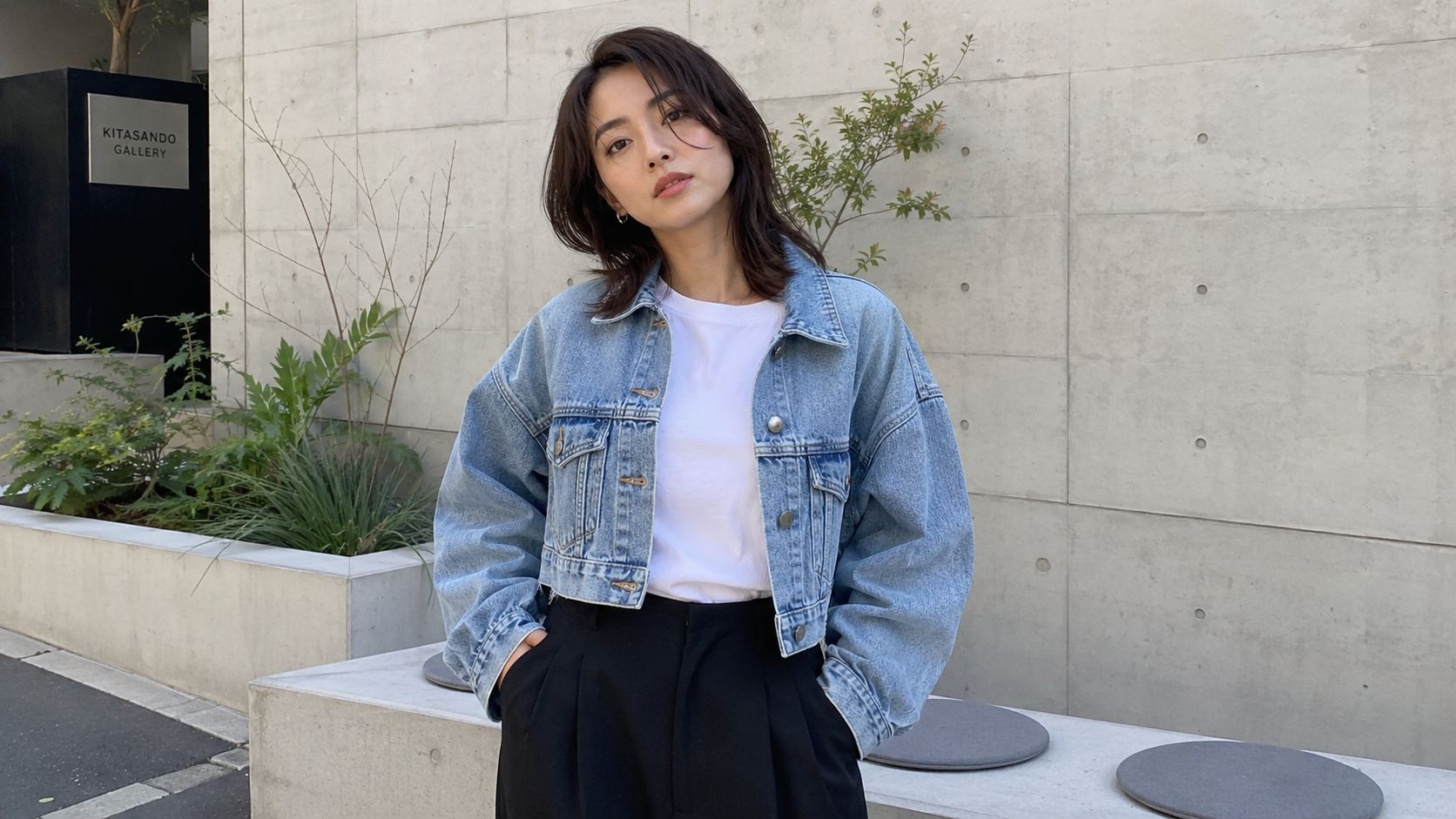
The popular advice is simple: buy an oversized denim jacket and let the volume do the work. That advice is incomplete. An oversized cropped denim jacket only looks intentional when the shoulder drop, sleeve length, body length, and waistband placement cooperate with your proportions.
The silhouette has roots in practical workwear, but its current appeal is more precise. The denim jacket began as durable workwear in the 1880s, then moved through rock and roll, greaser style, experimental womenswear, and mainstream fashion before the cropped version became widely recognized. This history of the cropped denim jacket shows why the garment can change purpose without losing its identity.
Below, I'll treat the jacket as a stylist would in a fitting room. You'll learn how to measure it, how to judge it on petite, tall, and long-torso frames, which bottoms create balance, and how to choose denim that keeps its shape instead of looking like a regular jacket bought in the wrong size.
Is the Oversized Cropped Denim Jacket Here to Stay
The question isn't whether an oversized cropped denim jacket is fashionable. It's whether you'll wear the shape after the novelty fades. Denim trends move in cycles, and the cropped version has already shown a different rhythm from the broader oversized movement. Independent trend signals recorded search peaks for denim jackets around spring and late-year shopping periods, while cropped denim jackets rose sharply in late 2024 and oversized styles gained momentum later in 2025. The Gen Z denim trend discussion also places standard denim jackets ahead of niche variations in overall search interest.
That pattern argues against treating this jacket as a universal replacement for every denim layer. It's better understood as a styling tool with a defined job. The oversized shape adds relaxed layering, while the cropped hem creates a sharper, more deliberate outfit line. Those qualities work together, but they don't suit every wardrobe or every occasion.
The useful split between relaxed and sharp
Runway and street-style coverage for 2026 keeps both directions active. Oversized silhouettes belong to loose layering, casual trousers, soft tailoring, and outfits built around movement. Cropped silhouettes sit in a more pointed lane, especially with high-rise bottoms, fitted dresses, and Y2K-influenced styling.
That distinction matters when you shop. If your wardrobe is mostly low-rise jeans, long tunics, and loose dresses, the jacket may fight your existing proportions. If you regularly wear high-waisted trousers, mini dresses, fitted skirts, or jumpsuits, the shorter body length gives those pieces a clear waistline.
The broader market also supports caution rather than dismissal. One industry estimate placed the global denim jacket market at USD 4.98 billion in 2024, with a projection of USD 5.41 billion in 2025 and USD 13.15 billion by 2035, implying an 8.6% CAGR, according to the denim jacket trend report. A separate estimate valued the segment categorized as cropped, oversized, and distressed at USD 4.76 billion in 2025, forecasting USD 8.92 billion by 2034 at a 7.4% CAGR. These are market projections, not a promise that one particular jacket will become timeless.
My recommendation: Buy the oversized cropped version if you want a strong proportion-changing layer. Don't buy it simply because oversized denim is currently visible.
For a broader view of Japanese fashion labels and style context, explore Japanese clothing brands and style influences. The jacket earns wardrobe-staple status only when it solves a recurring outfit problem, such as making wide-leg trousers look balanced or giving a simple dress a structured third layer.
What Makes a Denim Jacket Oversized and Cropped
“Cropped” and “oversized” describe different parts of a jacket. Cropped refers mainly to body length, while oversized describes the volume through the shoulders, chest, sleeves, and armholes. A convincing oversized cropped denim jacket combines both without allowing either feature to overwhelm the other.
The most useful retail benchmark is a body length of around 21 inches for deliberate oversized crop styles. Denim measurement guides commonly define crop lengths as 24 to 27 inches, so always check whether a seller is using “crop” loosely or describing a short body. A representative oversized crop size chart demonstrates why the label alone isn't enough. A short jacket may still have broad chest and sleeve measurements rather than scaling every measurement down.
The four measurements that matter
Start with the body length. The hem should land at or just above your natural waist, particularly if you plan to wear high-rise trousers or skirts. If it ends several inches below the waistband, the jacket may look like a shortened regular fit rather than a purposeful crop. If it ends well above the waist, it can expose more of the torso than intended and make layering awkward.
Next, inspect the shoulder seam. A relaxed shoulder can sit slightly past your natural shoulder point, but the drop should remain controlled. Independent oversized-denim guidance recommends roughly half an inch to one inch beyond the natural shoulder line, rather than a seam that falls toward the upper arm. This oversized denim jacket fit guide is useful for comparing relaxed proportion with a jacket that doesn't fit.
The armhole is the hidden test. Even with a dropped shoulder, it needs to remain high enough for comfortable reach. A low armhole creates drag across the back and restricts movement, especially when you drive, lift a bag, or layer over knitwear. A jacket can look roomy in a photograph and still fail in motion.
Finally, check the sleeve. A relaxed sleeve may cover part of the hand, but it shouldn't swallow it completely. Cuffing can correct a slightly long sleeve, while excessive length usually signals that the entire jacket block is too large.

Hair volume can also affect how the shoulder line reads. The & Honey Melty Moist Repair Shampoo & Treatment Set 440ml Each is a Japanese hair care duo formulated for dry, damaged hair, with honey, royal jelly, propolis extract, hydrolyzed keratin, argan oil, ceramide NG, and sodium carboxymethyl hyaluronate. That connection is practical rather than decorative. Sleek, manageable hair leaves more visual space around a broad collar and dropped shoulder, while large hair volume can make an already generous jacket appear wider.
Finding Your Perfect Fit Across Different Body Types
The phrase “works for everyone” doesn't help you buy a jacket. The same cropped hem can lengthen one frame, cut across another, and sit too high on a third. Judge the garment against your natural waist, shoulder point, torso length, and sleeve reach, not against the model's styling.
Petite frames
A petite wearer usually benefits from the cropped proportion because the shorter body doesn't cover as much of the lower figure. The risk is excessive volume. If the shoulder seam drops too far toward the upper arm and the sleeve extends past the hand, the jacket can dominate the frame.
Look for a hem at or slightly above the natural waist, a shoulder seam only modestly beyond your shoulder, and sleeves that can be cuffed without creating a heavy stack. High-rise trousers or a fitted dress will keep the lower half visible. The goal isn't to remove the oversized character. It's to keep the volume concentrated around the upper body rather than letting it spread downward.
Taller shoppers
Tall frames can carry more shoulder and sleeve volume, but a very short body may create an abrupt visual break. Try the jacket over a longer high-rise trouser, a column skirt, or a dress with a clear waist. A sleeve that ends at the wrist or slightly beyond usually looks more deliberate than one that stops halfway up the forearm.
If the jacket's body length is around 21 inches, compare that measurement with your actual torso rather than assuming it will sit at your waist. A taller shopper with a longer waist-to-shoulder distance may need a slightly longer crop while still keeping the dropped shoulder and broad chest.
Longer torsos
Long-torso shoppers should be especially strict about hem placement. A jacket that ends well above the natural waist can expose an unplanned gap between the jacket and the bottom, particularly when the top underneath is also short. Choose a crop that reaches the waistband or just above it, then use a high-rise bottom to create continuity.
A wider shoulder doesn't automatically compensate for a short body. In fact, broad shoulders combined with a high hem can make the torso appear even more compact. Look for balance between the vertical body length and horizontal volume.
Your online fitting checklist
Use these checks before ordering:
- Measure the body length: Compare the seller's center-back length with a jacket you already like.
- Check shoulder placement: The seam should sit slightly beyond your shoulder, not near the upper arm.
- Test armhole mobility: Raise your arms and reach forward. Back drag means the armhole is too low or too tight.
- Read sleeve measurements: Decide whether you'll cuff the sleeve or need a shorter cut.
- Compare chest width: Broad chest measurements create volume, but excessive width can erase your waist.
- Locate the hem against your waistband: The crop should cooperate with the rise of your preferred trousers or skirts.
For shoppers comparing clothing measurements across international sizing systems, this Japanese bra size guide offers useful context on why body measurements matter more than familiar size labels. The same principle applies here. A label such as small, medium, or large tells you less than body length, shoulder width, sleeve length, and chest measurement.
Styling Strategies That Balance Proportions
An oversized cropped denim jacket does not balance every outfit automatically. Its short hem splits the body into a compact upper section and a longer lower section, so the bottom needs clear length, shape, or both. A styling guide describes this cropped proportion as one-third at the top, with the remaining lower portion visually elongated, as explained in this cropped jacket styling guide.
Start with the waistband, not the jacket. The strongest everyday formula combines a fitted base, high-rise trousers, and the jacket worn open. Black straight-leg trousers sharpen denim, while wide-leg trousers create a deliberately roomy silhouette. Both work because the high waist gives the cropped hem a precise stopping point.
Four outfit formulas that hold up
Spring over a dress: Layer the jacket over a mini dress or a simple fitted midi with a defined waist. The shorter length keeps the lower body visible, while the dropped shoulder adds casual contrast. Choose visually light shoes if the jacket is especially broad.
Structured trousers in fall: Pair a dark or medium denim jacket with high-rise structured trousers and a close-fitting knit. The trousers add polish, while the cropped body keeps the jacket from competing with the outfit's clean lines. This combination looks modern instead of careless.
Japanese street-style layering: Wear the jacket over a compact top with a long, straight skirt or wide trousers. Keep one element clean and vertical. A structured shoulder works with relaxed bottoms when the waistline remains visible.
Fitted bottom, generous jacket: Leggings, slim jeans, or a narrow skirt create the clearest contrast with oversized sleeves. The jacket provides volume, while the lower half maintains a long, uninterrupted line. Use this formula when the jacket is wide through the chest and arms.
For visual inspiration from Japanese beauty and styling culture, browse cute Japanese makeup styles. Keep the rest of the outfit edited when the jacket is the dominant shape. Hair, accessories, and footwear should support the silhouette rather than add competing volume.
Accurate measurements matter across countries and brands. Compare the garment's body length, shoulder width, sleeve length, and chest measurement instead of trusting the size name. Using ClothME for accurate sizing can help you compare those dimensions before ordering.
The video below offers another styling reference without replacing measurement checks.
Avoid a low-rise bottom unless you want a deliberately exposed, early-2000s effect. It shortens the visible lower line and can leave the upper volume looking disconnected. The jacket works best when its hem aligns clearly with the waistband or the waist seam of the dress beneath it.
Choosing the Right Denim Weight and Wash
Fabric decides whether the jacket looks sculptural, soft, or accidental. Rigid, non-stretch denim holds the boxy block and keeps a dropped shoulder from collapsing. A softer or stretchier fabric feels easier to wear, but it can lose the crisp shape that makes an oversized cropped jacket distinctive.
Wash changes the message. Light denim looks casual, vintage, and easy with summer dresses or pale trousers. Medium blue is the most adaptable choice for a first jacket. Dark indigo has more visual weight and can move toward polished styling with well-fitted trousers, black skirts, or refined accessories.
Compare before you buy
| Denim Weight | Wash Type | Best For | Seasonal Versatility | Structure Retention |
|---|---|---|---|---|
| Lightweight | Light wash | Warm-weather layering and dresses | Strong in spring and summer | Moderate |
| Midweight | Medium wash | Everyday outfits and mixed wardrobes | Broad seasonal use | Strong |
| Midweight | Dark indigo | Tailored trousers and sharper outfits | Strong across transitional seasons | Strong |
| Heavier rigid denim | Light or medium wash | Defined streetwear silhouettes | Best in cooler transitional weather | Very strong |
These descriptions are style guidance, not a substitute for the seller's fabric specification. Read the fiber content, look for whether the denim is described as rigid or non-stretch, and inspect photographs of the collar, cuffs, placket, and hem. A firm collar and clean topstitching usually support the jacket's structure better than limp facings and loose edges.
For a deeper fabric-focused reference before comparing garments, use More Sewing on picking denim. The key is to choose weight according to your climate and intended layering. A heavy jacket may hold the best shape but feel excessive in a warm environment, while very light denim may be comfortable but fail to create the squared silhouette you wanted.
Hardware deserves attention too. Buttons should sit securely, pocket openings should lie flat, and the hem should look even rather than twisted. Distressing can add character, but it shouldn't conceal weak construction. If you're buying one jacket to wear repeatedly, medium-weight denim in a medium or dark wash is the safest choice. If you already own a classic jacket, a light rigid crop gives you a more noticeable change.
International shoppers should also review retailer policies and delivery expectations before ordering from abroad. This guide to Japanese shipping times provides useful context for comparing cross-border shopping timelines, even though delivery terms vary by retailer.
Care Instructions and Smart Buying Decisions
Rigid denim doesn't need constant washing. Frequent laundering can alter color, soften the fabric faster, and change the carefully calibrated body length. Air the jacket after wear, spot-clean small marks, and wash it only when it needs cleaning.
When washing becomes necessary, follow the care label, close buttons, and turn the jacket inside out to reduce surface abrasion. Use cool water where the label permits, avoid aggressive heat, and reshape the shoulders and hem while the jacket is damp. Hang it in a way that supports the shoulder seams without pulling the fabric out of shape.
Protect the cropped construction
Drying matters because heat can change the relationship between the waist and hem. Air-dry the jacket rather than relying on high heat, and don't leave it crumpled in a dryer or laundry basket. Store it on a sturdy hanger that supports the shoulders. Thin wire hangers can create dents, while folding a structured jacket under heavy clothing can flatten the dropped shoulder.
Use this buying checklist before you commit:
- Confirm the body length: Around 21 inches is a common benchmark for deliberate oversized crop styles, but compare it with your own torso.
- Inspect the armhole: It should allow reach without pulling across the back.
- Check the shoulder seam: A modest drop looks relaxed. A seam near the upper arm usually looks oversized in the wrong way.
- Evaluate the hem: It should sit evenly at or just above the natural waist, with secure stitching.
- Review the hardware: Buttons and pocket construction should look firmly attached and neatly finished.
- Read the full size chart: Chest, shoulder, sleeve, and body measurements matter more than the size label.
Buying through a retailer that clearly identifies its products and ships directly from Japan can simplify the authenticity question for international customers. Buy Me Japan serves global shoppers with Japanese beauty, lifestyle, food, and hair care products, and its catalog includes Japanese brands such as & Honey, Shiseido, Canmake, Kao, and many others. If your outfit research also leads you toward Japanese hair care, follow this practical product-use guide for another example of checking instructions before use.
The oversized cropped denim jacket is worth buying when its measurements support your wardrobe. Choose the rise and hem relationship first, then the wash, weight, and details. A well-measured jacket will look relaxed without looking careless, and that distinction is what keeps the silhouette useful beyond a single season.
Buy Me Japan offers international customers access to authentic Japanese beauty, hair care, food, and lifestyle products shipped directly from Japan, including carefully specified options from brands such as & Honey and Shiseido. Visit Buy Me Japan to explore products that complement your wardrobe and build a more considered Japanese-inspired routine.



Share:
How to Use Zote Soap for Laundry: The Complete Guide
Hairstyle Cover Forehead: Flattering Styles and Tips