


What do you expect a bottle labeled tsubaki to do for your hair? Grow it, rebuild broken bonds, or just make it feel smoother after washing? Those are very different promises, and confusing them is why many shoppers feel disappointed. Tsubaki has a long history in Japan and a real cosmetic role, but it's not one single ingredient, one single product, or one guaranteed result. Once you separate the plant, the oil, and the brand name, choosing becomes much simpler.
What Tsubaki Actually Means for Your Hair
If you've assumed tsubaki means pure camellia oil in every bottle, you're not alone. That assumption causes most of the confusion. Tsubaki is the Japanese name for the camellia, especially Camellia japonica, and shoppers use the same word for three different things.
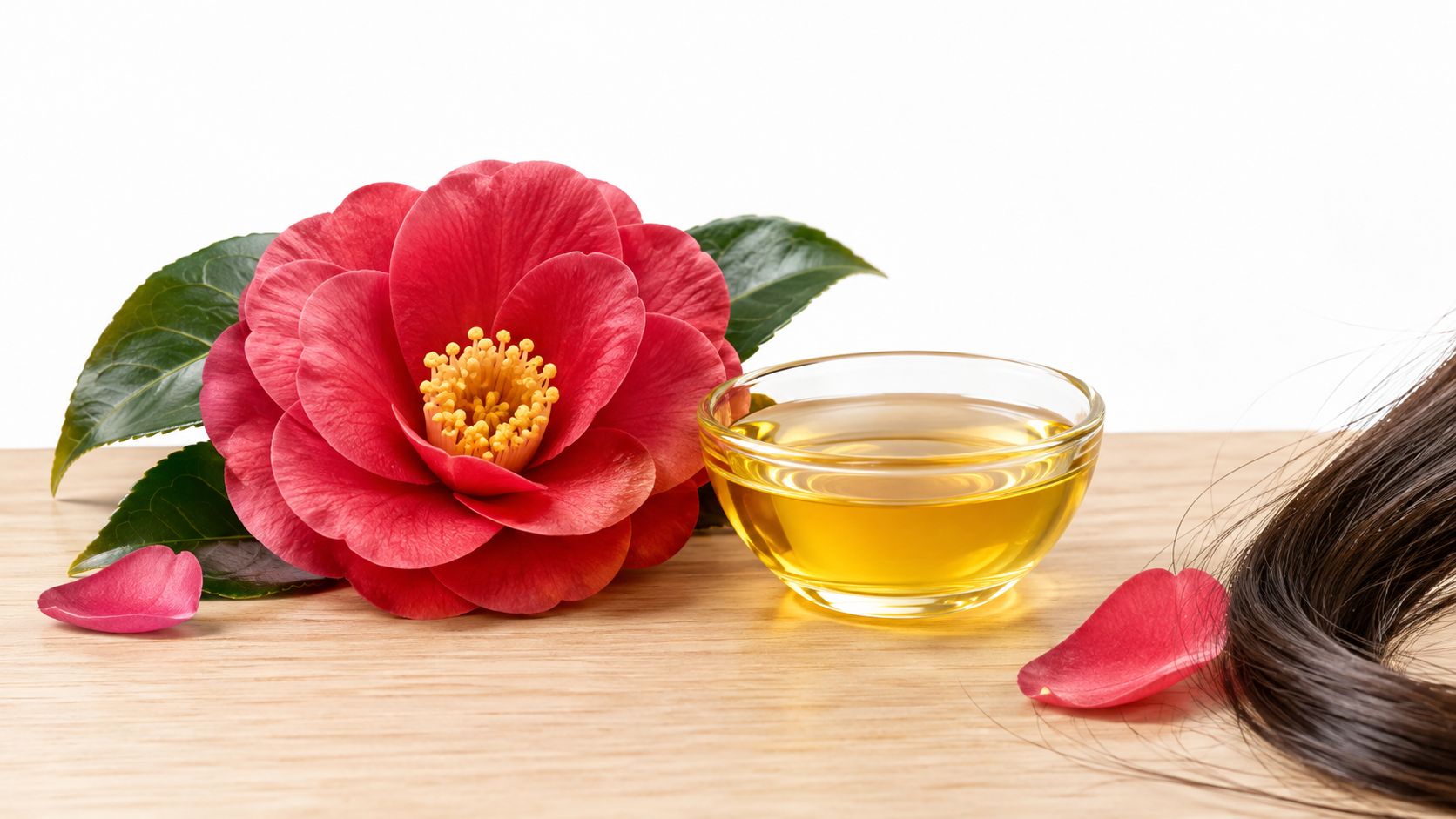
Three Meanings Behind One Word
- The plant: Tsubaki refers first to the camellia plant itself, valued in Japan as an ornamental flower for centuries.
- The seed oil: Tsubaki oil is pressed from camellia seeds, particularly Camellia japonica, and has traditionally been used for hair grooming and other household purposes.
- The product line: Tsubaki is also the name of a Shiseido hair care line, which is a brand identity, not a guarantee that a formula contains only camellia oil.
That distinction matters because a product with tsubaki on the front may contain camellia seed oil, camellia flower extract, a camellia inspired fragrance, or a combination of these with silicones and conditioning polymers. Each ingredient plays a different role. Seed oil mainly works on the surface as an emollient. An extract isn't the same as an oil. Fragrance contributes scent, not conditioning.
Start with this question: Does the label name camellia seed oil as an ingredient, or is tsubaki mainly part of the brand and scent story?
Set your expectation early. Camellia oil is used primarily as an emollient and occlusive layer. It can support moisture retention on the hair surface, reduce static and frizz, and improve how hair feels when you comb it. It isn't presented in the evidence as a treatment that changes hair growth cycles.
That doesn't make it unuseful. Slip, shine, and softer ends are exactly what many people want from a conditioner, mask, or leave in product. The problem starts when surface smoothing is mistaken for rebuilding hair from the inside or solving thinning. Keep those categories separate and you'll judge every tsubaki product more fairly.
A Short History of Tsubaki in Japan
Tsubaki wasn't invented for a modern shampoo aisle. People in Japan admired and cultivated the flower long before it became a beauty label. Understanding that timeline helps explain why the name carries trust today.
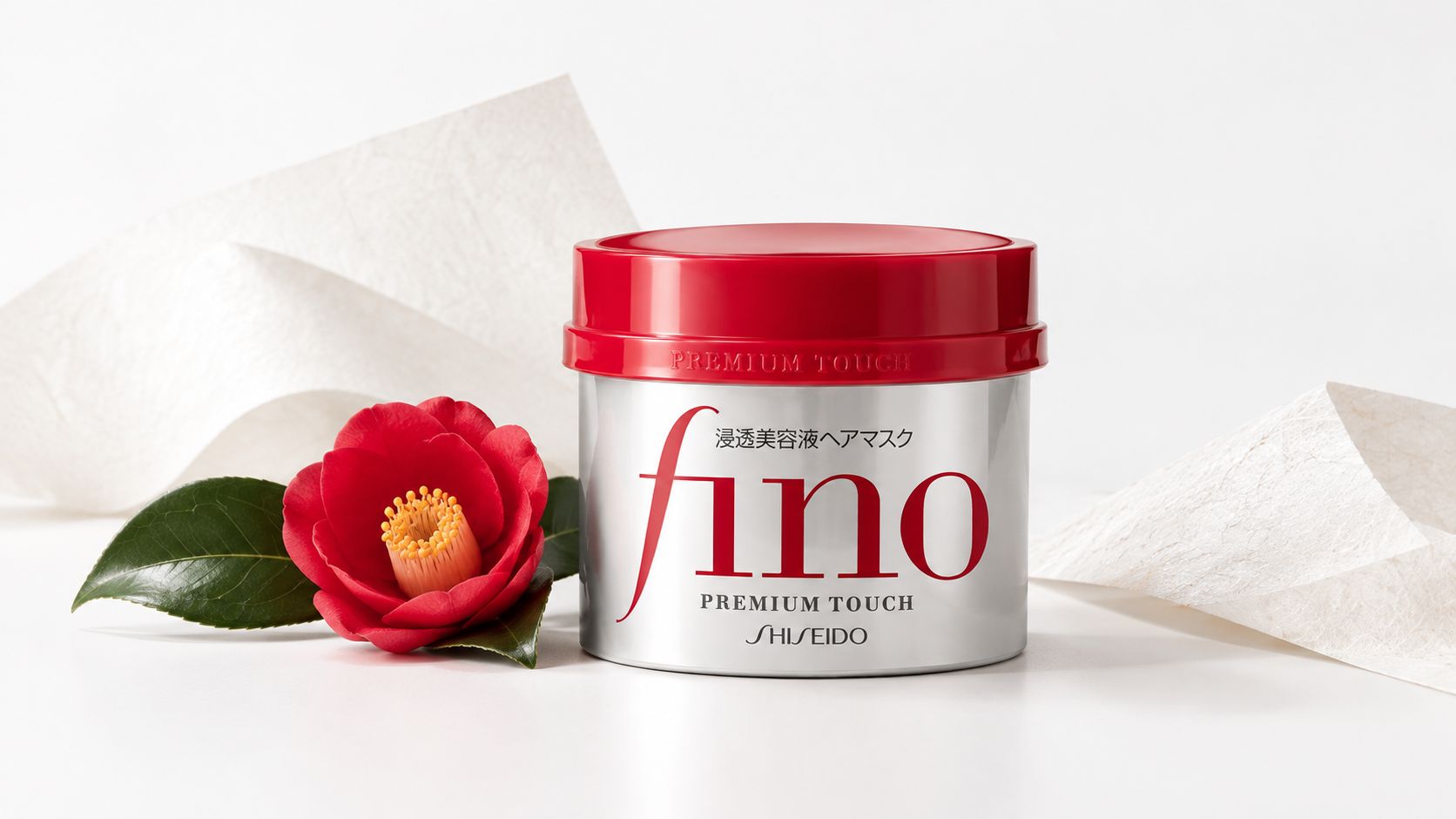
Camellia flower viewing became popular in Japan during the Muromachi period, dated approximately 1392 to 1507, according to National Diet Library material on camellia history in Japan. Interest grew during the Edo period (1603 to 1867), when figures such as Hidetaka Tokugawa at Edo Castle and tea ceremony teacher Oda Urakusai collected and cultivated camellias. By the Genroku era from 1688 to 1704, more than 200 camellia varieties had been recorded.
From Garden Flower to Household Oil
The plant's value didn't stop at decoration. Oil produced from camellia seeds was traditionally used in Japan for hair grooming, skin care, cooking, fuel, and other household purposes, as described in Japan Search material on camellia oil history. Its strongest documented rise in beauty use came during the Edo period, when it became commonly associated with hair care. Historical accounts also describe the fruit as a resource as far back as the Jōmon period, approximately 2,300 years ago, although the scale of early use is difficult to quantify.
One plant therefore supplied several things at once. It gave households an ornamental flower for gardens and tea settings, seeds that could be processed and pressed, and oil that could be filtered for practical use. That multifunctional role is why tsubaki remains recognizable beyond cosmetics.
The story then moved abroad. German physician and naturalist Philipp Franz von Siebold reportedly brought four camellia varieties from Japan to Europe, and the East India Company also helped introduce camellias to European horticulture. Modern references describe several thousand garden varieties worldwide.
So when you see tsubaki on Japanese packaging, you're seeing a name linked to gardening, tea culture, regional resource use, and grooming across centuries. History explains the cultural meaning. It doesn't, by itself, prove what a modern formula will do on your hair.
Why Camellia Oil Works on Hair
Camellia oil suits hair products for a simple physical reason. It spreads easily, adds lubricity, and leaves a smoother surface without feeling like a heavy solid fat. The explanation sits in its fatty acid profile.
Camellia japonica seeds contain approximately 35 to 45% oil, and camellia oil is identified for use in food, hair oil, and ointment bases in material from Japan's National Institute of Health and Nutrition. Its principal fatty acid is oleic acid, a monounsaturated fat that stays fluid at room temperature. That fluidity helps the oil spread across the hair fiber and reduce combing friction.
What the Numbers Actually Show
| Source | Oleic Acid | Other Notable Fatty Acids |
|---|---|---|
| Comparative lipid study of C. japonica seed oils | More than 80% | Lower linoleic acid than Camellia sinensis oils |
| Nagasaki Prefecture agricultural report | Approximately 86% | Not specified in the summary |
| Goto produced camellia oil study | 68.6% | 20.7% linoleic acid and 6.9% palmitic acid |
A comparative study reported more than 80% oleic acid in C. japonica seed oils in research published in the Journal of Oleo Science. A Nagasaki Prefecture report found oleic acid accounts for approximately 86% of camellia oil's fatty acids, as shown in the Nagasaki agricultural research report. Yet Goto produced oil measured 68.6% oleic acid, 20.7% linoleic acid, and 6.9% palmitic acid in a Japanese analysis of Goto camellia oil.
Those figures don't contradict each other. They show that species, cultivar, growing source, extraction, refining, and storage can shift the result. Camellia oil isn't one identical composition in every sample.
At the molecular level, neutral lipids accounted for 88.2% of Camellia japonica oil, while oleic acid represented 86.3% of fatty acids in that fraction, according to a structural analysis of camellia oil lipids. Oleic acid was also high at the sn-2 and sn-3 triglyceride positions, at 93.6% and 94.7% respectively. In plain terms, oleic acid is built into the oil's main structure, not a trace addition.
For you, that supports a modest claim. An oleic rich oil can form a coherent lubricating film over cuticle scales, helping hair feel softer and look glossier. If you're weighing texture and weight, a comparison of Japanese hair milk and hair oil can help you decide which leave in format fits your hair better.
What Tsubaki Can and Cannot Do for Damaged Hair
For bleached or mechanically damaged hair, temporary surface improvement and lasting structural change are different things. A product can make fibers feel smoother without restoring their original strength. The image below shows the kind of rinse-off mask shoppers may expect to do both.
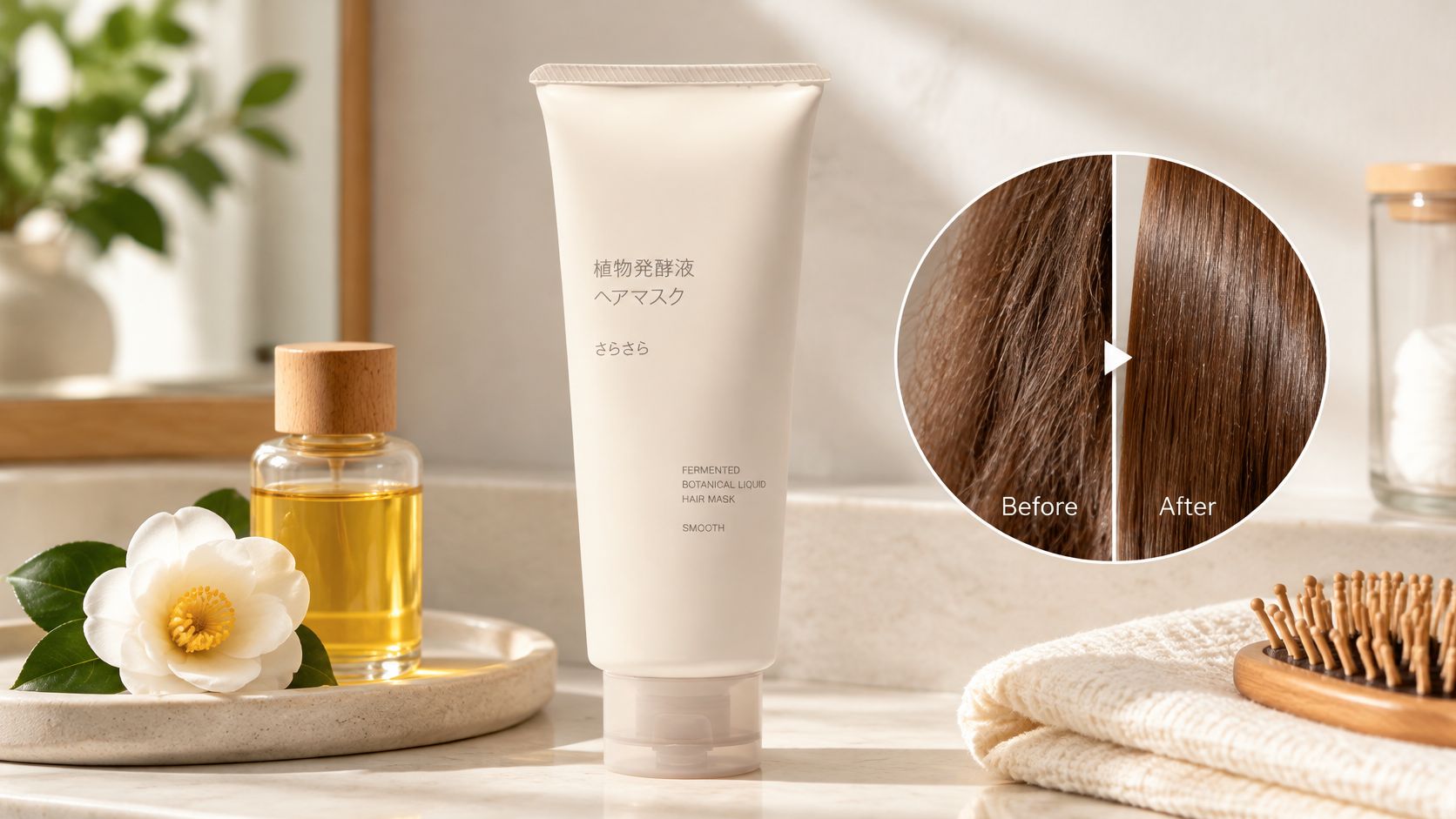
The word tsubaki can mean the camellia plant, its seed oil, or Shiseido's Tsubaki product line. Those meanings are related, but they are not interchangeable. A hair product carrying the Tsubaki name is a finished formula, and its effects depend on its full ingredient blend, not just the plant or oil. Camellia oil may improve how damaged hair looks and feels, but it has not been proven to change hair growth cycles or prevent medically significant hair loss, as described in this medical overview of camellia oil. If thinning is your main concern, a tsubaki shampoo is not a medical treatment.
Temporary Cosmetic Help Versus Structural Change
- Reasonable to expect: Easier combing, less roughness, added gloss, and smoother ends while conditioning effects remain.
- Not reasonable to assume: New hair growth, prevention of medically significant loss, or permanent rebuilding of severely damaged fibers from camellia oil alone.
- Depends on the formula: The feel you get varies with the product's ingredients, how much you use, contact time, and hair porosity.
Research comparing conditioners on bleached hair found that a camellia oil formula helped protect tensile properties, while an argan oil formula had stronger effects on tensile strength and color retention. The comparison is a reminder that “natural” does not automatically mean more effective, and that one oil cannot address every kind of damage.
Watch the application example with contact time in mind. A mask left on the hair has a different chance to condition than shampoo rinsed away soon after application.
A shampoo's main role is cleansing, while a conditioner or mask has more time to leave conditioning ingredients on the hair. A leave-in oil stays until the next wash, so its smoothing effect may be easier to notice. None of these formats should be confused with rebuilding hair from within.
If your hair is bleached, brittle, or breaking, read this guidance on repairing dry and damaged hair alongside product descriptions. Gentler handling, reduced heat, trims, and a broader routine may help more than relying on one ingredient.
How to Read a Tsubaki Ingredient Label
Front labels are designed to be remembered. Ingredient lists tell you what you're buying. Learning a few distinctions will save you from paying for a story when you wanted a specific ingredient.
Step One Identify the Camellia Ingredient
Look for the exact INCI style name. Camellia seed oil means an oil derived from seeds. Camellia flower extract is a different preparation from the flower and shouldn't be treated as interchangeable. Fragrance or parfum may create a camellia scent even when it isn't the ingredient doing the conditioning work.
Position matters, but it isn't the whole story. Ingredients listed earlier are generally present at higher levels than those near the end, yet some conditioning agents work at low levels. What you can't do is infer performance from the front label ingredient alone. Silicones and conditioning polymers in a formula often contribute much of the slip and smoothness you feel, especially in rinse off products.
Step Two Check Fragrance and Sensitivity Clues
Consumers frequently ask whether tsubaki means one standardized ingredient and whether it's suitable for sensitive scalps. It doesn't mean one standardized ingredient across all products. A 2025 scientific review of Camellia japonica in cosmetics reports that C. japonica seed oil showed non toxicity in tested cell models at specified concentrations, and a small 30 person lotion study found short term reduction in transepidermal water loss. The same review emphasizes that evidence is still limited.
Natural doesn't automatically mean risk free. Concentration, formulation, fragrance, and your own sensitivity all matter.
Broader dermatology literature warns that natural ingredients can cause irritation or allergic reactions. That's why patch testing is sensible, particularly if you have a sensitive scalp, a history of fragrance reactions, or you're trying a leave in product. Test a small amount first, follow the product directions, and stop using it if irritation develops.
Step Three Match the Format to the Claim
A gentle, skincare inspired approach to hair care can be useful, but it doesn't prove a traditional ingredient is cleaner or safer by default. Ask what the whole formula is built to do. If you're deciding between two rinse off steps, an explanation of Japanese hair treatment and conditioner differences will help you place the ingredient list in context.
Tsubaki Compared with Other Japanese Hair Care Brands
Japanese drugstore shelves group many repair sounding products together, so brand names alone don't tell you enough. Compare positioning and ingredient focus instead of looking for a single winner. The same brand family may also contain several lines with different formulas.
| Brand | General Positioning | Ingredient Focus | Best Suited To |
|---|---|---|---|
| Tsubaki | Repair oriented care built around camellia identity | Camellia seed oil and conditioning ingredients, varying by line | Shoppers wanting smoothness, shine, and softer feeling lengths |
| Fino | Intensive mask and treatment positioning | Rich conditioning and moisturizing ingredients | Very dry or rough hair that tolerates richer formulas |
| Ichikami | Japanese botanical inspired daily care | Plant inspired positioning with line specific formulas | Shoppers prioritizing gentle feeling daily cleansing and care |
| Salon style finishing lines | Styling and finish focused care | Leave in smoothing and heat styling support ingredients | People whose main concern is manageability after drying |
The Shiseido Fino Hair Mask Treatment 230g illustrates why format matters. Its catalog description lists ingredients including sorbitol, squalane, and royal jelly extract, with emollients and conditioners intended to smooth frizz and support moisture retention. That's a different ingredient story from a camellia led line, even though both sit in Japanese repair oriented care.
Don't compare only by the word repair. A rich mask may suit coarse, very dry hair but feel heavy on fine hair. A lighter camellia led conditioner may preserve movement but provide less intensive coating. Scalp focused or gentle daily lines answer a different need from an ends focused treatment.
Use the table as a starting point, then check the exact line and ingredient list. For a closer look at one botanical positioned alternative, see a guide to Ichikami shampoo by Kracie. Exact formulas and sizes can change, so current product pages and packaging should guide your final choice.
Choosing and Using Tsubaki Products by Hair Type
What does your hair need from a tsubaki product: cleansing, detangling, or a smoother finish? Start with its behavior, not the ingredient name. Fine, bleached, and curly hair can all feel dry, but they may need different product amounts and formats. Porosity also affects how readily hair takes up and loses water and conditioning ingredients.
Match Format to Contact Time
- Shampoo: Choose for cleansing comfort. A brief wash does not provide the same conditioning as a mask.
- Conditioner: Apply to lengths and ends after shampooing for regular detangling and surface smoothness.
- Mask or treatment: Use when hair feels rough or dry, following the stated leave-on time. Longer is not automatically better.
- Leave-in or pure oil: Start with a small amount on mid-lengths and ends. Fine or oily hair usually needs less, and roots often need none.
For fine or oily hair, keep conditioner away from the scalp and rinse well. Too much oil can reduce volume and make strands look separated. For dry or curly hair, focus product on areas that tangle or lose definition, then decide whether a leave-in is needed after rinsing. For bleached hair, gentle detangling can make handling easier, while surface conditioning cannot reverse chemical damage.
If products seem to sit on your hair rather than absorb, this guide to Japanese hair care for low porosity hair offers advice on adjusting how much you apply and how you layer products. If your scalp feels oily while your ends feel dry, cleanse the scalp and condition the lengths. Treating those areas separately is often more practical than expecting one product to meet both needs.
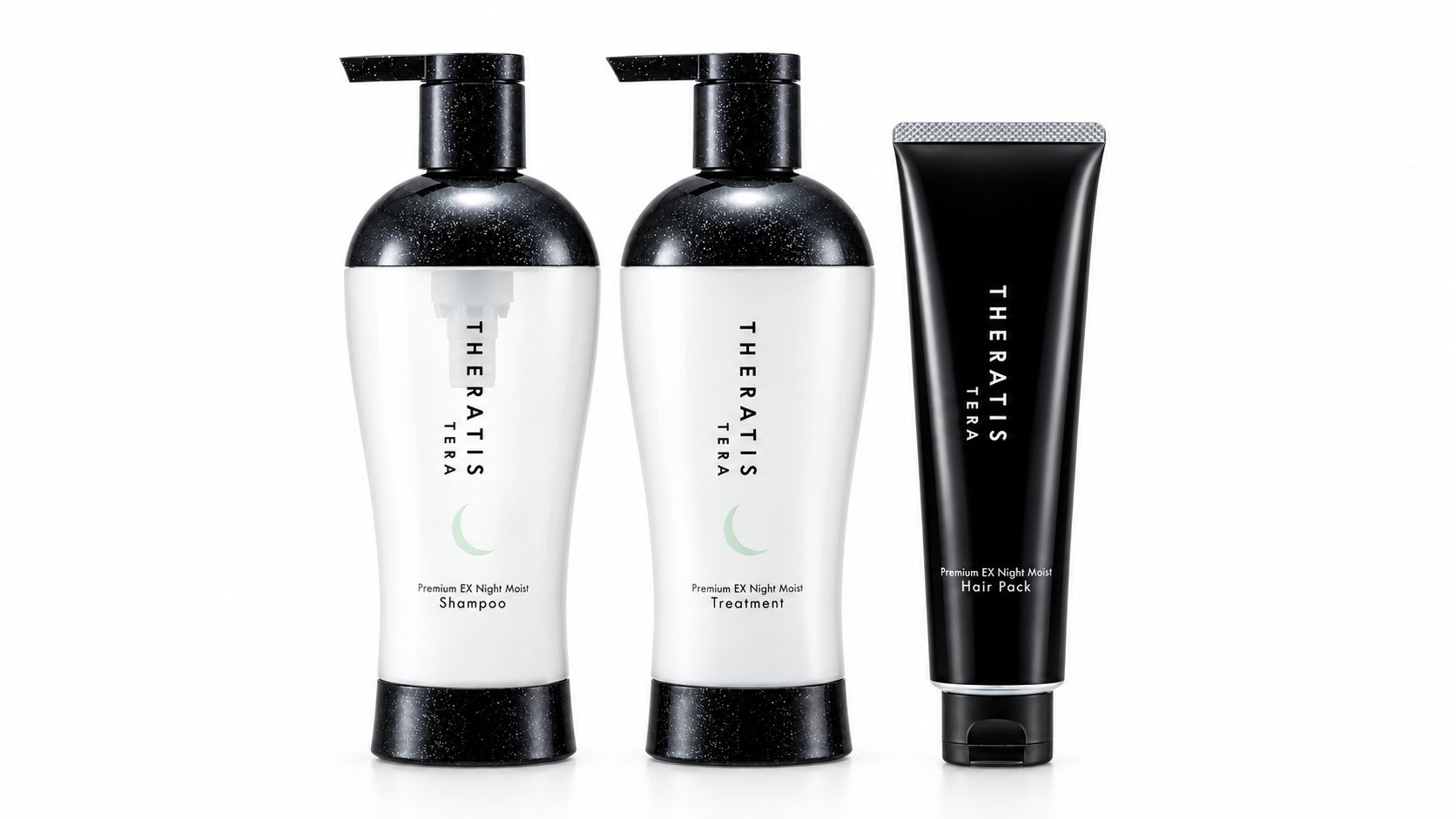
A coordinated routine can include shampoo, treatment, and a mask. The Theratis Tera Premium EX Night Moist Shampoo, Treatment & Hair Mask Set 435ml x2 + 130g is listed in that three-step format, with two 435 ml products and a 130 g mask. Check the ingredient list against your needs: camellia oil can add surface slip and shine, while those cosmetic effects are different from structural repair or hair regrowth.
Practical rule: Change one step at a time. You can then tell whether the shampoo, mask, or leave-in affected how your hair feels.
For thinning hair, choose products for cosmetic manageability and scalp comfort, not as a way to encourage regrowth. Avoid heavy application at the roots if it makes hair look flatter. Follow the current packaging directions, since leave-on times and frequency vary by formula.
Where to Buy Authentic Tsubaki Products
Before buying, revisit three points. Tsubaki can mean the plant, the seed oil, or a product line. Camellia oil's clearest cosmetic role is surface conditioning, slip, and shine. The ingredient list tells you more than the front label.
When shopping from outside Japan, look for clear product information, sourcing through official suppliers in Japan, tracked shipping, secure payments, and helpful customer service. Buy Me Japan presents itself as a Japanese online store making authentic Japanese products accessible through a convenient and reliable shopping experience. Start with one tsubaki product that matches your hair type, check the current packaging and ingredient label on arrival, and patch test before regular use.
Explore authentic Japanese hair care, including tsubaki products and other Japanese beauty essentials, with sourcing through official suppliers in Japan, tracked shipping, and secure payments. Visit Buy Me Japan to compare current lines and choose one product that fits your hair type and routine.

Share:
Senka Perfect Whip: Skincare Benefits and Usage Tips