


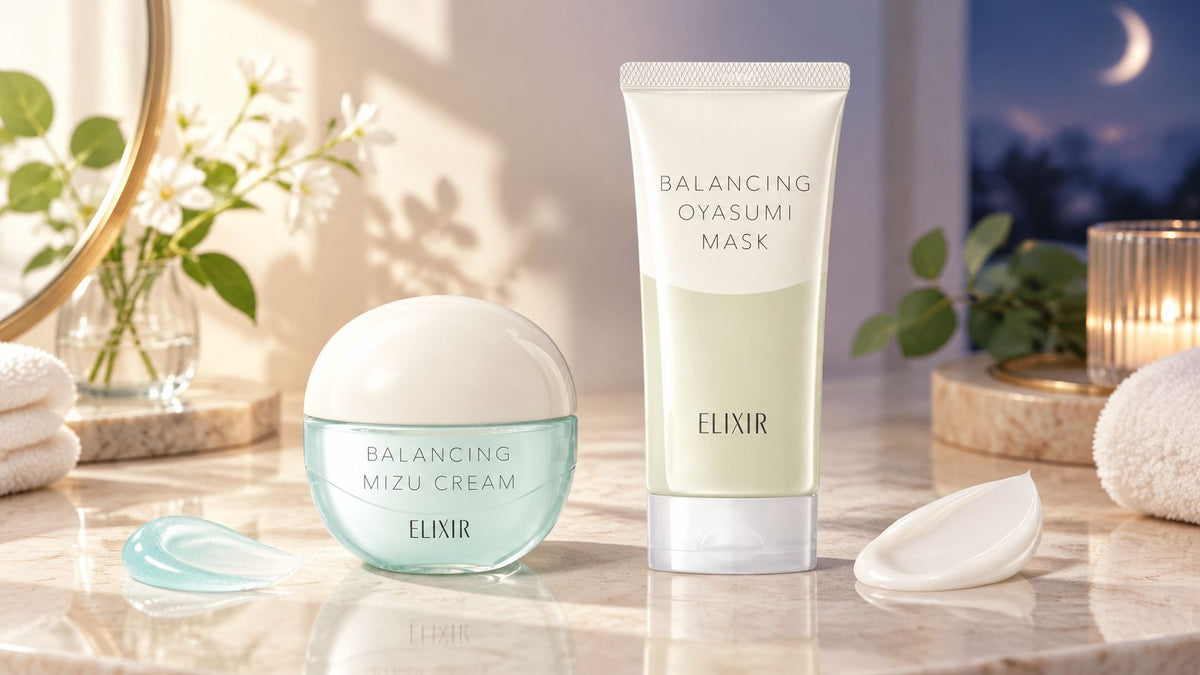
You're looking at two Japanese skincare jars from the same Shiseido line, both sitting in the moisturizing aisle, and both promising soft skin by morning. One is a daily cream you'd smooth on before sunscreen; the other is a leave-on sleeping gel meant to coat your face while you rest. When comparing Elixir Mizu Cream vs Oyasumi Sleeping Mask, choosing a format gets much simpler once you stop asking which jar is "stronger" and start looking at how each layer behaves on your skin overnight.
In Japan's beauty market, overnight masks aren't treated as automatic replacements for regular moisturizers. According to an IndexBox Japan beauty face-mask market analysis, sheet masks represent roughly 55 to 65% of unit volume and wash-off clay and cream masks make up 20 to 25%, while overnight sleeping masks sit in a distinct 10 to 15% niche tied closely to moisturizing and anti-aging routines. Shoppers there choose them for specific texture and hydration roles rather than brand hype.
I've tested both leave-on creams and overnight gel masks across humid summers and dry heated winters, and the divide comes down to overnight mechanics, skin tolerability, and what hydration evidence supports. Separating measurable moisture retention from unproven repair promises helps you pick the jar you'll finish.
Side-by-Side Differences at a Glance
| Feature | Elixir Mizu Cream | Oyasumi Sleeping Mask |
|---|---|---|
| Format | Leave-on cream step | Leave-on overnight mask, applied as the final night step |
| Listed size | Mizu Cream's size is not verified in the sources used here, so compare the box and product page before assuming parity | 90 g |
| Texture | Cream | Fresh, watery gel |
| Application amount | Two pearl-sized portions over the whole face | Circle about 2 cm in diameter in the palm, spread across the face without fully rubbing in |
| Routine timing | Morning and evening, after lotion and any emulsion | End of nighttime skincare, 2 to 3 times weekly or nightly |
| Base ingredients | Mizu Cream's full base ingredient list is not verified in the sources used here | Water, dipropylene glycol, butylene glycol, glycerin, sodium PCA, soluble collagen |
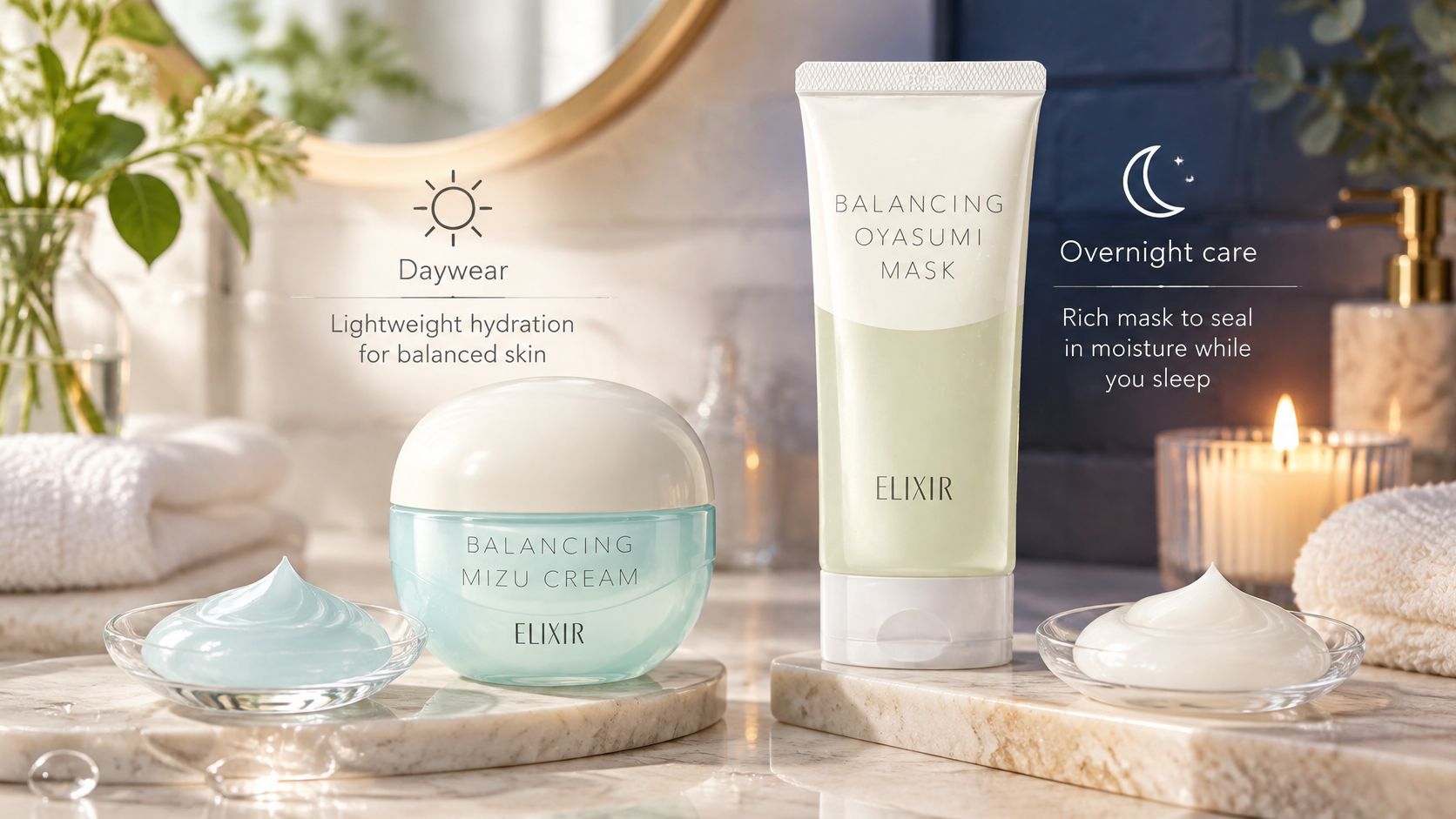
The practical split is visible before any ingredient discussion. Shiseido's official ELIXIR Reflet Balancing Mizu Cream instructions describe two pearl-sized portions used morning and evening, after kesho-sui, a Japanese hydrating lotion similar to a watery toner, and after any nyueki, or milky emulsion. That makes Mizu Cream a routine builder. It has a set place in both daytime and nighttime layering, where texture has to sit comfortably under sunscreen or makeup.
The Shiseido Elixir Balancing Oyasumi Sleeping Mask 90g is a 90 g leave-on gel mask for bedtime. Its base is water-forward, with water, dipropylene glycol, butylene glycol, and glycerin, followed by sodium PCA and soluble collagen, plus peach-seed, turmeric-root, saxifraga, and green-tea extracts, fragrance, and preservatives. In practice, that light gel start matters. The mask is spread over the face and left resting on the surface, so the layer behavior depends more on film-forming and reduced evaporation than on a rich cream feel.
The size row needs care. Oyasumi has a verified 90 g listing in the product record linked here. Mizu Cream's size is not verified in the sources used here, so this comparison should not treat the two jars as equal or assume a ratio. For buying decisions, that matters because price per use, how long a jar lasts, and how generous a two-pearl application feels all depend on the actual listed size on the box or product page.
Why Elixir Enriched Cream Is a Separate Product
Shoppers searching the Elixir range may see Elixir Enriched Cream and assume it is another name for Mizu Cream. It is a separate concentrated cream, positioned for daily moisturizing and firmness care. Its emollient build includes cetyl ethylhexanoate, cetearyl alcohol, triglycerides, macadamia-derived phytosterol ester, glyceryl stearate, and dimethicone, which gives it a richer profile than a watery gel mask.
That separation matters because borrowing specifications across Elixir products makes the comparison less useful. A dense daily cream and a bedtime gel mask solve different problems, even when the line name looks familiar. Mizu Cream belongs in the twice-daily cream step, Oyasumi works as an overnight final layer, and Enriched Cream should be assessed on its own terms rather than folded into either choice.
How Each Format Works and Which Suits Your Skin
Think of overnight hydration like simmering soup in a kitchen pot. A standard cream blends water-attracting humectants with oils and film-formers so it absorbs evenly and sits comfortably beneath sunscreen or makeup. An occlusive overnight layer acts more like putting a lid over that pot, slowing evaporation rather than pouring extra water into the skin itself.
Let's look at the two formats side by side to see how their textures reflect these different roles on a bathroom vanity.
Skin loses moisture overnight through transepidermal water loss (TEWL), which is the steady escape of water vapor from the deeper layers through the outer barrier into dry room air. As outlined in a sleeping-mask formulation analysis on occlusive hydration, occlusive materials such as petrolatum, dimethicone, squalane, and waxes reduce TEWL by slowing that vapor escape rather than adding water directly to the stratum corneum.
That simple physics rule dictates how you layer. Occlusion works best when water or humectants are already sitting on your face. Putting a sleeping mask over bare, dry skin traps very little moisture; applying it as the final evening step over a watery toner, serum, or light moisturizer helps hold that water in place for several hours. If you're unsure how Japanese hydrating layers stack underneath a cream or mask, our Japanese lotion, milk, and cream routine guide breaks down the exact order.
Matching Your Skin Situation to the Right Format
Because skin tolerance varies wildly, format choice should start with how your face feels after cleansing and upon waking. Use the guide below to match your current skin condition to the safer starting format.
| Skin situation | Format that usually fits better | Reason | Precaution |
|---|---|---|---|
| Dry or tight after cleansing | Sleeping mask layered over a moisturizer | Occlusion slows water loss when water is already on the skin | Start 2 to 3 nights a week and watch morning comfort |
| Oily or congestion-prone | Lighter cream | Less occlusion, easier to control | Watch for new congestion or shine by morning |
| Sensitive or reactive | Neither assumed; test first | Richer films can irritate some users | Patch test each product before whole-face use |
| Heat-sensitive | Lighter cream | Richer film can feel warm overnight | Stop and reassess if discomfort appears |
Here's the practical logic behind each row:
- Dry or tight skin: Layering a sleeping mask over a water-based serum or daily cream slows overnight evaporation when indoor air pulls moisture out of your cheeks.
- Oily or congestion-prone skin: A lighter leave-on cream gives you predictable, adjustable dosing because heavier occlusion can feel greasy and raise the risk of follicular buildup in susceptible pores.
- Sensitive or reactive skin: Neither format gets a free pass, since any prolonged film can trap irritants or trigger redness on a stressed barrier.
- Heat-sensitive skin: A lingering overnight coating can trap warmth against flushed cheeks, making a breathable cream far more comfortable through the night.
Clinical reporting in Dermatology Times commentary on overnight masks underscores that purpose-formulated sleeping masks aren't interchangeable with ordinary moisturizers or standard sheet masks. Products designed to stay on for seven or eight hours need textures suited to prolonged contact, because unsuitable occlusion or excessive wear can aggravate irritation and weaken barrier comfort. For broader context on how wash-off, sheet, and leave-on categories fit different goals, Nueva Life outlines the general benefits of using facial masks across routine types.
Patch-test rule: Apply a small dab of either product behind the ear or along one side of your jawline for several nights before coating your entire face. If stinging, redness, itching, or new breakouts appear, stop using the product and consult a dermatologist.
To see how a leave-on Japanese sleeping gel behaves in real texture terms before deciding, watch this short application walkthrough.
Keep one final reality check in mind when shopping. Words like "cream" and "sleeping mask" describe delivery formats, not guaranteed ingredient concentrations or clinical outcomes. The Japanese ingredient label on the box remains your final check for fragrance, botanical extracts, or oils your skin might dislike.
How to Apply Each Format in Your Routine
Even a well-matched formula underperforms if you apply it like the wrong category. The biggest difference between these two jars isn't just when you open them, it's how completely you rub them in.
Nighttime Steps for the Oyasumi Sleeping Mask
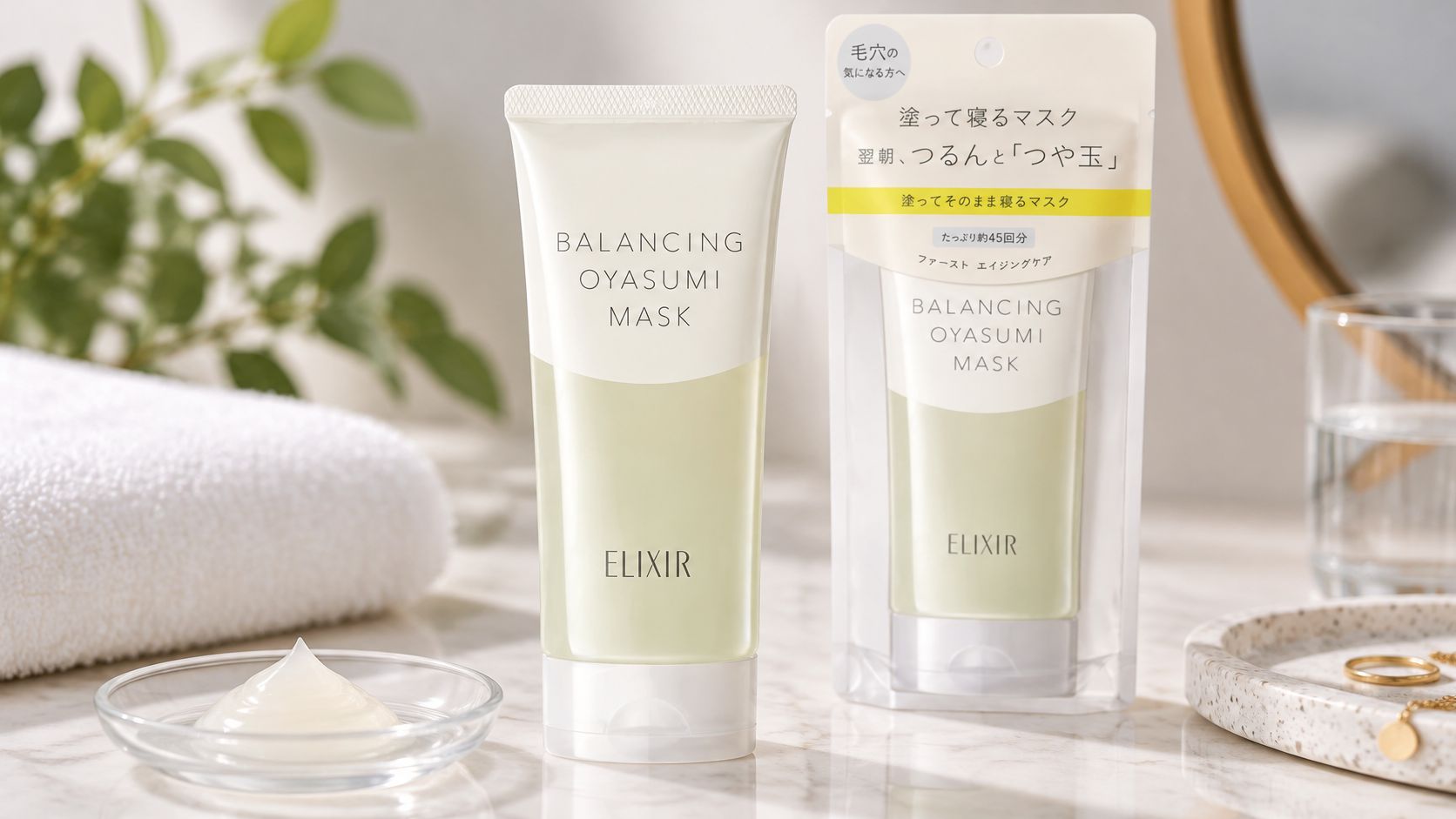
Following Shiseido's official ELIXIR Reflet Balancing Oyasumi Sleeping Mask instructions, treat this gel as the absolute final step of your evening skincare.
- Finish cleansing and apply your usual hydrating lotion. Putting watery hydration down first gives the overnight gel moisture to hold in place. If you also layer a targeted treatment beforehand, following proper serum steps for fading dark spots from Mesoderm RX keeps thin actives absorbing smoothly before a gel film seals them in.
- Scoop a circle roughly 2 cm in diameter into your palm. Using a measured dose stops you from under-applying a patchy layer or overloading your face with excess gel.
- Massage the gel in small circular motions over areas where pores concern you. Working across the nose, chin, and inner cheeks first distributes the fresh gel evenly over uneven texture.
- Spread the remaining product across your whole face without fully rubbing it in. Stopping short of full absorption leaves the intended mask-like film resting on the surface rather than breaking down the gel matrix.
- Wait without touching your face while the gel settles. As noted on Shiseido's official ELIXIR Oyasumi Mask product page, the time required for the gel to feel familiar on your skin varies by individual, so don't expect a fixed minute-by-minute countdown before lying down.
- Sleep with the coating on, aiming for 2 to 3 nights per week at first. Shiseido specifies two to three evenings weekly as the standard cadence, while noting nightly use is acceptable if your skin tolerates it comfortably.
Two common slips ruin the experience right away. Rubbing the sleeping mask all the way in like a daytime moisturizer defeats the point of its surface layer. Going heavy-handed beyond the 2 cm guide also raises the odds of sticky transfer onto your pillowcase without delivering extra morning softness. For extra troubleshooting on layering and timing before bed, check our practical guide on how to use a sleeping mask.
Morning and Evening Steps for Elixir Mizu Cream
Mizu Cream follows a more traditional Japanese skincare sequence built for repeatable daily wear.
- Apply hydrating lotion over freshly cleansed skin. This restores immediate surface water after washing.
- Smooth on any milky emulsion next, then follow with Mizu Cream. Placing the cream after emulsion follows Shiseido's intended order so lighter fluid layers absorb first.
- Measure two pearl-sized portions and blend evenly over your entire face. Unlike the sleeping mask, you work this cream cleanly into the skin so sunscreen or makeup won't pill on top.
- Repeat the same step morning and night. Consistent twice-daily dosing keeps your baseline hydration steady without switching textures between weekdays.
Give whichever routine you pick a strict one-week check. After seven mornings, inspect your skin in natural light before washing: does it feel calm and supple, or are you noticing new T-zone shine, itchy patches, or tiny clogged bumps? Your skin's morning feedback tells you far more than the jar description.
What Hydration Studies Can and Cannot Prove
Marketing language around overnight masks often mixes two outcomes that should stay separate: water held in the outer skin layer, and deeper repair that may or may not follow. For Elixir Mizu Cream versus Oyasumi Sleeping Mask, the useful question is mechanical. Does the format reduce overnight moisture loss, or does it leave a richer film on the surface?
The clearest technical benchmark is short-term TEWL suppression set against long-term tolerability and usability. A sleeping-mask clinical evidence summary notes that highly occlusive sleeping masks can produce larger immediate drops in water loss than non-occlusive gel moisturizers, while sustained hydration and barrier-recovery gains are often modest. The same summary cites a four-week comparison in which a petrolatum-based sleeping mask delivered roughly 7.3% greater hydration improvement than a non-occlusive ceramide moisturizer, with no meaningful difference in subjective plumpness or tape-stripping barrier-recovery speed.
That figure has firm limits. The four-week comparison tested a petrolatum-based sleeping mask against a non-occlusive ceramide moisturizer, not Elixir Mizu Cream or Oyasumi Sleeping Mask. It also measured one formula under study conditions, so the 7.3% result cannot be transferred to a water-and-glycol gel mask as a predicted outcome.
Hydration Retention Versus Regeneration Claims
Independent evidence reviews draw a similar line between moisture retention and cellular renewal. A Cosmenia review of sleeping-mask versus night-cream evidence reports that sleeping masks reliably reduce water loss and raise surface hydration through occlusion, yet finds no clear proof that they outperform a well-formulated night cream in broader skin repair outcomes. Even where a review mentions "sleep-focused beauty" as a projected Japanese beauty trend keyword for 2026, a retail trend label remains a market signal, not clinical evidence of faster regeneration.
A sleeping mask earns its place on your nightstand when overnight moisture loss is your main problem, not when you're hoping for deeper repair than a solid daily moisturizer can deliver.
Tolerability matters as much as the hydration number. The Cosmenia review of sleeping-mask versus night-cream evidence connects heavier petrolatum-based sleeping masks with a higher risk of follicular plugging in some populations. That does not make every overnight mask a pore-clogging product, but it does argue against treating occlusion as harmless by default. Oyasumi's ingredient list opens with water and glycols rather than petrolatum, so it should be judged on its own label and on how your pores respond.
Humectant behavior is another reason to separate water delivery from sealing. If your skin feels tight even under a creamy surface layer, a hyaluronic moisture boost serum addresses the water-binding step directly, while a sleeping mask mainly changes what happens to that water overnight. This distinction is practical: humectants draw and hold water in the skin's surface layers; occlusive films slow its escape. They solve different parts of the same problem.
Before choosing either jar, identify the outcome your skin needs most: measurable overnight moisture retention, weightless daytime-to-nighttime comfort, or predictable pore tolerability. Mizu Cream fits the case where repeatable comfort across morning and night matters more than a sealing step. Oyasumi fits the case where a bedtime film is acceptable and overnight moisture escape is the target. Neither format has evidence here for deeper repair beyond what a well-formulated daily moisturizer can already provide.
Routine Fit, Climate and Value per Use
A gel that feels perfect on a heated winter night can sit untouched once humid weather arrives. How often you reach for a jar, the air in your bedroom, and how a texture behaves under morning sunscreen decide which product earns its shelf space, so judge both formats by the routine you keep rather than the one you plan to start.
Three Real-World Factors That Decide Which Jar Gets Used
- Routine fit across morning and night: A cream slides cleanly into a multi-step morning sequence beneath sunscreen and foundation, whereas the Oyasumi Sleeping Mask is strictly a night-only final coating you won't wear out the door. That difference matters more than it first appears, because a product with only one daily slot depends entirely on how faithfully you keep that slot.
- Climate and bedroom air: Dry winter heating and overnight air conditioning are the clearest triggers for adding a sealing bedtime gel, while warm, humid nights often make a lingering layer feel clammy. If your skin swings between tight and shiny with seasonal weather, our practical guide on how to treat dehydrated skin explains how to balance watery hydration with barrier protection.
- Skin that changes with the seasons: Combination skin often needs a sealing layer only part of the year. If your cheeks feel tight in January but your T-zone turns shiny by June, a fixed single-jar routine will fit badly for months at a time, and rotating formats with the weather suits you better.
Value per use is arithmetic, and I'd run the numbers before comparing shelf prices. A sleeping mask applied two or three nights a week delivers roughly 8 to 13 applications a month, while a twice-daily cream delivers around 60. The jar that looks more expensive upfront can easily cost less per application, and the jar used sparingly can stretch across many months even at a higher cost per night. Divide the price on each product page by the number of applications you expect from it, because a bargain jar you abandon half-finished is the most expensive outcome of all.
You also don't have to treat this as an either-or decision all year long. Many routines work best by keeping a dependable cream as the everyday base and bringing in an overnight gel only when seasonal dryness demands it.
A Quick Format Decision Checklist
- Anchor with Mizu Cream if you prefer one moisturizer that handles both morning sunscreen layering and simple nightly care without a second jar.
- Rotate by season if heated winter air leaves you tight but summer humidity leaves you shiny, keeping the cream year-round and the gel as a cold-weather addition.
- Skip the overnight gel in humid climates if warm nights already have you waking up oily or congested, and reconsider the format when autumn air dries out.
- Commit to a single jar if your routine is minimal, since a night-only product you reach for a few times a week is far easier to abandon than a cream you use morning and night.
Confirm the Format Before You Buy
Smart Japanese skincare shopping takes two minutes of verification before checkout. Because packaging updates, regional labels, and stock levels change over time, run through these four quick checks before committing to either jar.
Four Checks Before Adding a Jar to Your Cart
- Pick the format that matches your routine and skin behavior first. Decide whether you need a flexible morning-and-night cream or a dedicated final bedtime layer, and if you're still weighing rinse-off or sheet formats alongside leave-on jars, our Japanese mask comparison guide shows where other mask types fit cleanly.
- Read the current packaging and Japanese ingredient list. Brands periodically tweak formulas, fragrance levels, or container weights, making the physical box label the final authority on what touches your face.
- Confirm which product line you're buying. Shiseido Elixir and similar lines carry multiple creams and gels under nearly identical names, so match the exact product title and container size on the listing to the format you decided on before anything goes into your cart.
- Verify live availability directly on the product page before building your routine. Don't assume every variant is always in stock; check current details on the Oyasumi Sleeping Mask product page before placing an order.
One habit worth building here: save the product page or note the exact listing name after your first purchase. When a jar runs empty months later, reordering the identical item takes seconds instead of a fresh round of label detective work, and you're far less likely to grab a lookalike product from the same line by mistake.
If you're ordering for the first time, first-time shoppers who sign up get a 10% off coupon, which softens the cost of trying a format you're not yet sure about.
The format you choose changes overnight skin behavior far more than the brand name printed on the lid. Select a daily cream or a leave-on sleeping mask based on your skin condition, room climate, and layering routine rather than unproven repair claims. When you're ready to compare authentic Japanese skincare formats at your own pace, take a look through the full Buy Me Japan product catalog.
If you're building a dependable Japanese skincare routine from home, Buy Me Japan brings together Japanese moisturizers, overnight masks, and daily essentials from brands like Shiseido Elixir. You can browse live product listings with secure checkout, flat and free shipping options, and a 10% discount on your first order when you sign up. Explore the storefront to find the format that fits your skin and routine best.
Share:
Canmake Quick Lash Curler: Application and Remover Instructions