


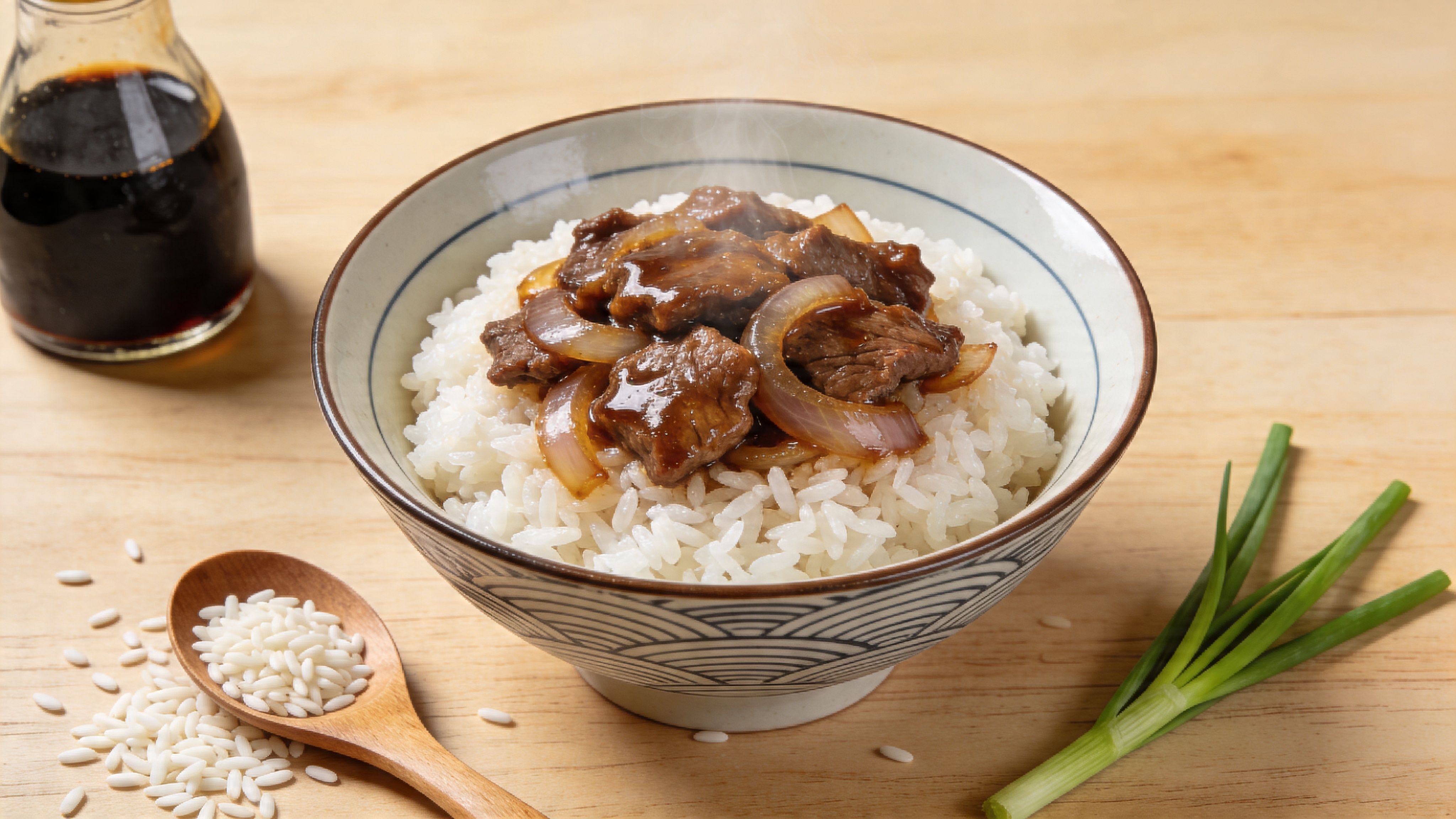
TL;DR: Donburi is a fundamental Japanese rice bowl dish featuring a bed of steamed rice topped with a wide variety of simmered meat, fish, vegetables, or other ingredients. It became popular in the Edo period (1603–1868) as a practical meal in Tokyo, and the classic donburi bowl is typically about 15 cm wide and 8–10 cm deep.
You may be here because you saw “donburi” on a menu and paused for a second. Is it a type of bowl, a style of meal, or a specific recipe?
The short answer is that it’s both simple and deeply Japanese. Donburi is one of the easiest ways to understand everyday Japanese food because it brings comfort, convenience, and flavor together in one bowl.
Your Introduction to the World of Donburi
If you're wondering what is donburi, think of it as Japan’s answer to the perfect all-in-one meal. You get warm rice on the bottom, a flavorful topping on top, and a sauce that ties everything together.
That sounds simple, but donburi is more than “rice with stuff on it.” The balance matters. The rice shouldn’t feel plain. The topping shouldn’t sit on top like an afterthought. The sauce should seep into the rice just enough so every bite tastes complete.
For travelers, donburi is often one of the most welcoming Japanese dishes to try first. It’s familiar in structure, easy to eat, and available in many forms, from beef and egg bowls to tempura and eel.
Why people get confused
Many first-time diners mix up donburi with a regular bowl of rice. In Japanese meals, plain rice is often served separately as one part of a set meal. Donburi is different because the rice and topping are served together as one finished dish.
A quick way to remember it:
- Plain rice bowl: rice is a side
- Donburi: rice is the base of the whole meal
- Main idea: you’re meant to eat the topping and rice together
Donburi feels casual, but it carries the same care for balance that you see across Japanese cooking.
Once you know that, menus become much easier to read. When you see names ending in “-don,” you’re usually looking at a type of donburi.
The Rich History of Donburi From Street Food to Staple
Donburi didn’t begin as luxury food. It began as practical food.
During the Edo period (1603–1868), donburi grew as a street food in Tokyo, where people needed quick, filling meals in a busy city. One account explains that the first recorded donburi was unagi don, or eel over rice, created when a theater owner asked for eel to be served over hot rice in a covered bowl so it would stay warm during long kabuki performances, a style formalized in the Bunka era (1804–1818) (Wagaya Atlanta’s history of donburi).
Why the format worked
A bowl was practical. It kept food warm, made serving easier, and turned rice and topping into one portable meal.
That made donburi ideal for workers, merchants, and theatergoers. Instead of sitting down to several dishes, people could eat something hearty and satisfying in a compact form.
How the dish evolved
Over time, the idea expanded. Once cooks saw how well sauce, rice, and toppings worked in one bowl, they started building new versions around local tastes and changing ingredients.
A few broad shifts shaped donburi’s identity:
- Street food roots: fast, affordable, warming
- Restaurant adoption: more specialized bowls with distinct toppings
- Home cooking appeal: easy to make, easy to eat, easy to love
There’s also an older background to the idea. Some histories trace a predecessor to the Muromachi period (1336–1573) in a temple dish called houhan, where rice was combined with vegetables and broth. That helps explain why donburi feels so natural in Japanese food culture. It didn’t appear from nowhere. It developed from an older habit of combining rice with flavorful toppings.
What makes this history memorable is that donburi still feels like it was designed for real life. Even today, that original purpose remains clear. One bowl. Full meal. Very little fuss.
Deconstructing the Perfect Donburi Bowl
A good donburi works because three parts support each other: the rice, the topping, and the sauce. If one part is weak, the whole bowl feels flat.
The bowl itself matters
The bowl isn’t just a container. A typical donburi bowl has a diameter of about 15 cm and a depth of 8–10 cm, a shape designed to hold roughly 150–200g of rice while helping sauce settle into the bowl without spilling. Kikkoman also notes that the classic sauce base is often built around a 3–4:1:1 ratio of dashi:soy:mirin (Kikkoman’s donburi glossary).

That’s why donburi feels different from eating toppings on a flat plate. The depth helps the rice stay warm and lets the flavor move downward, not just sit on top.
The three building blocks
Here’s the easiest way to understand a donburi bowl:
- Rice first: short-grain Japanese rice gives the bowl its soft, slightly sticky base
- Topping second: this can be beef, chicken, egg, tempura, eel, tofu, or seafood
- Sauce last: usually savory with some sweetness, so the rice absorbs flavor without becoming soupy
A beginner mistake is treating the rice like filler. In donburi, the rice is active. It catches the sauce, balances saltiness, and softens stronger flavors.
Why the harmony matters
Think of donburi like a layered song. The rice is the steady rhythm. The topping is the melody. The sauce is what makes the whole thing feel connected.
Small extras can change the bowl too. A sprinkle of seaweed seasoning, green onion, or sesame can add contrast. If you want a simple example of how rice toppings change the final flavor, this guide to nori komi furikake is a useful companion.
Practical rule: In a good donburi, you shouldn’t have to “fix” each bite. The bowl should already be balanced.
A Guide to the Most Popular Donburi Varieties
Once you know the base idea, the names become much easier to follow. Most donburi types are named after the topping.
The Meiji period (1868–1912) changed donburi in a major way because the end of the beef ban helped lead to gyudon, while katsudon, invented in 1913, became famous partly because “katsu” sounds like the Japanese word for “victory” (history of donburi at DON SG).
Common Donburi Types at a Glance
| Name | Main Topping | Flavor Profile | Best For |
|---|---|---|---|
| Gyudon | Thinly sliced beef and onion | Savory, lightly sweet, soft | People who like comforting beef dishes |
| Oyakodon | Chicken and egg | Gentle, silky, home-style | Anyone who wants a softer, cozy bowl |
| Katsudon | Breaded pork cutlet, egg, onion | Rich, hearty, crisp-meets-tender | Big appetites and comfort food lovers |
| Tendon | Tempura seafood or vegetables | Crisp, lightly sauced, satisfying | Fans of fried textures |
| Unadon | Grilled eel | Sweet-savory, glossy, deeper flavor | Diners who want a classic traditional bowl |
How to choose your first donburi
If you like familiar flavors, start with gyudon. It’s one of the easiest bowls for newcomers because beef, onion, and sweet-savory sauce feel approachable.
If you want something softer and more home-cooked, choose oyakodon. The egg binds the bowl together and gives it a gentle texture.
If texture matters most, katsudon and tendon are strong choices. One gives you fried pork cutlet, the other gives you tempura.
For seafood lovers, tuna bowls and other fish rice bowls are also worth exploring. If that sounds appealing, this overview of what is maguro helps make tuna terminology much less confusing.
A useful menu tip
When you see “-don” at the end of a dish name, read the first part as the clue. “Gyu” points to beef. “Katsu” points to cutlet. “Una” points to eel.
That small trick makes Japanese menus feel much more friendly.
How to Enjoy Donburi Like a Local
Donburi is relaxed food, so you don’t need to worry about strict etiquette. Still, a few habits can make the experience feel more natural.
First, try to eat the rice and topping together. Don’t finish all the topping first and leave a bowl of plain rice behind. The dish was designed as a combined bite.
Simple etiquette that helps
- Use chopsticks if you can: that’s the traditional way, though a spoon is also fine
- Keep the bowl close: many people lift it slightly or hold it near the table while eating
- Appreciate the lid if there is one: it helps keep the meal warm and adds a sense of presentation
Donburi also suits quick meals, which is one reason it feels so approachable. In that way, it shares some of the fun, everyday spirit found in other Japanese food experiences, even fizzy drink rituals like how to open a Ramune.
Eat across the bowl, not in neat sections. That’s how the flavors stay balanced from first bite to last.
If you’re in a restaurant, a side of pickles or soup may appear. Enjoy them between bites, but keep the bowl itself as the center of the meal.
Essential Ingredients for Authentic Donburi at Home
Making donburi at home is much easier than many people expect. Once you have the core pantry items, you can create several styles without learning a long list of complicated techniques.

The pantry basics
For a classic donburi flavor, focus on these essentials:
- Japanese soy sauce: brands like Kikkoman are widely used for the savory backbone
- Dashi stock or dashi powder: Ajinomoto products can help create a fast, reliable base
- Mirin or a similar sweet cooking seasoning: this rounds out the sauce
- Short-grain Japanese rice: the texture matters more than many beginners realize
- Optional finishing touches: Kewpie mayo, furikake, seaweed, or pickled garnishes depending on the bowl
If you’re building a donburi pantry, a practical place to start is this guide to Japanese cooking sauce, which breaks down the sauces people often confuse.
Why authentic ingredients change the result
The difference usually isn’t complexity. It’s balance.
Japanese soy sauce, dashi, and mirin are designed to work together in a very specific way. When one element is replaced with a sharper or flatter substitute, the bowl can still taste good, but it won’t have the same rounded flavor that makes donburi feel complete.
If you want to better understand how alcohol is used in Japanese cooking, this explanation of Japanese sake for cooking adds helpful context.
A short visual guide can make the process feel less abstract:
Easy ingredient pairings for beginners
You don’t need to start with eel or deep-fried cutlets. These combinations are easier:
- Beef and onion: a natural entry point for gyudon-style bowls
- Chicken and egg: ideal for a simple oyakodon-inspired dinner
- Tempura leftovers: an easy shortcut for tendon-style meals
- Tofu and mushrooms: a gentle meat-free option with plenty of flavor
The easiest authentic donburi is the one you’ll actually cook on a busy evening. Start small, then build your pantry over time.
Quick Tips for Ordering and Easy Home Preparation
Modern donburi is both traditional and adaptable. That’s part of its charm.
Search interest in “donburi kit” has risen by 42% in the US, UK, and Australia, and Japan’s export market for ready-to-eat donburi components has grown by 15%, showing stronger interest in convenient home solutions (ByFood on donburi trends).

If you're ordering at a restaurant
Look for a place that specializes in rice bowls or Japanese casual meals. Then scan for the topping you already know you enjoy.
A few easy tactics help:
- Start simple: beef, chicken, or tempura bowls are usually the easiest entry point
- Check add-ons: egg, green onion, and pickles often change the whole feel of the bowl
- Ask how it’s served: some versions are saucier, others are lighter and more topping-focused
If you're making a fast version at home
Convenience products make donburi much more realistic on a weekday. Sauce packets, seasoning bases, and pre-made stock can turn leftover rice and a small amount of protein into a full meal.
For flavor foundation, knowing how to make dashi stock helps even if you later use shortcuts.
If you pack donburi for lunch or takeaway, container choice matters too. This guide to eco-friendly takeaway containers is useful if you want a bowl that holds warmth and sauce more neatly.
A very practical home approach is to cook fresh rice, warm a prepared sauce, add one main topping, and finish with something bright like sliced green onion or seaweed. That keeps the bowl true to the donburi spirit without turning dinner into a project.
Your Next Favorite Meal Awaits
Donburi is one of the clearest expressions of Japanese everyday cooking. It’s practical, comforting, and flexible enough to suit many tastes.
If someone asks what is donburi, you can now answer with confidence. It’s a Japanese rice bowl dish where the rice, topping, and sauce are meant to be enjoyed as one complete meal.
That’s why it works so well for first-time diners and home cooks alike. You can start with a classic like gyudon or oyakodon, or build your own version from a few good pantry staples.
The best next step is simple. Try one bowl with attention. Notice how the sauce sinks into the rice, how the topping changes the texture, and how everything is designed to feel complete in a single dish.
Frequently Asked Questions About Donburi
Is donburi the same as a regular rice bowl
Not quite. A regular rice bowl usually holds plain rice as a side. Donburi is a finished meal with toppings served over the rice.
What does the word donburi mean
It can refer to both the bowl and the dish served in it. In everyday use, people often mean the rice bowl meal itself.
Is donburi always made with meat
No. Many versions use seafood, egg, tofu, or vegetables. The format is flexible, which is one reason it’s so widely loved.
Can beginners make donburi at home
Yes. A basic donburi can be very manageable if you have cooked rice, a simple sauce base, and one topping such as beef, chicken, egg, tofu, or tempura.
What’s the best donburi for a first try
Gyudon is a very friendly starting point if you like savory beef dishes. Oyakodon is another good choice if you want something softer and more home-style.
Is donburi only restaurant food
Not at all. It’s common in restaurants, but it also fits home cooking very well because it’s built around convenience and balance.
If you’d like to try authentic Japanese ingredients, sauces, seasonings, snacks, and pantry staples for your own donburi night, explore Buy Me Japan. It’s a practical way to shop curated products shipped directly from Japan, especially if you want real Japanese brands rather than guesswork substitutes.


Share:
&honey Hair Oil: Japanese Beauty Secret for Hydrated Hair
How to Use Rice Vinegar: A Complete Japanese Guide