


You're scrolling through unfamiliar Japanese bottles, looking for something that won't leave your legs tight after a shower. One promises rich moisture, another makes generous foam, and a third highlights an ingredient you recognise from your face cream. They all sound reassuring, but they don't tell you the same thing.
Choosing a Japanese body wash for dry skin means looking beyond the front label. The cleansing formula matters, but so do your water temperature, washing tool, and what you apply afterward. A comfortable routine starts with understanding what the bottle can realistically do.
What Makes a Dry-Skin Body Wash Different
Suppose you're comparing two body washes. Both say “moisturizing,” but one emphasises a creamy texture while the other highlights glycerin. Neither description, by itself, tells you whether the cleanser will suit your skin.
Dryness isn't a shortage of water that a hydrating ingredient can immediately correct. Barrier compatibility matters too: a cleanser needs to remove everyday dirt without unnecessarily disturbing the skin's protective surface. Research comparing cleanser systems supports judging the whole formula rather than its most appealing ingredient.
Read the promise in context
A body wash has a short job. You apply it, wash, and rinse it away. A pleasant after-feel is useful, but it isn't the same thing as lasting moisturization.
Use these filters when comparing unfamiliar formulas:
- Cleansing system: Look for information about mild surfactants, not just foam or fragrance.
- Supporting ingredients: Treat moisturizing ingredients as supporting evidence, rather than proof of gentleness.
- pH positioning: Check whether the description explicitly identifies an acidic or weakly acidic formula.
- Bathing routine: Consider whether heat, rubbing, or skipping moisturizer could explain some of your discomfort.
In a Japanese online survey of adults who identified as having dry skin, 49.1% reported moisturizing after bathing, 44.6% used a nylon towel, and 36.8% bathed in water at 42°C or hotter during autumn and winter, according to the survey of bathing and cleansing behaviour. These are self-reported habits from an online sample, not a clinical prevalence estimate.
Practical rule: Before replacing your body wash, identify what happens before, during, and after you use it.
That gives you a more useful question than “Which bottle contains the most moisturizers?” Ask whether the product and your habits work together to make cleansing less demanding on dry skin.
Understanding Your Skin Barrier and Why It Matters
Think of your skin's outer layer as a brick-and-mortar wall. The cells are the bricks, and the lipids between them help form the mortar. It's a simplified picture, but it explains why removing too much of the material between cells can make the surface less effective at retaining water.
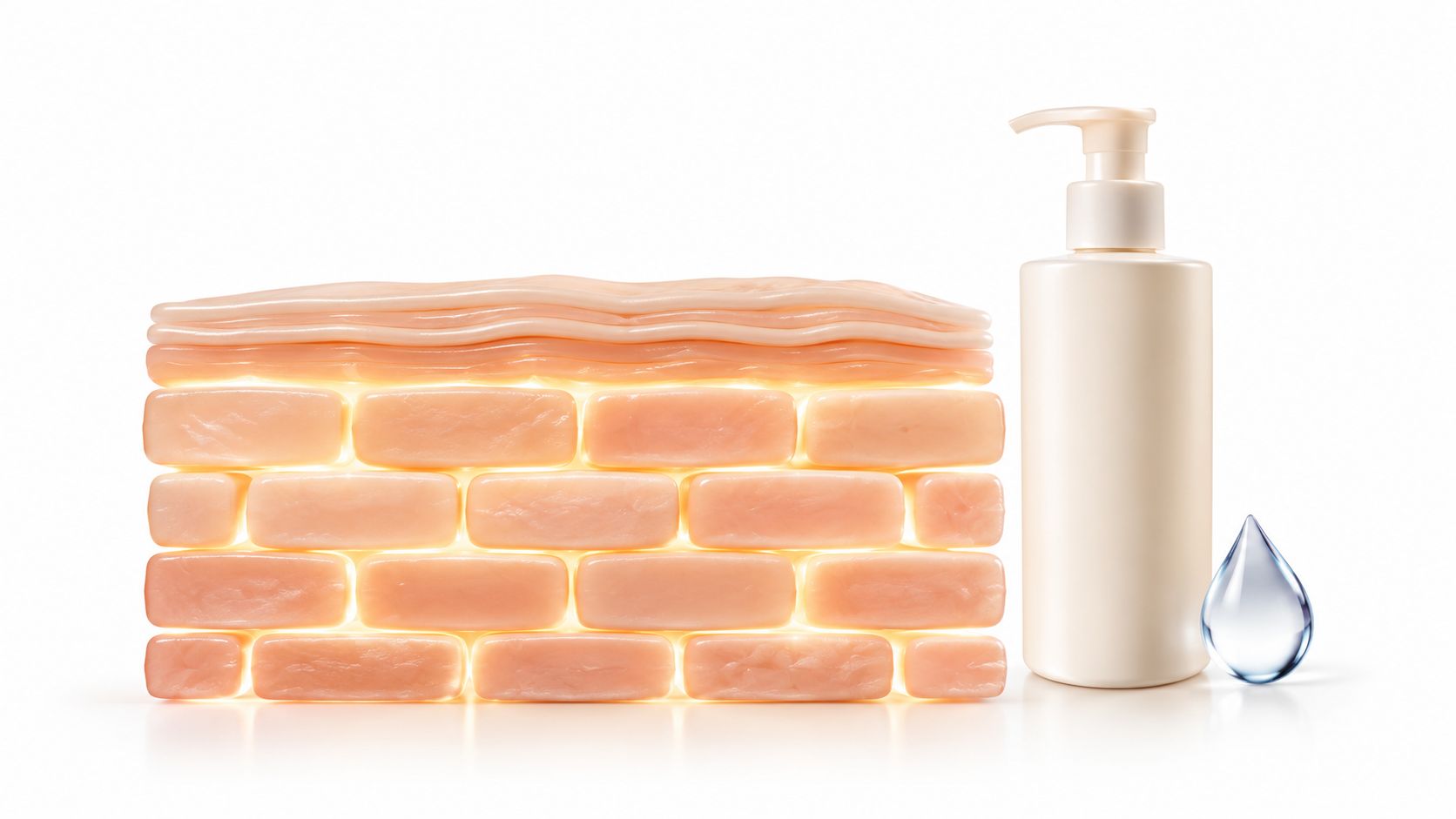
Transepidermal water loss, often shortened to TEWL, describes water passing through the skin and escaping into the surrounding air. Researchers use it to assess barrier function. It isn't something you can measure by judging how slippery or soft your skin feels.
What surfactants and pH change
Surfactants are the cleansing ingredients that help lift oil and dirt so water can rinse them away. Their effect depends on the complete formulation, not whether they're synthetic or derived from plant materials.
pH describes acidity or alkalinity. Skin normally has an acidic surface, and strongly alkaline cleansing can disturb that environment. A syndet is a synthetic-detergent cleanser, which may come as a liquid or a bar.
In a comparative study of 60 healthy adults washing at least four times daily for seven days, alkaline soap caused a sustained rise in skin pH and greater barrier disruption, while an acidic syndet reduced pH and caused less overall damage, as described in the comparative cleanser study. That intensive forearm-washing experiment informs selection criteria, but it doesn't establish how every retail body wash performs.
A “squeaky clean” sensation isn't a useful target for dry skin.
Your bathroom environment deserves consideration too. If you're also investigating hair changes, Water Filter Advisor's explanation of how hard water affects your hair offers a separate resource. Don't use hair feel to diagnose a skin-barrier problem or decide a cleanser's suitability.
Key Moisturizing Ingredients to Look For
A familiar ingredient can make a Japanese product page feel easier to browse. The mistake is assuming that an ingredient associated with a face cream will deliver an equivalent benefit in a wash that you rinse away.
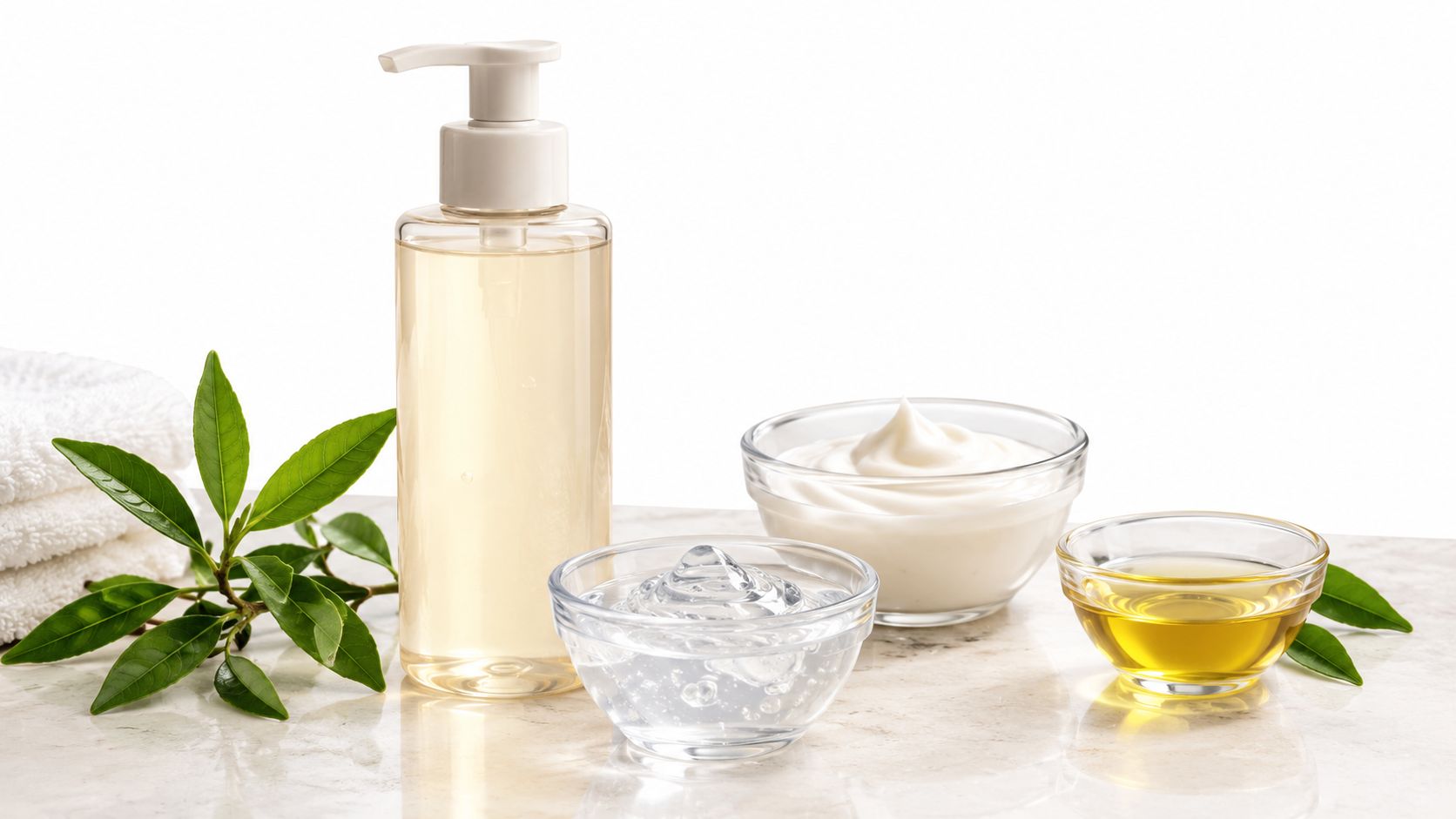
Humectants help attract and retain water. Emollients help soften the skin, while occlusives help reduce moisture escape when they remain on its surface. These categories describe ingredient roles, not guaranteed outcomes from a finished rinse-off product.
Interpret ingredients without overpromising
| Ingredient family | What to understand | What not to assume |
|---|---|---|
| Ceramides | Relevant to the skin's barrier lipids | A ceramide wash performs like a leave-on cream |
| Hyaluronic acid | A humectant associated with water retention | Its presence proves lasting hydration after rinsing |
| Urea | Used in moisturizing formulations | Every concentration or formula suits reactive skin |
| Glycerin | A humectant worth considering alongside the cleanser base | It cancels out an aggressive cleansing system |
| Plant or mineral oils | May contribute softness and a more conditioned feel | An oil-rich wash necessarily leaves a protective layer |
For more context on barrier-focused ingredient language, the guide to Japanese ceramide skincare is a useful companion when comparing wash and moisturizer descriptions.
A controlled patch study found that alkaline and creamy soaps significantly increased TEWL at 24 hours, while at 72 hours the persistent increase remained statistically significant only for alkaline soap, according to the study of cleanser-related barrier changes. This supports evaluating the cleanser system rather than trusting a creamy texture.
The distinction between wash and lotion also has practical evidence: a randomized study of 52 people with moderate-to-severe dry skin found greater improvement with a mild cleanser plus moisturizer than with cleanser alone over two weeks, as discussed in this review of cleansing and moisturizing for dry skin.
Ingredient lists are clues. They don't reveal how much remains after rinsing or establish performance by themselves.
Comparing Cream Washes, Oil Cleansers, Syndet Bars, and Sulfate-Free Foams
Start with the format you'll find easy to use, then check the formulation. A dense cream, an oil cleanser, a solid bar, and a foam can all be considered for dry skin, but their appearance doesn't establish their cleansing strength.
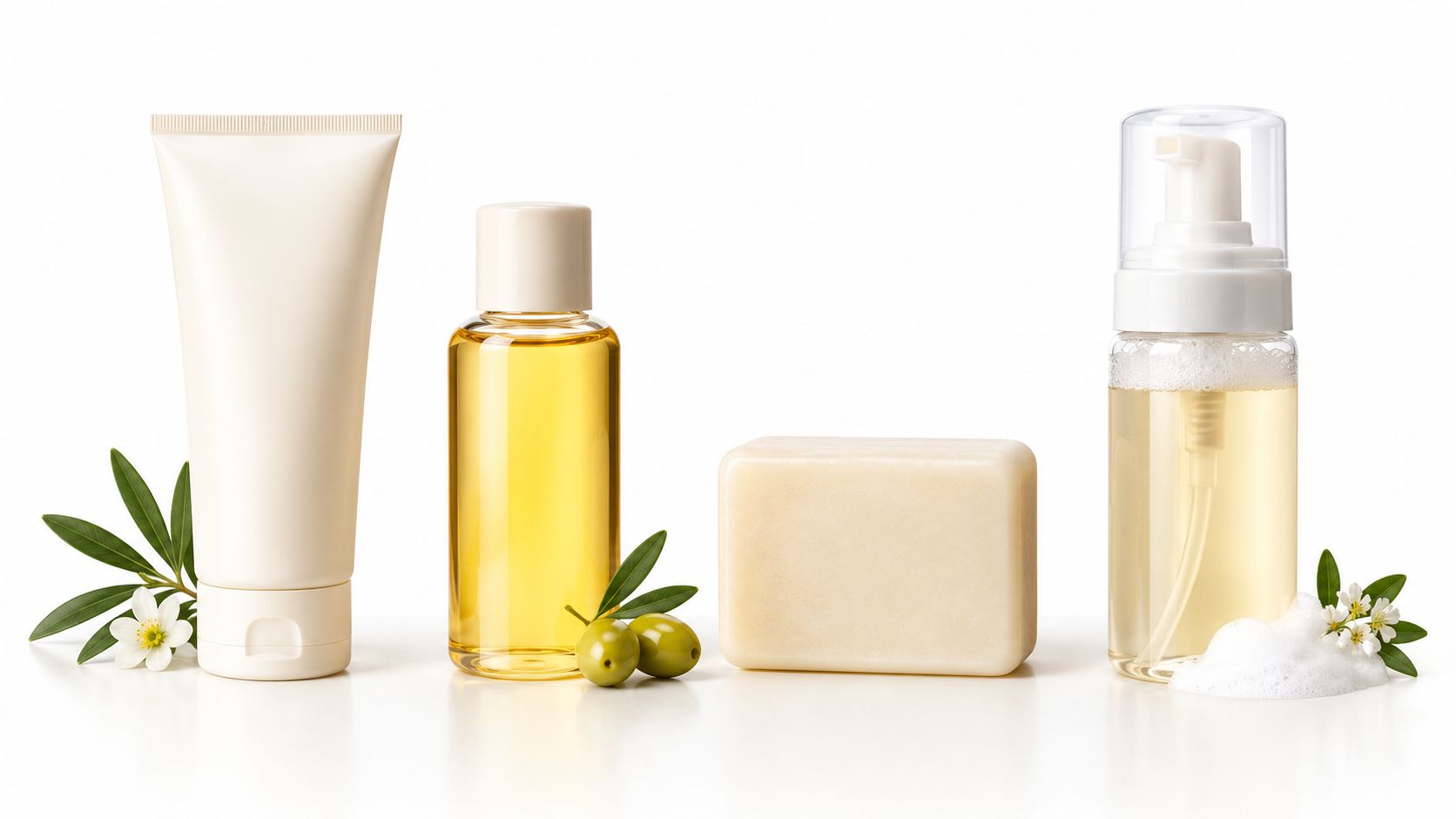
Body Wash Format Comparison for Dry Skin
These are shopping considerations, not fixed properties of every product in each category.
| Format | Typical surfactant feel | After-feel on dry skin | Best for | Main trade-off |
|---|---|---|---|---|
| Cream wash | Cushioned texture; cleansing strength varies | May feel softer or more conditioned | Shoppers who prefer a creamy application | Rich texture doesn't prove mildness |
| Oil cleanser | Slippery application; rinse behaviour varies | May feel conditioned | Those who dislike a high-foam washing experience | Confirm it's a rinse-off body cleanser, not bath oil |
| Syndet bar | Solid format; lather varies | Depends on pH and the complete formula | Shoppers who prefer a compact bar | A bar labelled “soap” isn't necessarily a syndet |
| Sulfate-free foam | Airy application; strength varies | Can feel comfortable or drying | Those who like foam and convenient dispensing | Sulfate-free alone doesn't establish gentleness |
Match the format to your preference
If your skin feels very dry, a cream or oil format may be a reasonable starting preference because you like its application and after-feel. That's a sensory choice, not evidence that the category performs better.
Someone else may prefer a mild syndet bar because it's simpler to handle. When reading the guide to natural soap bars, keep the distinction between traditional soap and syndet in mind. “Natural” describes an ingredient or marketing approach, not a barrier-performance result.
For foaming washes, don't reject or accept a formula based on one excluded ingredient family. Sulfate-free tells you what isn't included, but you still need to assess the surfactant system, pH information, and fragrance.
The most useful comparison is between complete descriptions. If neither page provides enough detail, keep that uncertainty visible instead of treating texture or packaging as a substitute for evidence.
How to Use a Body Wash Without Drying Out Your Skin
A carefully chosen bottle can't make a long, hot, vigorous wash gentle. The American Academy of Dermatology recommends five-to-ten-minute baths or showers with warm rather than hot water, targeted cleanser application, gentle patting dry, and immediate fragrance-free moisturizing in its guidance for relieving dry skin.

Make the wash less demanding
- Set the water first: Choose comfortably warm water rather than using heat as part of the cleansing process.
- Use only what you need: Dispense enough cleanser to remove dirt and oil. Don't keep adding product to build a thick lather.
- Target the areas that need cleansing: Give attention to sweat- and odour-prone areas, such as the armpits and groin, rather than repeatedly washing every dry patch.
- Rinse according to the directions: Remove the cleanser without turning rinsing into another prolonged shower.
- Pat gently: Leave the skin slightly damp instead of rubbing it completely dry.
For broader reading about bathing preferences, SEYANTE's water temperature guide for daily wellness provides additional context. For dry-skin care, use the dermatology recommendations above as your practical reference.
Keep moisturizer within reach
The National Eczema Association recommends applying moisturizer liberally while skin remains slightly damp, within three minutes of bathing or showering, in its moisturizing and soak-and-seal guidance. Put your moisturizer beside your towel so this step doesn't depend on remembering it later.
If you enjoy soaking, the guide to Japanese bath products can help you explore the category. Keep bath additives separate from your assessment of cleanser and moisturizer: each serves a different purpose.
A repeatable routine is more useful than chasing a stronger moisturizing promise every time your skin feels uncomfortable.
Fragrance, Sensitive Skin, and Patch Testing
Natural, mild, soap-free, and sulfate-free aren't guarantees of suitability. For skin that reacts easily, the complete formula and your response matter more than reassuring front-label language.
The National Eczema Association advises bathing or showering once daily with lukewarm water, using a gentle cleanser without fragrance or dye, avoiding washcloths and loofahs, and patting rather than rubbing dry in its bathing guidance for eczema-prone skin. That makes fragrance-free cleansing a sensible starting criterion for this risk profile.
Check more than the scent description
- Fragrance information: Read the full translated ingredient list, not just the named scent on the front. Don't infer fragrance strength from its position alone.
- Essential oils and dyes: Don't assume plant-derived scent is gentler. If you already know an ingredient bothers you, check for it explicitly.
- Medicated positioning: Read the stated purpose and directions carefully. The word “medicated” doesn't establish that a wash suits unexplained itching or eczema-prone skin.
The considerations in choosing a face cleanser for sensitive skin can also help you approach body-cleanser labels cautiously, without treating face and body products as interchangeable.
The following video is an optional companion to the written guidance.
Try cautiously and know when to stop
For a new rinse-off product, try a small area of intact skin using the product's normal directions, including rinsing. Don't leave body wash on as though it were lotion. A home trial can help you notice discomfort, but it can't guarantee that a product won't cause a reaction.
Stop using a wash that causes burning, worsening redness, or itching. Persistent itching, cracking, oozing, or widespread inflammation calls for medical advice rather than repeated product experiments.
Safety boundary: A cosmetic body wash isn't a substitute for evaluating an ongoing skin problem.
Shopping and Packaging Considerations
A product page should help you decide what you're buying, not require you to fill gaps with assumptions. Start with the current description and ingredient information, then consider the packaging that fits your bathroom and habits.
Frequent washing makes this assessment worthwhile. One Japanese dermatology survey reported that 77.4% of respondents bathed daily and 95.4% washed their whole body with soap at every bath, as reported in research discussing Japanese bathing practices. These describe surveyed routines, not a recommendation that everyone should wash the same way.
Compare the information before the bottle size
| Check | What to look for |
|---|---|
| Formula description | Explicit pH positioning, cleanser type, fragrance information, and intended use |
| Ingredient list | A complete current list rather than selected promotional ingredients |
| Directions | Whether the product is a rinse-off body wash and how it should be dispensed |
| Packaging | Pump bottle, tube, bar, or compatible refill |
| Storage information | Any stated handling, expiry, or use-after-opening guidance |
If a Japanese label is unfamiliar, use the translated description alongside the packaging information. Don't guess a pH value from the word “gentle,” assume a formula is fragrance-free because its scent isn't mentioned, or estimate ingredient concentrations from order alone.
Choose a manageable first purchase
- Size: If a smaller option is listed, it may make more sense for an unfamiliar formula than committing to a large container.
- Refills: Confirm the refill matches the exact product and follow the manufacturer's container instructions.
- Travel: Check the stated size and closure. A pump bottle isn't automatically suitable for packing.
- Value: Compare listed price and quantity, but don't invent a price-per-use estimate without knowing how much you dispense.
Browse the current Japanese product catalog with these checks beside you. If essential details are missing, ask for clarification before purchasing rather than treating an attractive bottle as evidence of suitability.
Putting It All Together
The useful choice isn't the body wash with the longest ingredient story. It's the one you can assess clearly, use comfortably, and fit into a routine that respects your skin.
Consider two unnamed bottles. One highlights several moisturizing ingredients but gives little information about its cleansing system or fragrance. The other provides clearer formulation details and directions. You don't have to declare either universally better, but the more transparent description gives you a firmer basis for deciding.
Use a repeatable decision path
- Establish what's known: Separate confirmed product details from appealing but incomplete marketing language.
- Choose for your risk profile: Prioritise fragrance information if your skin is reactive, and don't use a cosmetic label to explain persistent symptoms.
- Pick a practical format: Select packaging and texture you'll use correctly, without treating either as proof of gentleness.
- Evaluate the whole experience: Notice how your skin feels after your usual routine, not just while the wash is on it.
- Make the next decision deliberately: Keep a suitable product, reconsider an uncomfortable one, and seek advice when symptoms persist.
For your leave-on step, the guide to choosing a barrier-supporting moisturizer can help you assess a different set of product promises. Don't judge that product by the same criteria you use for something designed to rinse away.
A Japanese body wash for dry skin is a cleansing choice, not a standalone fix. Your best starting point is a clearly described formula, realistic expectations, and habits you can maintain. You don't need a complicated bathroom shelf to make a more informed purchase.
Buy Me Japan is a trusted Japanese online store that makes authentic Japanese beauty and lifestyle products accessible through convenient, reliable shopping. Visit Buy Me Japan to explore the current skincare selection, using the formula, fragrance, and packaging checks above to guide your next purchase.


共有する:
Japanese Mascara for Straight Lashes: A Practical Guide