


The most popular advice for mature skin is often the least useful: add a stronger retinoid, more exfoliating acids, and a larger collection of “anti-aging” products. For many people over 40, especially around menopause, that approach creates tightness, stinging, flaking, and a routine they eventually abandon.
Japanese skincare for mature skin over 40 takes a more measured route. It starts with gentle cleansing, light hydration in layers, barrier-supporting ingredients, and daily UV protection. Targeted actives still have a place, but they work better when the skin can tolerate them consistently. Japan's older consumer base has also made mature-skin care a central part of the beauty market, giving shoppers access to long-established formulas rather than a category built around short-lived trends.
This guide focuses on the practical details that make a routine usable: order, texture, ingredient choice, and how to adjust care for firmness, dryness, and dark spots. The central principle is simple: fewer actives, better layering, and steady use usually serve mature skin better than constant escalation.
Why Japanese Skincare for Mature Skin Over 40 Starts With Barrier Care
The case against adding more actives
Skin over 40 doesn't automatically need a more aggressive routine. It often needs a more selective one. A weakened barrier loses water more easily and reacts more quickly to friction, fragrance, harsh cleansing, and poorly spaced active ingredients. If a retinoid or brightening serum leaves the skin persistently irritated, its theoretical benefits matter less because regular use becomes difficult.
Japanese routines commonly place emphasis on gentle cleansing, repeated light hydration, and barrier-supporting ingredients. Ceramides, glycerine, hyaluronic acid, amino acids, and soothing formulas help create a comfortable base before wrinkle or pigmentation treatments enter the routine. Independent beauty reporting also describes fermented rice as a traditional ingredient associated with barrier care and notes that it contains ceramides, although product formulas vary and the ingredient list should always be checked.
This approach is especially relevant in Japan, where mature-skin demand is supported by demographics. In 2023, 29.1% of Japan's population was aged 65 or older, the country's highest recorded proportion, a demographic context linked to the importance of anti-aging and barrier-repair products in the market (Dermapproved's overview of ELIXIR and Japan's aging-care market). Shiseido's ELIXIR line launched in 1983 after years of collagen research, making it a long-running reference point for mature-skin routines rather than a recent social-media trend. The same source notes sustained leadership for the line, with different ranking periods reporting either 19 consecutive years as Japan's No. 1 lotion-and-emulsion line or 15 consecutive years as a No. 1 brand, depending on the ranking used.
What this means for your routine
You don't need every product category. You need a routine that protects the skin you have, then adds one clearly chosen treatment.
A sensible foundation looks like this:
- Cleanse gently: Remove sunscreen and makeup without leaving the face squeaky or tight.
- Layer water-based hydration: Use a Japanese lotion, or keshosui, before treatment products.
- Seal deliberately: Emulsions and creams reduce the dry, tight feeling that makes mature skin look more lined.
- Introduce one active: Give the skin time to show whether it tolerates retinoids, vitamin C derivatives, or another targeted ingredient.
- Protect every morning: UV exposure can undermine work done by the rest of the routine.
If you're researching barrier recovery after procedures or treatments, this practical resource on barrier support for RF microneedling offers useful general context on supporting compromised skin. For a simple product-order reference, see Buy Me Japan's barrier repair skincare routine.
The result shouldn't feel like a twelve-step obligation. Consistency, not product count, is what makes a routine sustainable.
What Actually Changes in Your Skin After 40
The visible changes after 40 aren't just a matter of looking tired. Skin structure itself changes, and the routine needs to respond to those changes rather than treating every concern as a surface problem.
The barrier and the deeper layers
Research involving 130 Japanese women from their 20s to their 60s found that the stratum corneum, the outermost layer of skin, hardened with age while the dermis became softer. The widening elasticity gap between those layers corresponded with deeper wrinkles, according to Shiseido's report on age-related changes in skin elasticity.
That finding explains why mature skin can feel both rough and less firm at the same time. The surface may need more flexible hydration, while the deeper appearance of laxity can't be solved by adding a harsher cleanser or scrubbing away texture.
Independent research also found that, among 37 healthy Japanese women, older adults had a significant reduction in cheek, forehead, and forearm Propionibacterium abundance compared with younger women. The result doesn't mean you need to sterilize the skin. It supports a gentler strategy that avoids unnecessary disruption to the barrier and its microbial environment.
Practical rule: If a product leaves your skin hot, tight, or persistently flaky, reduce frequency before adding another treatment.
These structural changes translate into straightforward decisions:
- Harder-feeling surface: Limit aggressive exfoliation and physical scrubs.
- Greater water loss: Add lotion layers and use an emulsion or cream while skin is still slightly damp.
- Faster irritation: Patch test new actives and avoid changing several products together.
- Uneven texture: Improve hydration first, because dehydration can make fine lines and roughness look more pronounced.
Menopause changes the tolerance equation
Mainstream skincare advice often treats women over 40 as one broad “anti-aging” group. Menopause deserves more specific attention. Independent dermatology literature reports that estrogen loss can drive up to 30% dermal collagen loss during the first 5 years of menopause, followed by approximately 2.1% per year thereafter (J-Beauty Decoded's discussion of menopausal mature skin).
That doesn't mean a topical routine can replace clinical care or reverse every structural change. It does mean dryness, fragility, and retinoid sensitivity may become more important than adding a second brightening serum. For many people, the correct order is comfort first, treatment second.
Hyaluronic acid attracts and holds water at the skin's surface, while ceramides help support the lipid structure that keeps moisture from escaping. A useful primer on hyaluronic acid serum can help you understand where a hydrating serum fits, but the surrounding moisturizer still matters.
The Layering Order That Defines a Japanese Routine
A Japanese routine is less about collecting steps than about applying the right textures in the right order. Start with the thinnest comfortable layer and move toward richer products, allowing each step to settle without rubbing the skin repeatedly.
Morning order
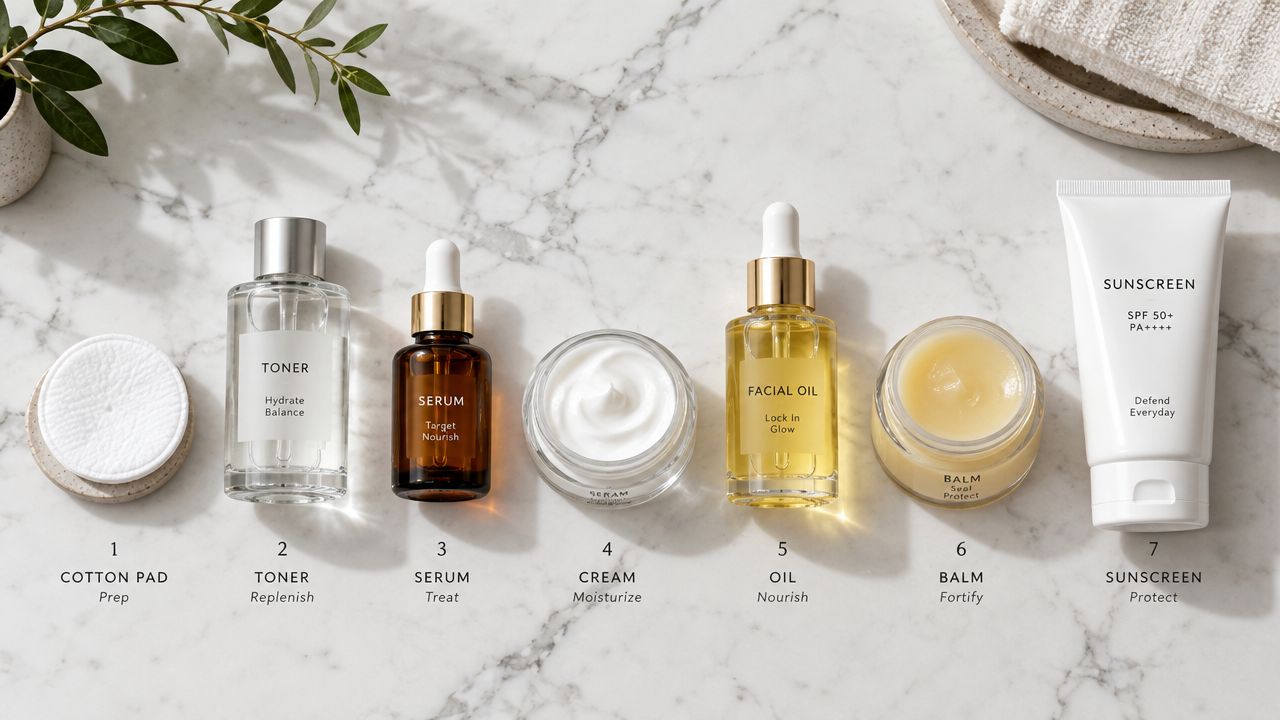
1. Oil cleanser, when needed. Use an oil cleanser in the evening to dissolve sunscreen, makeup, and oil-soluble residue. In the morning, many people with dry or sensitive mature skin can use only lukewarm water or a gentle cleanser, depending on how the skin feels.
2. Low-pH foam cleanser. A low-pH formula can clean without the stripped sensation that often makes mature skin uncomfortable. Keep contact brief, use light fingertips, and rinse thoroughly.
3. Hydrating lotion, or keshosui. This isn't merely a Western-style astringent toner. Japanese lotion is usually a hydration step applied immediately after cleansing. Pat on a thin layer once or twice, particularly over the cheeks and areas that feel tight.
4. Essence or serum. Choose one main purpose. A hydrating essence can be enough on a dry morning, while a targeted serum may focus on firmness or uneven tone. Buy Me Japan's guide to the best essence for face explains how this lighter category differs from a cream.
5. Emulsion. An emulsion is a lighter moisturizer with a fluid texture. It works well when your skin needs comfort but dislikes a heavy finish.
6. Cream, if required. Apply a richer cream over dry zones, or across the face if the emulsion doesn't prevent tightness.
7. Sunscreen. Finish with a broad-spectrum sunscreen. Guidance for aging-skin routines commonly recommends SPF 30 or higher daily, while Japanese routines often favor SPF 50 and PA++++ for stronger UV protection. Reapply according to the product instructions and your exposure.
The lotion-first sequence is the important distinction. It gives the skin a light, flexible hydration layer before heavier products, rather than treating toner as a final cleansing step.
Evening order and retinoid placement
At night, remove sunscreen and makeup with an oil cleanser, then follow with your low-pH cleanser. Apply lotion, then your serum or essence. If you're using a retinoid, apply it where the product directions specify, usually after cleansing and before moisturizer, or buffer it between hydrating and cream layers if your skin is easily irritated.
Don't force every step on retinoid nights. A shorter routine often works better:
- Cleanse.
- Apply a light lotion layer.
- Use the retinoid sparingly.
- Finish with a ceramide-supporting cream.
Skip exfoliating acids or other strong treatments on the same night until you know your tolerance. On recovery nights, use lotion, emulsion, and cream without the active.
A practical visual demonstration can help with the rhythm of layering:
The goal is not maximum absorption at any cost. The best order is the one that leaves skin comfortable enough for tomorrow's routine.
How to Choose Each Product Type for Skin Over 40
Product categories overlap, so shop by texture and tolerance rather than by marketing language. “Anti-aging” on a label doesn't tell you whether a formula will suit dry, reactive, combination, or menopausal skin.
A practical category comparison
| Product Type | Look For | Avoid or Limit |
|---|---|---|
| Cleanser | Low-pH foam, gentle milk, or an oil cleanser for sunscreen and makeup removal | Strong fragrance, aggressive scrubbing, and a tight post-wash feeling |
| Lotion | Hyaluronic acid, glycerine, amino acids, or soothing hydration | Alcohol-heavy formulas that sting or leave the skin dry |
| Essence | Lightweight hydration, fermented rice extracts, or barrier-supporting ingredients | Multiple overlapping treatment essences used without a clear reason |
| Serum | One focused active, such as a retinoid, peptide formula, or vitamin C derivative | Combining several strong actives before you know your tolerance |
| Emulsion | A fluid moisturizer for flexible, comfortable hydration | Skipping it when skin becomes tight simply because it feels light |
| Cream | Ceramides, richer emollients, or a protective finish for dry areas | Heavy occlusion across the whole face if it causes congestion |
| Sunscreen | Broad-spectrum protection, with SPF 30 or higher; Japanese options may offer SPF 50 and PA++++ | Treating sunscreen as optional or relying on makeup with low protection |
Ingredients with distinct jobs
Hyaluronic acid helps draw water into the surface layers, but it doesn't replace a moisturizer. Apply it under an emulsion or cream so the added hydration has a more protective finish.
Fermented rice is valued in Japanese beauty for its skin-conditioning role, and reporting describes it as also high in ceramides. It can be a pleasant choice in a lotion or essence, but the full formula determines whether it suits you.
Peptides are a reasonable option when firmness is your main concern and you want something generally less demanding than a retinoid. They should still be evaluated by the whole formula, not treated as a guarantee of lifting.
Retinoids are more intervention-oriented. They can be useful for wrinkle-focused routines, but mature or menopausal skin may need a slower introduction and more cushioning.
Vitamin C derivatives can support a brighter-looking complexion, while brightening products may be more comfortable than highly acidic vitamin C formulas for reactive skin. Choose one brightening path first.
Japanese retinol formulas for dry or mature skin are frequently paired with ceramides, hyaluronic acid, amino acids, or botanical extracts to support comfort during use (Japanese retinol products). That pairing reflects a sensible trade-off: a treatment product may be more useful when the rest of the routine reduces irritation.
Adjusting Your Routine for Firmness, Dryness, and Dark Spots
A basic routine can serve several concerns, but the emphasis should change depending on what your skin is showing. The common mistake is treating every issue with an active. In practice, hydration usually comes before brightening, because dry, irritated skin tolerates less and often looks more uneven.
For loss of firmness
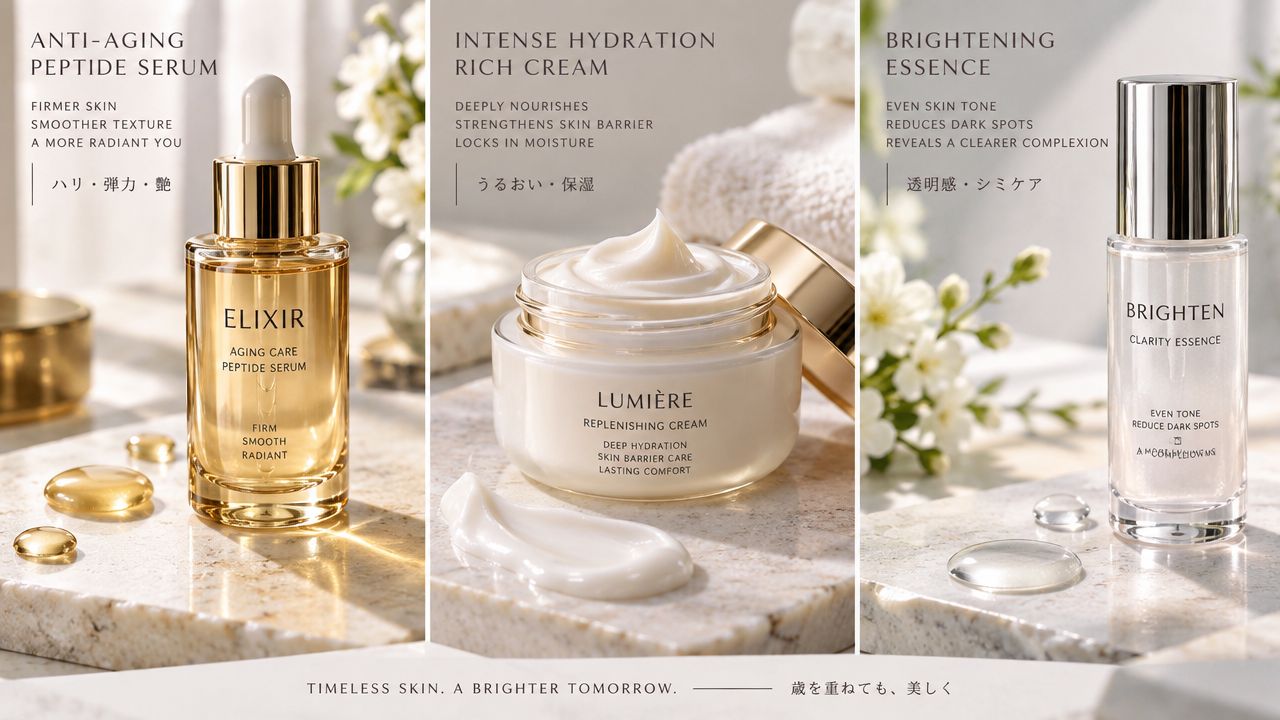
Keep the gentle cleansing and lotion layers, then choose either a peptide serum or a retinoid as your main treatment. Don't start both together. A peptide product may suit someone who wants a lower-irritation option, while a retinoid requires more attention to frequency, buffering, and sunscreen.
Use a hydrating lotion first, apply the chosen treatment as directed, and finish with an emulsion or cream. Extend the same careful application to the neck, using upward strokes without pulling. For more detailed reading on neck care for menopausal women, focus on the same principles used on the face, gentle handling, moisture, and daily UV protection.
For persistent dryness
Dryness needs more than a watery serum. Add a second thin lotion layer, use a richer emulsion, or apply a small amount of facial oil over cream if your skin accepts it. The objective is to reduce water loss without creating a greasy film that makes you avoid the routine.
Regular application matters. In a randomized study of 160 women aged 35 to 65, regular moisturizer use improved stratum corneum cohesion and reduced the appearance of facial aging, while low-frequency use in the comparison group didn't provide the same aging-prevention benefit. The findings are described in the moisturizer and anti-aging regimen study.
For dark spots and uneven tone
Brightening should come after the barrier feels calm. Use a vitamin C derivative or a Japanese brightening quasi-drug product, but don't stack several tone-focused treatments immediately. Sunscreen remains the foundation, because new UV exposure can work against your effort to maintain a more even-looking complexion.
A focused option is Japanese tranexamic acid skincare, but read the current product information carefully and introduce only one new treatment at a time.
A cautious retinoid schedule
- Weeks one and two: Use the retinoid twice weekly on completely dry skin, or over a light lotion if the product directions allow it. Follow with a ceramide-supporting cream.
- Weeks three and four: Continue twice weekly if the skin remains comfortable. Don't increase frequency because of impatience.
- After week four: Consider a gradual increase only if there is no persistent stinging, flaking, or redness. If irritation appears, return to recovery nights.
This schedule isn't a promise of results. It's a tolerance strategy. Stop and seek professional advice if a product causes a severe or ongoing reaction.
Practical Tips for Making Japanese Skincare a Lasting Habit
The routine that works is the one you can repeat without dreading it. Start with cleanser, lotion, moisturizer, and sunscreen. Add a serum only when you can explain its job in one sentence.
Patch test every new active, especially if your skin has become reactive around menopause. Introduce one change at a time, and don't begin a retinoid in the same week as a new exfoliant or brightening treatment. If the skin becomes uncomfortable, remove the newest active first and return to gentle hydration.
Give products enough time to judge their texture, tolerance, and place in the routine. A first application can tell you whether something stings or pills, but it can't establish a cosmetic outcome. Keep brief notes on frequency, dryness, and irritation so you can identify what helped instead of changing everything at once.
A useful habit: Keep your morning routine visible and your evening routine simple. Convenience improves consistency more reliably than adding another treatment step.
Authenticity also matters when you're buying Japanese products internationally. Buy Me Japan presents Japanese beauty and lifestyle products through a convenient online shopping experience, with items sourced through official suppliers in Japan. The store also references tracked shipping, secure payments, and customer service, but current product pages should be checked for the latest availability and purchasing details.
Remember the routine in three phrases:
- Barrier first: Calm, hydrated skin can handle targeted care more comfortably.
- Thin to rich: Lotion, treatment, emulsion, then cream when needed.
- Protect daily: Sunscreen belongs in the routine even when the rest stays minimal.
Buy Me Japan offers authentic Japanese skincare alongside other Japanese beauty and lifestyle products, making it practical to build a hydration-first routine around the categories discussed here. Visit Buy Me Japan to explore the current skincare range and choose products that match your skin's texture, tolerance, and main concern.

共有する:
Japanese Retinol Products: A Practical Buyer's Guide