


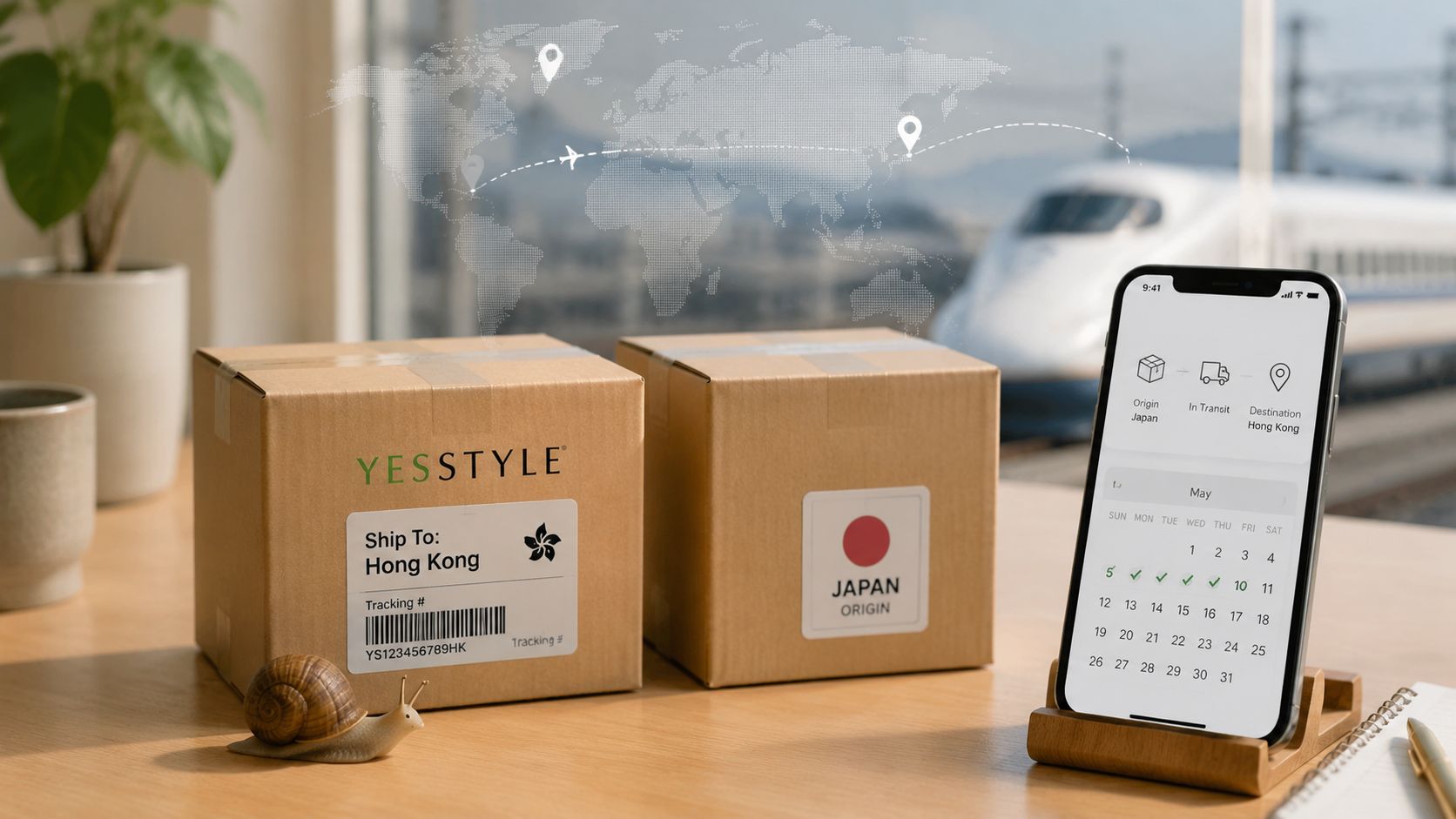
You place a YesStyle order, get the confirmation email, and then start checking the tracking page far more often than you'd like to admit. That waiting period is where most frustration starts. Not because international shipping is unusual, but because the estimate on the screen rarely tells the whole story.
For shoppers buying Japanese beauty, skincare, hair care, or snacks, shipping time shapes the entire experience. If you're ordering sunscreen before a trip, replacing a finished Shiseido Fino mask, or restocking Hada Labo lotion, the difference between a smooth delivery and a dragged-out one matters.
A realistic answer to YesStyle shipping time has to go beyond a single number. It needs to account for processing, dispatch, customs, local handoff, and the gaps where tracking seems frozen. If you're comparing marketplaces with more focused Japanese retail options, it also helps to understand what kind of shipping model you're buying into. Readers looking beyond beauty often run into the same question with food and gift shopping too, which is why broad guides to where to buy Japanese snacks online tend to overlap with beauty shipping concerns.
Introduction Why Shipping Time Matters
The biggest mistake shoppers make is treating the checkout estimate like a delivery promise. With cross-border orders, that number is usually a service window. It isn't a guarantee, and it definitely isn't the full journey.
That matters even more with beauty products. Japanese sunscreens, sheet masks, cleansers, scalp care, and hair masks are often replenishment purchases. You're not just browsing for fun. You need the product before your current bottle runs out, or before travel, gifting, or a seasonal weather change makes the timing important.
Practical rule: If a product is time-sensitive, buy based on the slowest realistic outcome, not the fastest advertised one.
I've found that shoppers are usually less upset by a long delivery window than by an unclear one. If you know the shipment may take a while, you can plan around it. If the order looks stalled with no explanation, confidence drops quickly.
That is why the true question isn't just "how long does YesStyle take?" The better question is what parts of the journey are stable, what parts are variable, and when it makes sense to choose a retailer with a simpler route from Japan to your door.
Decoding Official YesStyle Shipping Windows
The cleanest place to start is the official shipping window after dispatch. According to YesStyle's shipping update, YesStyle's standard international shipping time falls within 7–21 working days after dispatch, while Express shipping takes 3–5 working days. The same source also indicates that this standard range works out to roughly 10–25 calendar days from its Hong Kong hub once transit is translated from working days into a more practical calendar estimate.

Processing time and shipping time aren't the same
Many shoppers find this detail confusing. "Shipping time" usually starts after the package has been dispatched. It doesn't always include the time needed to gather, pack, and release the order from the warehouse.
In practical terms, your order timeline often has two phases:
| Phase | What it means | What to expect |
|---|---|---|
| Order processing | Item picking, stock confirmation, packing, dispatch preparation | Can vary depending on what you bought |
| Transit after dispatch | Movement through the international carrier network | Covered by the official shipping window |
If every item is ready, things move more smoothly. If one item isn't ready, the order can slow before it even reaches the shipping stage.
What working days really means
A lot of shoppers read 7–21 working days and mentally convert that into one to three neat calendar weeks. That's optimistic. Working days usually exclude weekends and can also interact awkwardly with public holidays across multiple countries.
That is why the calendar-day estimate matters more in practice. A shipment moving through an international lane from Hong Kong can feel much slower on the customer side than the phrase "working days" suggests.
Orders that look fast on paper often feel slower in real life because the shopper is counting every day, while the carrier is counting only working days.
For buyers in the US, UK, EU, or Australia, the broad lesson is simple. Standard shipping is usually a patience purchase. Express is the option for shoppers who want a tighter window and are willing to structure the order around items that can ship quickly.
If you're comparing that with how Japanese beauty buying works more broadly, a practical reference point is this guide on what to buy in Japan for cosmetics and beauty staples, especially if you're planning a restock rather than a one-off impulse order.
The official window is a baseline, not a promise
Use the official YesStyle shipping time as your starting framework, not your final expectation. It tells you the service tier. It doesn't tell you whether your exact basket, destination, or customs flow will behave cleanly.
That distinction alone removes a lot of unnecessary stress.
Common Reasons Your YesStyle Order Is Delayed
If your order feels stuck, the cause is usually operational rather than mysterious. The most useful explanation comes from the logistics side. As noted in this cross-border shipping discussion, logistical bottlenecks include warehouse batching cycles, reliance on economy-class international postal lanes that lack guaranteed transit times, and asynchronous tracking updates between the carrier and the platform.

Warehouse release doesn't always happen in real time
Many shoppers assume a paid order is packed and sent immediately. Large cross-border retailers often don't work that way. Orders are commonly grouped into dispatch batches, which means your parcel may be packed and labeled before it enters the next transport step.
That gap creates a familiar complaint. The account says the order is dispatched, but the carrier page doesn't seem to move. In many cases, the package is between systems rather than lost.
Economy lanes save cost but add uncertainty
A lot of standard international shipping uses lower-priority postal or partner networks. Those routes can work fine, but they usually don't come with the kind of tight commitment you'd expect from premium courier services.
That trade-off shows up in a few ways:
- Customs handling varies: Some parcels clear quickly, while others sit in a queue.
- Handoffs slow visibility: A package may change from an export partner to a destination postal service with limited update speed.
- Peak periods hit harder: Lower-priority lanes absorb volume surges less gracefully.
This is one reason beauty buyers get impatient with seasonal orders. Products like Biore UV, Canmake base makeup, Cezanne brow items, or &honey hair care often feel like everyday essentials, but the shipping lane treats them like ordinary low-priority parcels unless the service tier is upgraded.
Tracking delays can create false alarm
The tracking issue deserves its own attention because it causes the most unnecessary panic. Asynchronous updates mean the retailer and carrier aren't always refreshing data at the same pace. A shopper checks one page, sees no movement, then checks another and sees a different stage or no scan at all.
A tracking pause doesn't automatically mean a shipping failure. It often means the parcel hasn't hit the next visible scan point yet.
There are also softer delay factors that shoppers underestimate:
- Mixed-availability orders: One slower item can hold the whole shipment.
- Holiday traffic: International parcel systems get congested around major sale periods.
- Destination-country customs: The destination country's process can be slower than the export side.
The key lesson is that delays often come from the structure of the shipping model itself. They aren't always signs of a bad retailer. They are signs of a layered retail and carrier chain with more points where time can slip.
How to Track Your Package and Interpret Statuses
The most useful thing you can do once the order is placed is track intelligently, not obsessively. Check the store account first for the shipment record and tracking number, then verify the same number on the carrier side when that becomes available.

Real-world delivery experiences vary a lot. A shopper example discussed in this public post about actual YesStyle arrival time shows that some orders arrive in as little as 4 working days, while others land much closer to the 21-day upper limit. That's why tracking needs to be read as context, not as a countdown clock.
What the common statuses usually mean
Here is the practical interpretation shoppers need:
- Pre-shipment or label created: The shipment exists in the system, but the carrier may not have completed an active movement scan yet.
- In transit: The parcel is moving through one or more transfer points. This can still include long silent gaps.
- Held at customs: The shipment is waiting for destination-country review or release.
- Out for delivery: It has entered the local final-mile stage.
The most misunderstood phase is the silent middle. International parcels often disappear from visible tracking between export processing and destination intake.
Don't assume a package is lost just because tracking hasn't updated for several days. International shipping often has scan deserts between handoff points.
If you want a broader primer on reading handoff and delivery scans, Peak Transport's AIT tracking tips are a useful reference because they explain why customer-facing tracking can look incomplete even when the parcel is still progressing normally.
When to stop refreshing and start acting
A smart tracking routine is simple:
- Check the store account first for the shipment number and order status.
- Check the carrier page next once the number is active.
- Wait through normal scan gaps before assuming a failure.
- Contact support when the status becomes inconsistent rather than slow.
This explainer is also helpful if you're buying presents or travel items and want to set expectations early. The same issue comes up with curated gift shopping, which is why readers often cross-reference guides to cool gifts from Japan for international delivery.
A quick walkthrough can help if you prefer seeing the process rather than reading about it.
A Faster Alternative Shipping Directly From Japan
If speed and predictability matter more than browsing a giant mixed marketplace, the shipping model matters as much as the product catalog. According to this delivery benchmark discussion for cross-border Japanese retail, factoring in processing and transit, YesStyle's standard delivery often takes 15–30 calendar days, and a retailer shipping direct from Japan can benchmark its delivery to be 1–2 weeks faster as a practical reliability advantage.

Why direct-from-Japan can feel more reliable
A specialist Japanese retailer has a simpler promise to fulfill. The store is centered on Japanese goods, the catalog is more curated, and the logistics chain is closer to the country of origin.
That matters for products where buyers care about freshness, authenticity, and replenishment speed. Think of items such as Shiseido Fino Premium Touch Hair Mask, Biore UV sunscreen, Hada Labo lotions, Canmake makeup, Minon skincare, Ichikami hair care, or Transino brightening products. These aren't random add-ons for many shoppers. They're repeat-use staples.
A direct-from-Japan model usually works better when you care about:
| Priority | Marketplace model | Direct-from-Japan specialist |
|---|---|---|
| Catalog breadth | Very broad | More focused |
| Product specialization | Mixed categories | Stronger Japanese beauty focus |
| Route simplicity | More layered | More direct |
| Restock confidence | Variable by item mix | Stronger for curated Japanese staples |
Who benefits most from the simpler route
This is most relevant for three types of buyers.
First, the replenishment shopper. If you're replacing the same cleanser, sunscreen, hair mask, or essence, you don't need a massive catalog. You need the right item with less friction.
Second, the routine builder. People buying a Japanese beauty routine often want products that work together and come from brands with a strong domestic reputation. That includes names like &honey, Shiseido d Program, Kanebo DEW, Kate, Kao Liese, Momori, Fancl, Kose Sekkisei, Yuskin, Cezanne, DHC, Meishoku, and Hadabisei.
Third, the cautious international buyer. A curated Japanese store can feel easier to trust because the retail identity is clearer. You're not sorting through fashion, accessories, snacks, and cosmetics all in one sprawling interface.
If your main goal is authentic Japanese beauty with less delivery anxiety, a specialist retailer usually makes more sense than a broad marketplace.
For shoppers who want to compare what kinds of Japanese products are worth buying directly from origin, this overview of popular products in Japan across beauty and lifestyle is a useful starting point.
What works and what doesn't
What works is matching the retailer to the purchase type. If you're casually browsing and don't mind waiting, a broad cross-border marketplace can still fit. If you're buying Japanese skincare or hair care you depend on, a more focused direct-from-Japan route is often the better operational choice.
What doesn't work is treating every international beauty order like it has the same urgency. A backup bottle of cleansing oil and a sunscreen you need before next week should not be purchased with the same shipping assumptions.
Your Guide to Smart Japanese Product Shopping
The smartest shoppers don't ask only whether a store has the product. They ask how the store moves the product. That one shift changes expectations fast.
For YesStyle, the practical takeaway is simple. The catalog is broad, the official window gives a useful baseline, and the actual delivery experience can stretch depending on processing, transit, customs, and tracking visibility. That matches the way many shoppers describe the experience in user-generated content. In this TikTok unboxing example from sincerelysammy, the order is described as taking around one month, which lines up with the longer real-world wait many international buyers already expect.
A simple way to choose where to buy
Use this filter before you place the order:
- Choose broad marketplaces when browsing matters more than speed.
- Choose focused Japanese retailers when authenticity, curation, and delivery confidence matter more.
- Separate urgent and non-urgent purchases so one slow item doesn't ruin the entire plan.
This matters even more if you're exploring Japanese beauty while also trying to decode labels, ingredients, and app-based shopping tools. If you want help on the language side, Translate AI's review of the best Japanese apps is a practical companion resource for international shoppers reading Japanese listings or packaging details.
Buy like a planner, not a gambler
A good purchase decision starts with honest timing. If you need your Biore sunscreen, Shiseido Elixir lotion, Fino mask, or Hada Labo refill soon, build in a buffer. If you just want to browse and you're comfortable waiting, a wider marketplace may still be fine.
For buyers who want a more deliberate overview of reliable places to shop, this guide to the best online Japanese stores for international customers is worth reading before you place your next order.
The best result isn't finding the cheapest listing. It's choosing the retailer whose shipping model matches your real deadline, your product standards, and how much uncertainty you're willing to accept.
If you want authentic Japanese beauty, skincare, snacks, and lifestyle products from a store focused on Japan rather than a broad marketplace model, Buy Me Japan is a strong place to start. It ships directly from Japan, curates trusted brands, and makes it easier to shop with confidence when product quality and a cleaner buying experience matter.



共有する:
What Is Cica in Skincare? Benefits & Best Products 2026
Shirataki Rice Where to Buy: A Complete 2026 Guide