


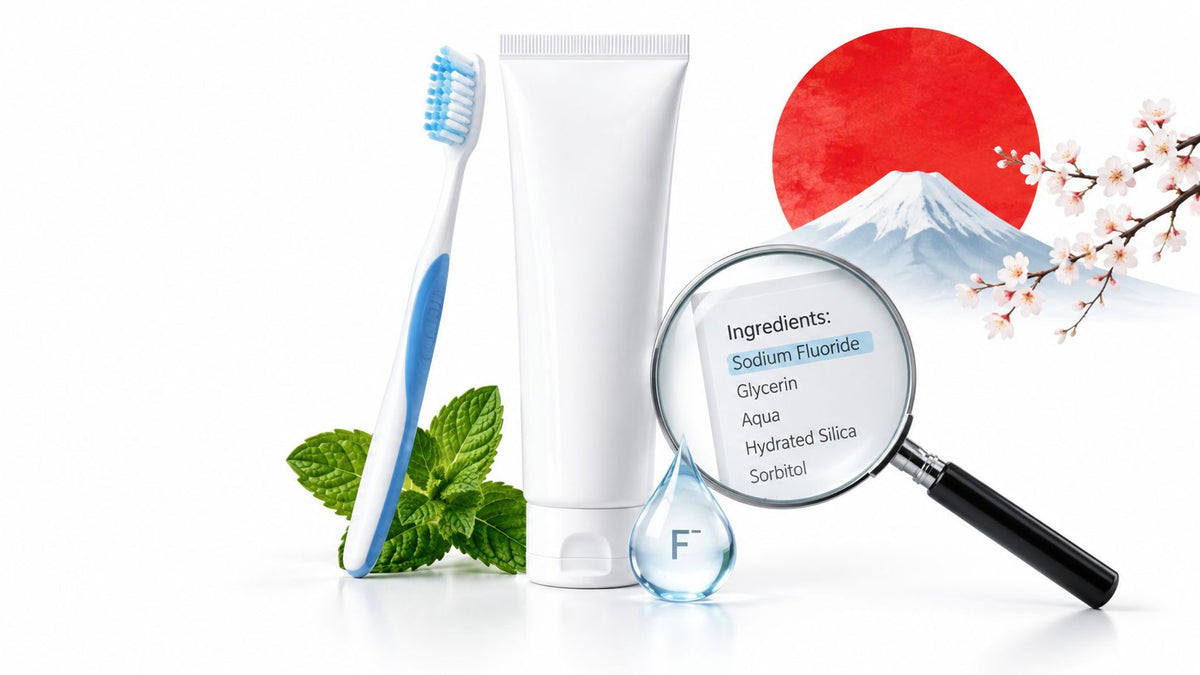
What if the main difference in Japanese toothpaste isn't flavor, foam, or whitening, but how it's regulated and what it's expected to do every day? That's the question that makes this category easier to understand. Once you see Japanese oral care as prevention first, the labels, fluoride numbers, and ingredient names start to fall into place, and you can choose by need instead of by packaging.
What Makes a Toothpaste Japanese
What makes a Japanese toothpaste Japanese? It isn't the country printed on the box. It's a combination of prevention focused habits, regulated medicated formulations, and ingredient choices built for steady daily use rather than dramatic cosmetic change.
Prevention Before Cosmetic Appeal
In Japan, toothpaste carries a large share of everyday cavity prevention, alongside mouth rinses and professional care. That helps explain why labels often emphasize fluoride, plaque control, gum care, and enamel support before they talk about flavor. You're not just buying a mint paste, you're choosing a functional routine.
That shift is measurable. Japan's fluoride toothpaste share rose from 12% of the market in 1985 to roughly 91% in 2015, a nearly eightfold increase over three decades. For a first time buyer, that's the clearest signal that prevention, not cosmetic appeal alone, shaped the modern category.
A Regulated and Specialized Shelf
Many Japanese formulas are sold as quasi-drugs, a regulated category between cosmetics and medicines. You'll see specific active ingredients, stated purposes, and, on newer high fluoride products, a clear concentration in parts per million, or ppm. Flavors also tend to feel more restrained, and tubes are often compact, dense, and designed for a defined concern.
- Fluoride formulas focus on daily cavity prevention and enamel remineralization
- Hydroxyapatite formulas focus on mineral support and a smoother enamel surface
- Enzyme and medicated formulas focus on plaque, gums, breath, or sensitivity
- Whitening formulas usually address surface stains rather than changing natural tooth color
Practical rule: Choose by primary concern first, then check the active ingredient, then consider flavor and texture.
If you already shop ingredient led Japanese beauty, this logic will feel familiar. The same careful, routine based approach appears in guides to well regarded Asian beauty products and everyday essentials, where function matters more than a single headline claim. With toothpaste, that mindset is even more important because two similar looking tubes can provide very different fluoride exposure.
How Japan's Fluoride Rules Shaped the Category
For decades, Japanese regulations limited dentifrice fluoride concentration to 1,000 ppm. That cap explains why older Japanese products can look modest beside formulas sold elsewhere. Japanese brands were working within a lower legal ceiling while fluoride use in toothpaste was still growing.
That growth came quickly once mainstream products adopted it. Fluoride toothpaste's share jumped from 43% in 1993 to 77% by 1999 after fluoride was added in 1994 to the widely used White & White and Dentor dentifrices. When familiar everyday products changed, fluoride brushing became normal for far more households.
The 2017 Turning Point
In March 2017, Japan's Ministry of Health, Labour and Welfare approved commercial sale of higher fluoride quasi-drug toothpastes containing up to 1,500 ppm fluoride. That approval is why you now see 1,450 ppm or 1,500 ppm printed prominently on some packages. The printed number works like a marker on a map: it tells you exactly where the product sits within the legal range, and what preventive strength it was designed to deliver.
Professional care sits in a separate lane from home brushing. Readers comparing store bought tubes with in-office treatment can review fluoride application for dental restorations to understand how professionally applied fluoride differs from daily toothpaste use. The two serve different roles and are not interchangeable.
What Current Guidance Means for Shoppers
Japan's 2023 joint recommendations from four dental academic societies specify approximately 900 to 1,000 ppm fluoride for children younger than 6 and 1,400 to 1,500 ppm for people aged 6 and older, as summarized in the four society recommendation on fluoride type and concentration labeling. That gives international shoppers a practical benchmark. If a product says it contains fluoride but never states the compound or concentration, you don't yet have enough information to judge it.
On a toothpaste tube, the details that define the product are the fluoride compound, the ppm value, the age guidance, and the caution statements. Flavor, color, and packaging design tell you very little by comparison.
The Four Main Types of Japanese Toothpaste
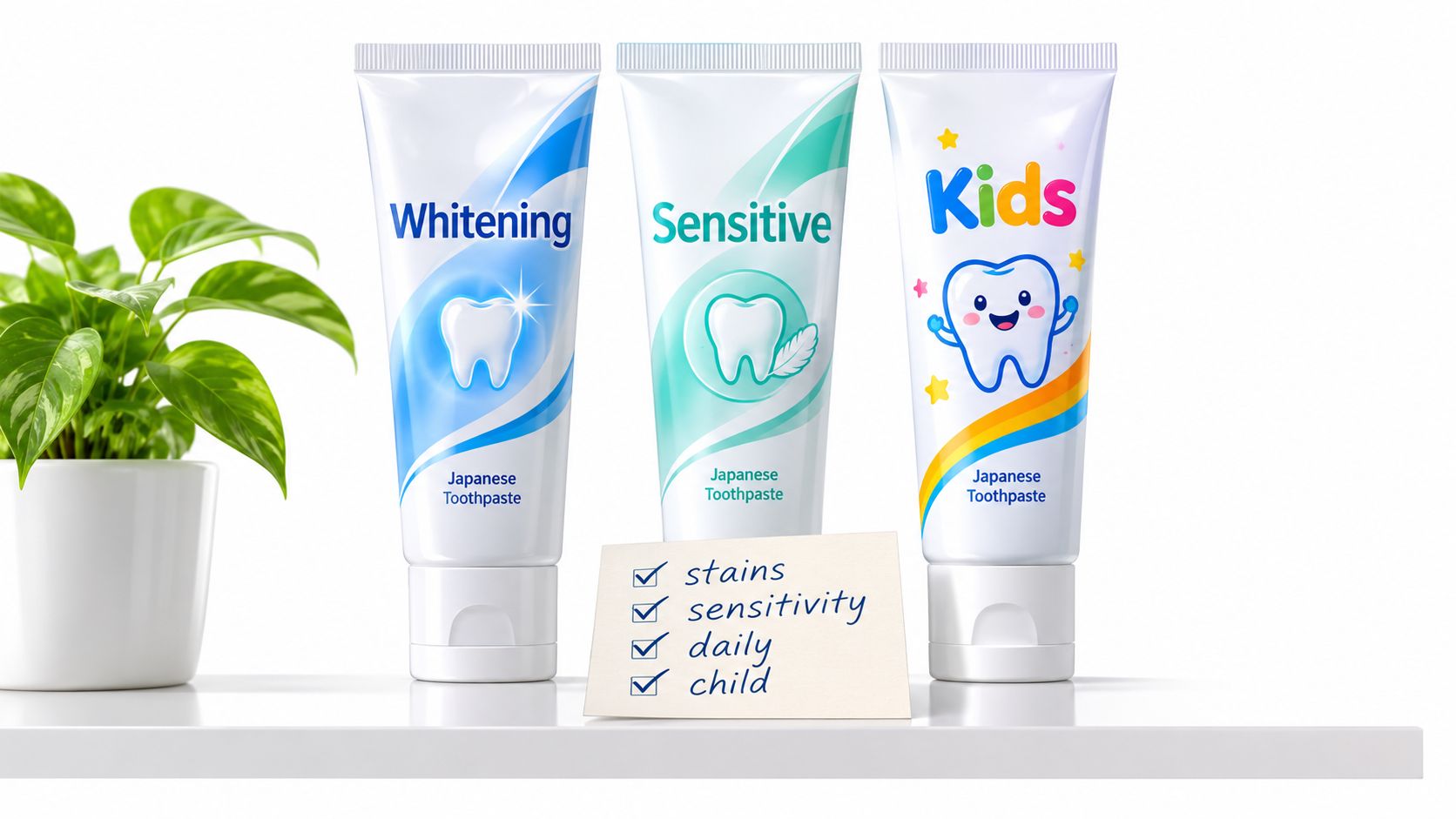
A brand list won't help you much if you don't know what each formula is trying to do. Start with four practical families. Your main concern should narrow the shelf quickly, whether that's surface stains, sensitivity, a preference for herbal ingredients, or stronger daily prevention.
Japanese Toothpaste Types at a Glance
| Type | Primary Focus | Common Ingredients | Best For |
|---|---|---|---|
| Whitening | Removing extrinsic surface stains | Hydrated silica, polishing agents, hydroxyapatite | Tea, coffee, and everyday surface dullness |
| Sensitivity and enamel care | Comfort and lower abrasion support | Hydroxyapatite, sensitivity focused actives, fluoride in some formulas | Teeth that react to cold, sweets, or brushing |
| Herbal or natural | Plant based flavor and gentle positioning | Botanical extracts, sometimes lower fluoride or no fluoride | Shoppers prioritizing ingredient style and mild taste |
| Fluoride focused medicated | Cavity prevention as the baseline | Sodium fluoride or sodium monofluorophosphate | Daily prevention, including exposed root surfaces |
Whitening toothpaste is often misunderstood. Most formulas polish away stains sitting on the surface, they don't bleach the inner tooth. That can make teeth look cleaner, but it also creates a trade off, because stronger polishing may not suit exposed dentin or sensitive areas near the gumline.
Sensitivity and enamel care formulas take the opposite approach. They usually prioritize comfort, lower abrasion, and mineral support over an intensely polished feeling. If cold drinks make you wince, this family deserves attention before whitening, even if brightness is also a goal.
A whitening claim tells you the goal. The abrasive and active ingredients tell you the method, and the method determines whether the product fits your teeth.
Herbal or natural options may use plant extracts and softer flavors, but natural doesn't automatically mean gentler, safer, or effective for cavity prevention. Check whether fluoride is present and at what level. If prevention is your priority, a pleasant botanical list can't replace that information. Readers who like ingredient led personal care may also enjoy learning about a natural soap bar and plant based cleansing, but oral care still requires its own evidence check.
Fluoride focused medicated toothpaste is the prevention backbone of the category. A Japanese Dental Association publication identifies fluoride toothpaste and fluoride mouthwash as self care measures that can help prevent and control root caries. That's relevant for adults with gum recession and exposed roots, though it isn't a promise of treatment. For most shoppers with no urgent cosmetic concern, this is the sensible starting point.
How to Read a Japanese Toothpaste Label
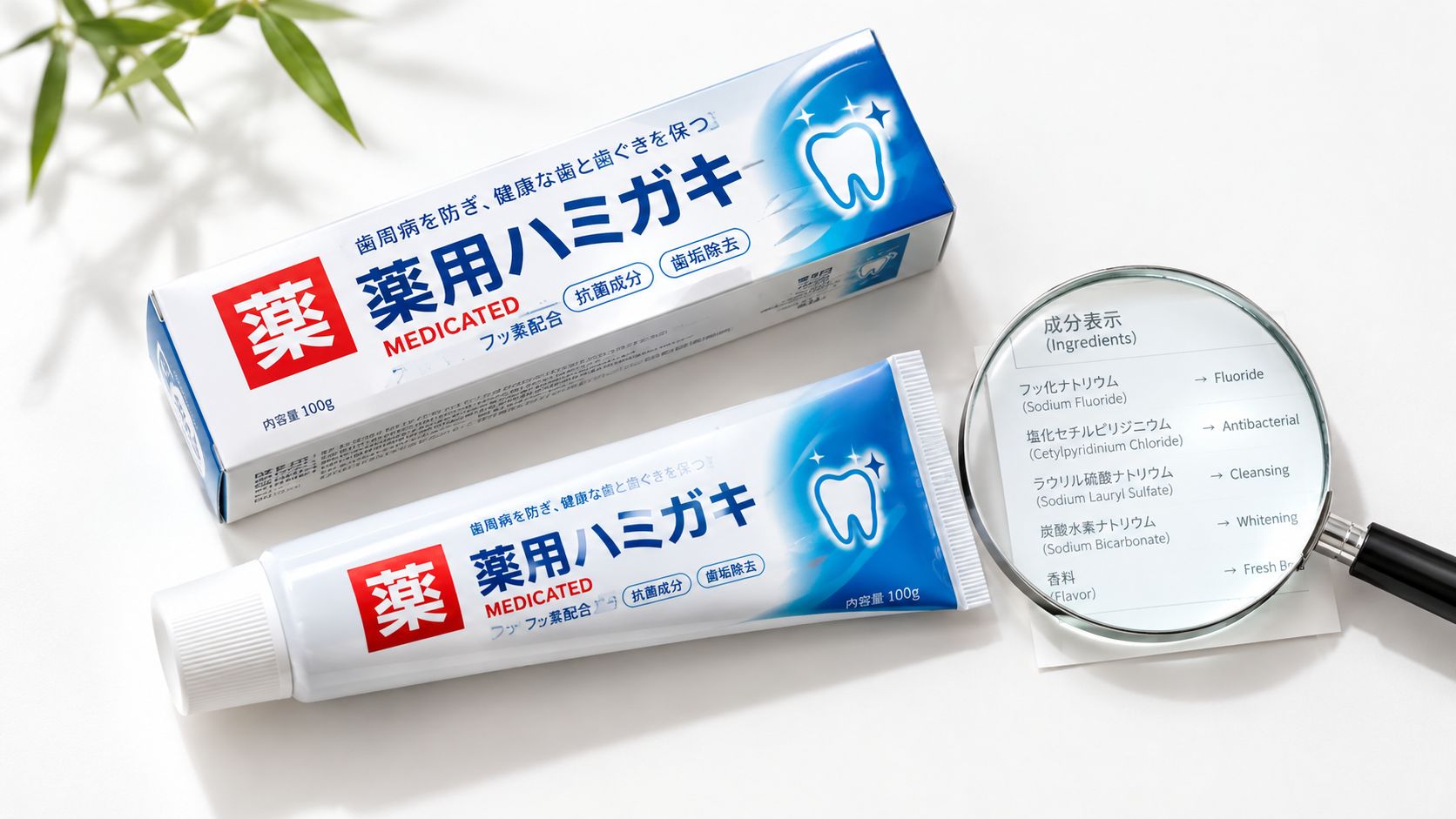
You don't need fluent Japanese to make a better choice. You need a scanning order. Start with the front for the product's main purpose, then move to the back for the active ingredient, concentration, age guidance, and warnings.
Start With Fluoride Type and Ppm
Fluoride toothpaste alone is too vague. Look for sodium fluoride or sodium monofluorophosphate, followed by a concentration such as 1,000 ppm or 1,500 ppm. Ppm means parts per million, and it's the clearest way to compare preventive strength across products.
- Find the purpose: Whitening, sensitivity, gum care, plaque control, or daily prevention
- Identify the active: Check the fluoride compound, hydroxyapatite, enzyme, or sensitivity ingredient
- Check the amount: Confirm ppm and any age guidance before buying for a child
- Scan for fit: Note abrasives, foaming agents, flavors, and caution statements
Transparency matters because similar packaging can hide different levels. A laboratory study of eight Japanese sodium fluoride toothpastes with undisclosed concentrations found one below 500 ppm F, four near 500 ppm F, and only three in the 900 to 1,000 ppm F range. If the concentration isn't visible, treat that as missing decision information.
Translate the Supporting Ingredients
Hydrated silica is a common abrasive that helps remove surface stains. More polishing isn't automatically better, especially for sensitive teeth. Sodium lauryl sulfate, often shortened to SLS, creates foam, but foam doesn't clean your teeth by itself, and some people prefer to avoid it if their mouth feels irritated.
Hydroxyapatite is a calcium phosphate mineral related to the mineral in enamel. Its position in the ingredient list and, when disclosed, its concentration matter more than a front of pack mention alone. Enzymes suggest a plaque focused approach, while herbal extracts mainly tell you about flavor or positioning unless they're listed as approved active ingredients.
The Japanese term often translated as medicated signals a quasi-drug product with recognized active ingredients and approved purposes. It doesn't mean the toothpaste treats disease or guarantees a result. Read it as a prompt to ask a narrower question, medicated for what, with which active, and at what strength.
Safety and Efficacy Questions Worth Asking
A good choice isn't only about what a toothpaste might help with. It's also about what could make it a poor fit. Abrasivity, swallowing, irritation, and overstated ingredient claims are the four areas where shoppers most often get confused.
Abrasion Helps Stains but Has Limits
Abrasive particles mechanically remove extrinsic stains during brushing. The trade off is that repeated high abrasion use may be unsuitable for exposed dentin, cervical lesions, or sensitive teeth. Japanese research using the RDA-PE method combined standardized brushing of 10,000 strokes on dentin with non contact profilometry to measure abrasion depth, as described in the Japanese study on toothpaste abrasivity and fluoride retention.
That research also found that a version with 0% abrasive retained significantly more fluoride at 10, 20, and 30 minutes than versions adjusted to higher abrasive levels in the same base. You don't need to memorize the experiment. Remember the principle, stronger stain polishing and maximum fluoride retention aren't always the same goal.
Hydroxyapatite Is Promising but Not a Simple Replacement
Hydroxyapatite is often presented as either a miracle alternative or an unproven novelty. Neither shortcut is useful. A systematic review cites a Japanese randomized trial in 181 schoolchildren where toothpaste containing 5% hydroxyapatite significantly reduced DMFT over three years, compared with a placebo containing neither hydroxyapatite nor fluoride.
That comparison matters. Beating a placebo without fluoride doesn't prove equal real world cavity prevention against a standard fluoride toothpaste. A separate 2025 laboratory study found a tablet with 5% nanohydroxyapatite performed similarly to 1,100 ppm sodium fluoride toothpaste against demineralization under controlled conditions, according to the 2025 microbial study on nanohydroxyapatite toothpaste tablets, but laboratory performance isn't the same as cavity outcomes in daily life.
- For sensitivity: Prefer lower abrasion and stop whitening focused products if discomfort increases
- For children: Use age appropriate amounts, supervise brushing, and discourage swallowing
- For SLS concerns: Choose an SLS free formula if foam leaves your mouth feeling irritated
- For prevention: Don't replace an established fluoride routine based only on a marketing claim
People who already choose gentle routines, such as a face cleanser for sensitive skin, often understand this balance. Gentler can be appropriate, but gentle still needs a clear purpose. If pain, bleeding, or a visible cavity is present, toothpaste selection isn't a substitute for dental care.
Choosing and Buying Authentic Japanese Toothpaste
Match the product family to one main need, then verify the label before you worry about branding. That order prevents the most common mistake, buying a whitening tube for sensitive teeth or a low fluoride herbal paste when daily cavity prevention was the goal.
A Simple Matching Method
- Surface stains without sensitivity: Start with a whitening formula and check its abrasive system
- Cold or sweet sensitivity: Prioritize sensitivity and enamel care over polishing
- Everyday prevention: Choose a fluoride focused medicated formula with a clearly stated ppm
- Children: Select by age guidance and concentration first, not by character packaging or flavor
Labels can help you verify newer products. Japanese regulations require high fluoride toothpastes above 1,000 ppm and up to 1,500 ppm to display both fluoride concentration and cautionary usage information, with labeled values rounded for easier comparison. If a listing claims high fluoride but shows no ppm value, ask for clearer packaging information.
Check Authenticity Before You Order
Look for clear Japanese packaging, manufacturer details, a complete ingredient panel, and product photos that match the exact variant described. Be cautious with repackaged items, missing outer boxes, or listings that use popularity as their only evidence. Ingredient panels can change, so check the current package when your order arrives.
Buy Me Japan is one option for shoppers who want authentic Japanese products sourced through official suppliers in Japan, with tracked shipping and secure payments. That matters here because the product name alone isn't enough, you need the correct formulation and packaging. Browsing a curated guide to what to buy in Japan for cosmetics and personal care can also help you compare adjacent categories without mixing cosmetic claims with medicated oral care claims.
Using Japanese Toothpaste and Getting Started
Use a pea sized amount unless the package gives different age specific directions. Brush gently with a soft brush, spit thoroughly, and avoid swallowing. For children, follow the product's age guidance and supervise brushing until they can spit reliably.
Quick Answers for First Time Buyers
- Can hydroxyapatite replace fluoride: It may suit some routines, but the evidence and comparisons aren't identical, so don't assume equivalence from the ingredient name alone
- How do you spot SLS free toothpaste: Check the ingredient list for sodium lauryl sulfate rather than relying on foam level
- Will whitening toothpaste bleach teeth: Most formulas manage surface stains, so expect a cleaner appearance rather than a changed natural shade
- Can you use it daily: Daily use depends on the formula's abrasion and directions, so reserve stronger whitening products for label directed use
Start with one tube that matches your biggest concern, use it consistently, and judge comfort as carefully as appearance. If you enjoy building a considered Japanese bathroom routine, you can also explore Japanese bath products for a complete self care ritual. The core lesson stays the same, read the active ingredient, confirm the strength, and let your actual need lead.
Browse authentic Japanese toothpaste and related personal care essentials at Buy Me Japan, where products are sourced from Japan for international shoppers. Compare the packaging, active ingredients, and fluoride concentration before you choose, then start with the formula that fits your teeth and your daily routine.

Compartir:
Minon-Ratgeber für empfindliche Haut und die tägliche Pflege