


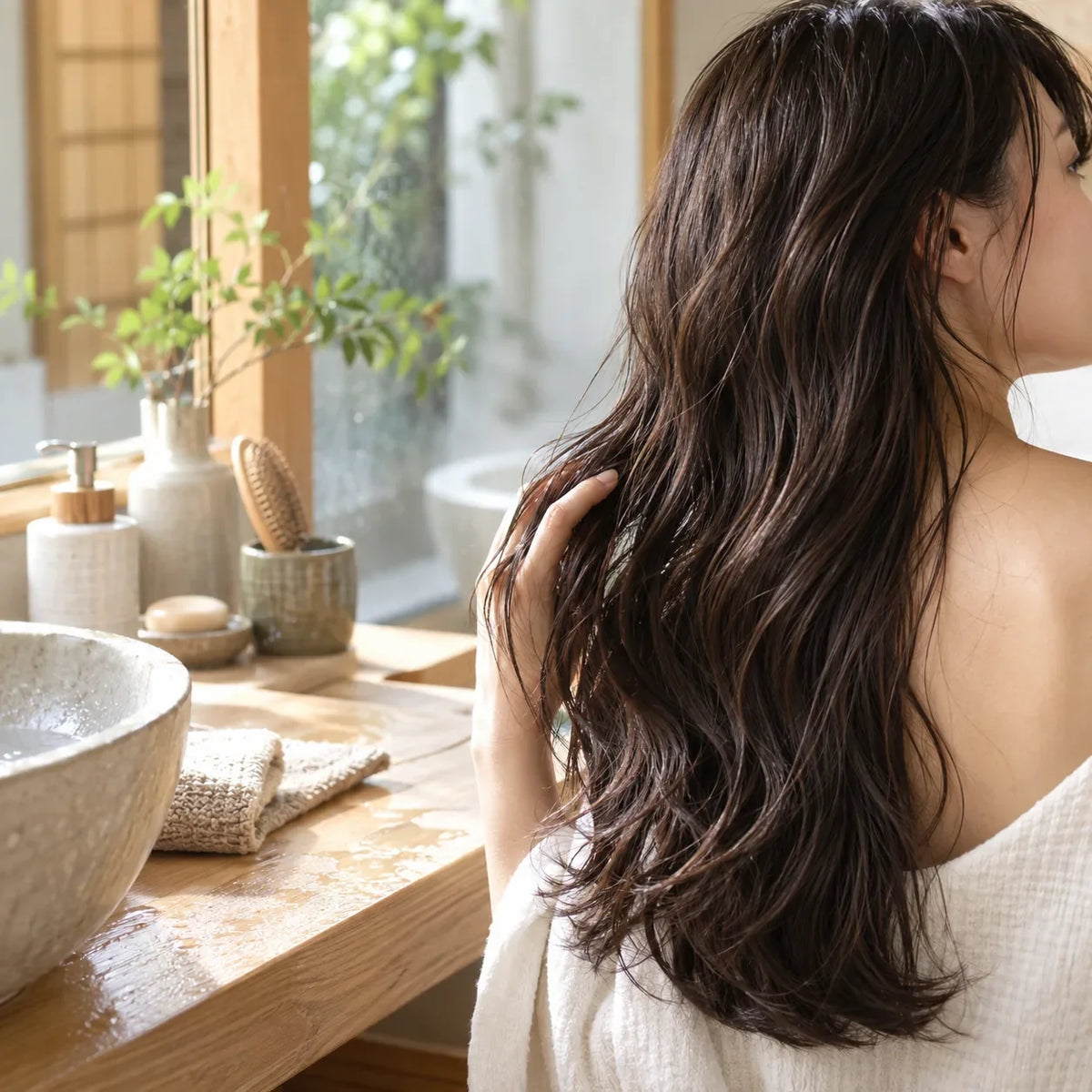
Frizz is not one single problem, so “use a richer shampoo” is not a very satisfying answer. Hair that puffs up in humid air needs a smoother surface; hair that feels brittle and catches on a brush needs gentler cleansing and more conditioning. The best Japanese shampoo for frizzy hair is the one that matches the reason your hair is unruly, not the one with the most dramatic promise on the bottle.
Japanese hair-care ranges make that comparison fairly easy because they tend to separate cleansing, treatment, and finishing products. Start by watching your hair for a few days. Does it expand when the weather is damp? Does it feel rough even after a careful wash? Do your roots become flat while the ends stay fuzzy? Those details tell you more than the word “moisture.”
First, work out what kind of frizz you have
Humidity frizz is the halo of short hairs and the sudden loss of shape that arrives in damp weather. Porous hair takes on moisture from the air, the fiber swells, and waves or curls separate. This hair usually likes a smooth, light coating and a routine that does not leave the cuticle feeling rough.
Dryness and damage frizz feels different. The ends may be crackly, tangle easily, or look frayed in every season. Frequent heat styling, colouring, chemical services, and rough towel drying can all contribute. A richer conditioner or treatment may make the lengths easier to handle, but a shampoo cannot reverse a split end. It can only set up a cleaner, less abrasive wash.
Fine, low-porosity hair can have either problem. Heavy oils and dense masks may sit on the surface, flatten the roots, and make the hair look even less controlled. Coarse or curly hair often has more room for conditioning, especially through the mid-lengths and ends. Think of this as a starting point rather than a permanent hair type.
Read the formula by its job
A shampoo has two competing tasks: remove sweat, sebum, and styling residue, then leave the surface comfortable enough for the next step. Milder cleansing systems can feel better on dry or frequently washed hair. Stronger cleansing can be useful when the scalp is coated, but it may make fragile ends feel squeaky if you use it too often.
Conditioning polymers, silicones, oils, proteins, and humectants each change the feel in a different way. A polymer or silicone can add slip and reduce the catching that makes frizz look worse. Oils can soften a coarse end, although a fine strand may need only a trace. Proteins can make porous hair feel more substantial for a while; too much can make some hair feel stiff. Glycerin and panthenol can support a comfortable finish, but the whole formula and your climate still matter.
Ingredient order is useful, but it is not a scorecard. An ingredient near the beginning generally has a larger share of the formula, while a botanical highlighted on the front may be present in a smaller amount. If the product page provides the Japanese label, compare the complete list rather than choosing by “camellia,” “rice,” or “repair” alone.
Three catalog options for different routines
These active listings give you three practical starting points. They are sets, so check the current contents and variant on the product page before ordering. Each image below is the exact live catalog image for the linked item.
YOLU Deep Night Repair Shampoo, Treatment, Hair Mask & Hair Oil Set
This set is a sensible comparison for someone who wants a complete, richer night-care routine rather than shampoo alone. The treatment, mask, and oil let you adjust how much conditioning the lengths receive. If your hair is fine, start with the shampoo and treatment, then add the mask or oil only where the ends still feel rough.

8 The Thalasso Smooth Repair & Aqua Serum Shampoo and Treatment Set
The words “smooth repair” make this a natural fit for hair that feels rough or loses polish after drying. It is a simpler two-step choice than the YOLU set, which can be helpful if too many finishing products leave your hair heavy. Work the treatment through the lower half of the hair and rinse carefully around the nape.

& Honey Professional IPS System Repair Shampoo, Treatment & Hair Oil Set
This set suits shoppers who want a repair-focused routine with an oil finish available for the ends. “Professional” describes the line, not a guarantee that every head of hair will respond the same way. Use a small amount of oil after drying, especially if your strands are fine or your scalp becomes oily quickly.

A wash routine that leaves less work for styling
- Wet the hair completely. A full lukewarm rinse loosens surface residue before you add cleanser.
- Clean the scalp, not the ends. Massage with fingertips and let the foam run through the lengths instead of scrubbing them.
- Repeat only when needed. A second wash can help after heavy styling, but it is not a rule for every wash day.
- Press out water before treatment. A damp surface lets a rinse-out product spread without being diluted by dripping water.
- Detangle gently. Use your fingers or a wide-tooth comb from the ends upward. Pulling through knots creates its own frizz.
- Rinse until the hair feels clean but flexible. Residue can flatten fine roots, while under-rinsing can make any texture feel coated.
Drying matters just as much. Blot with a soft towel rather than twisting the hair, then direct the dryer downward along the shaft. Keep the heat moving and use a separate heat-protective product when you need one; do not assume a shampoo set provides that protection.
Change the routine with the weather
In humid weather, simplify. A shampoo, light conditioner, and a small amount of smoothing leave-in are often easier to control than oil, mask, cream, and serum layered together. In a dry winter or an air-conditioned room, the ends may appreciate a richer treatment and less frequent cleansing, provided the scalp stays comfortable.
If your roots are oily but your ends are dry, split the routine instead of asking one product to do everything. Keep cleansing concentrated at the scalp and place conditioning below the ears. A clarifying wash can be useful when buildup is obvious, but it should not become a weekly punishment for ordinary frizz.
What to expect—and what not to expect
A good shampoo routine can make detangling easier, reduce surface roughness, and help the hair look more orderly. Those are cosmetic improvements. It cannot rebuild a broken strand or guarantee that humidity will never affect your hair. If the ends continue to split or the scalp is persistently irritated, a trim or professional advice is more useful than adding a stronger cleanser.
For more context, compare our Japanese hair conditioner guide and clarifying shampoo guide. The right Japanese shampoo for frizzy hair is the one that leaves your scalp comfortable, your lengths manageable, and your styling routine simpler than it was before.


Share:
Japanese Soy Sauce for Sushi Types Flavors and How to Use
Best Felt Tip Eyeliner: Picks for Every Eye