


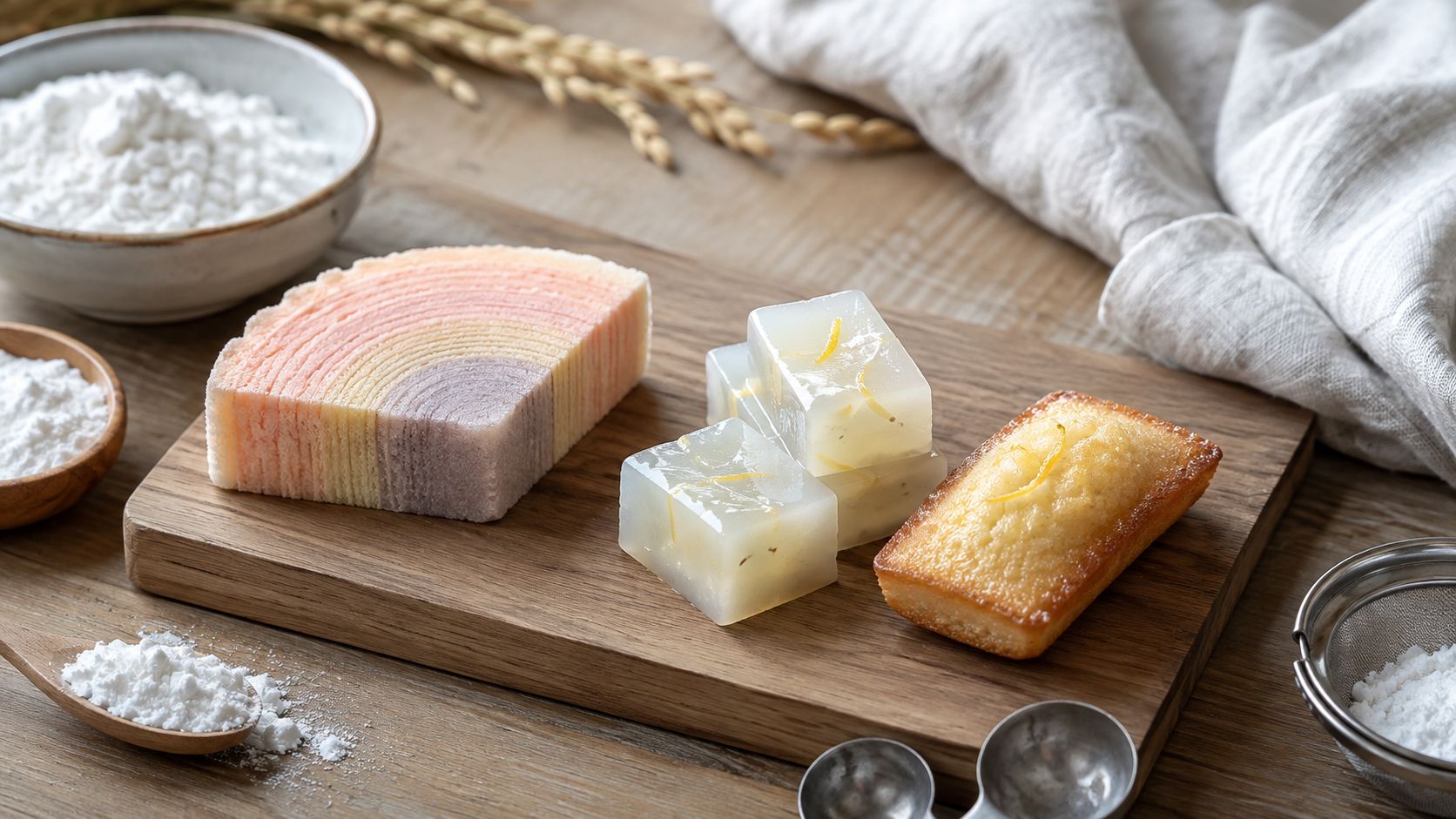
You've pulled a rice-flour cake from the oven, expecting a tender wheat-style crumb, but the center is dense, chewy, or slightly gummy. That result doesn't mean rice flour failed. It means the flour needs a different method.
This guide explains how rice flour cakes work, how Japanese flours such as joshinko, mochiko, and shiratamako differ, and how to choose the right flour for baking or steaming. You'll also find practical substitution guidance, troubleshooting, two adaptable recipes, and buying advice for authentic Japanese ingredients.
What Rice Flour Cakes Are and Why They Behave Differently
Rice flour cakes are cakes made primarily from milled rice rather than wheat. The category is broad. It includes baked financiers, pancake-style treats, steamed uirō, chewy mochi cakes, and layered desserts inspired by baumkuchen.
The first important difference is the absence of gluten-forming proteins. Wheat flour can create an elastic network that traps gas and supports a familiar cake crumb. Rice flour can't build that same network, so eggs, starch gelatinization, leavening, fats, and hydration must provide more of the structure.
Rice starch contains two main components, amylose and amylopectin. Their balance affects how the batter absorbs water, sets during heating, and changes during storage. Sweet rice flour contains mostly amylopectin, which produces a creamy batter and a soft, stretchy texture. Long-grain rice flour, with about 25–30% amylose, tends to produce a firmer, shorter crumb. These starch differences are described in Baking Business's explanation of starch and cake texture.
Why the texture changes after baking
A rice cake can feel pleasantly soft when warm, then become dry and crumbly as moisture escapes. It can also become sticky or firm as starch molecules realign, a process called retrogradation. Research on a rice-flour cake model found that most texture deterioration happened during the first day of storage. Crumb firmness rose significantly after one day, stayed similar through days two and three, and then increased slightly through day five, while moisture declined after two days, as reported in this rice-flour cake storage study.
That's why a successful recipe must control more than flour quantity. Hydration, sugar, fat, egg, particle size, baking temperature, and storage all influence the final bite.
Practical rule: If you want a soft rice-flour cake, solve hydration and staling before adding more leavening.
The cultural meaning of rice also matters. Even the Japanese word gohan connects cooked rice with a meal, as explained in this guide to what gohan means in Japanese. Rice flour cakes belong to a much larger food tradition, but their modern success depends on understanding the starch beneath that tradition.
Japanese and Global Rice Flour Cake Traditions
Japanese rice cakes aren't one single dessert. Their textures range from elastic and chewy to tender, translucent, and softly steamed, depending on the rice, grinding method, and cooking technique.
Mochi is the most familiar example internationally. Traditional mochi uses pounded glutinous rice, creating a stretchy texture that can be filled, grilled, or served with sweet toppings. Kyushu's karukan takes a different direction. It's a steamed cake made with rice-based ingredients and often flavored with mountain yam, producing a light, moist texture rather than the dense chew associated with mochi.
Kuzu mochi uses kudzu starch and has a smooth, delicate set. Uirō, another Japanese steamed cake, is made with rice flour and sugar. One documented preparation uses 160 g rice flour, 40 g potato starch, 120 g white sugar, and 520 ml water for one layer, while another uses 160 g warabi-mochiko, 80 g rice flour, 200 g sugar, and 480 ml water for a separate layer, as shown in this traditional uirō recipe. The high water ratio and starch blending help create uirō's translucent, yielding texture.
In other parts of Asia, rice cakes follow local ingredients and customs. Korea's tteok includes steamed and pounded rice preparations with textures from tender to springy. China's niangao is associated with Lunar New Year and is often made from glutinous rice flour. Southeast Asian kueh and Vietnamese bánh use rice flour, coconut, palm sugar, pandan, and steaming to create layered or jelly-like sweets.
India has its own rice-based steamed cakes and savory preparations, including rice flour dhokla-style foods. Europe developed desserts such as Italian torta di riso, while French rice desserts often emphasize milk, sugar, and a soft baked set. In the United States, mochi donuts and mochi muffins have introduced chewy rice-based textures to a wider bakery audience.
The shared idea is simple: rice can create a tender crumb or satisfying chew without wheat. Local cooks then shape that base with regional sugars, fats, fruits, beans, seeds, and aromas. For a modern example of how Japanese rice traditions meet a contemporary dessert format, see this guide to black sesame mochi ice cream.
Rice Flour Types and Their Baking Characteristics
A cake made with Japanese rice flour can turn tender, stretchy, or pleasantly firm, depending on the flour in your bowl. The name on the package identifies the rice and the milling method, so choosing the flour should come before adjusting a recipe.
Joshinko is regular rice flour made from non-glutinous rice. It produces a tender, relatively short crumb and suits baked or steamed cakes that need shape without much stretch. Use it for structured batters and steamed sweets such as uirō.
Mochiko is sweet rice flour made from glutinous rice. “Glutinous” means sticky, not that the flour contains wheat gluten. Its starch is rich in amylopectin, which gives cakes a chewy, elastic bite. Mochiko fits mochi cakes, butter mochi-style bakes, chewy rings, and dense steamed sweets.
Shiratamako also comes from glutinous rice, but its processing is different. The rice is soaked and milled, creating a flour that hydrates into a glossy, elastic dough. It is especially useful for daifuku and refined wagashi. Mixed with regular rice flour, it can also give a steamed cake more resilience.
Western long-grain and medium-grain rice flours can work, but milling quality and particle size affect the result. Fine, wet-milled, or micronized flour generally makes starch available more evenly during gelatinization, which can support better lift and a smoother crumb.
Rice flour comparison for cake baking
| Flour Type | Source Rice | Texture in Cake | Best For |
|---|---|---|---|
| Joshinko | Non-glutinous Japanese rice | Tender, short, cake-like | Baked cakes, steamed uirō, structured batters |
| Mochiko | Glutinous rice | Stretchy, chewy, dense | Mochi cakes, chewy rings, filled sweets |
| Shiratamako | Soaked and milled glutinous rice | Glossy, elastic, smooth | Daifuku, wagashi, blended steamed cakes |
| Long or medium grain rice flour | Long- or medium-grain rice | Firmer and more crumbly when higher in amylose | General gluten-free baking and firmer cakes |
Particle size changes how quickly flour absorbs liquid. Fine flour disperses readily. Coarser flour may leave a sandy mouthfeel unless the batter rests. Pre-gelatinized rice flour behaves differently again because some starch has already been cooked and dried before mixing.
For international shoppers, the rice variety matters as much as the label. Japanese rice-based foods are closely tied to everyday eating culture, while rice cakes have also become an established commercial category. A market overview reports that rice cakes represented 18.3% of the rice-based products market in 2024, with a 4.8% forecast growth rate for 2025–2033, as detailed in this rice-based products market overview. For a familiar non-Japanese comparison of rice varieties and everyday use, see this article on Kokuho Rose rice.
Substitution Ratios, Benefits, and Troubleshooting
Rice flour has a useful advantage in cakes. It provides a naturally gluten-free base with a clean flavor that lets matcha, yuzu, black sesame, and kinako remain noticeable. The texture can feel lighter than a wheat cake, but the flour isn't a universal cup-for-cup replacement.
For a standard cake, regular rice flour can replace wheat flour at 1:1 by volume when blended with 15–20% starch or tapioca for additional binding. Sweet rice flour can also be used at 1:1, but it needs more liquid, roughly 2 extra tablespoons per cup, because its starch creates a thicker, chewier batter.
Don't judge the batter immediately after mixing. Let it rest for 15 minutes so the flour can hydrate. A short rest often improves smoothness, especially with flour that isn't finely milled.
Rice flour substitution ratios and quick fixes
| Problem | Cause | Quick Fix |
|---|---|---|
| Dry cake | Overbaking or insufficient hydration | Lower the oven temperature by 25°F and check earlier |
| Sandy texture | Coarse flour or uneven hydration | Rest the batter 15 minutes before baking |
| Sunken center | Weak structure or excess liquid | Add one egg white for additional support |
| Gummy interior | Too much moisture or underbaking | Extend cooking gently and confirm the center has set |
Sugar also affects softness because it competes with starch for water. Fat improves tenderness, while eggs help emulsify the batter and support its set. If you're avoiding dairy, use a suitable plant-based milk with a similar thickness, but expect some texture variation. For egg-free baking, a recipe may need a carefully chosen starch or commercial egg replacer because eggs provide both structure and emulsification.
Baking note: A rice-flour batter should look smooth and cohesive before it enters the oven. If it looks gritty, the finished cake usually will too.
Rice flour works particularly well for cakes, muffins, steamed sweets, and pancake-style treats. It isn't the right choice for every pastry. Laminated doughs rely on wheat gluten for extensibility and layering, so a simple rice flour swap will usually disappoint.
For readers planning several wheat-free meals alongside dessert, an AI Meal Planner gluten free plan can help organize broader ingredient choices. Rice-based ingredients also appear in other pantry traditions, including the useful guide to where to buy pearl sago.
Two Reliable Rice Flour Cake Recipes to Try at Home
These two recipes use the same broad ingredient family but produce very different results. The baumkuchen-style cake is baked and chewy, while uirō is steamed and translucent.

Baked mochi baumkuchen style ring
This simplified recipe adapts the liquid, egg, and leavening balance used in a Japanese rice-flour baumkuchen recipe, which specifies 100 g rice flour, 1 egg, 2 tablespoons refined sugar, 130 cc milk, and 1/2 teaspoon baking powder, as shown by Japan Rice's rice-flour baumkuchen recipe.
| Ingredient | Amount |
|---|---|
| Mochiko or sweet rice flour | 100 g |
| Egg | 1 |
| Sugar | 25 g |
| Milk | 130 g |
| Baking powder | 2 g |
| Neutral oil | 15 g |
Whisk the egg, sugar, milk, and oil until smooth. Add the mochiko and baking powder, then mix until no dry pockets remain. Rest the batter briefly while you prepare a lined loaf pan or ring mold.
For a traditional layered effect, spread a thin layer in a heated pan or shallow mold, bake until set, add another layer, and repeat. In a small kitchen, a loaf pan is simpler. Bake until the center reaches 95°C, then cool before slicing.
Serve slices with kinako mixed with sugar, toast them under the broiler until puffed, or eat them plain while the edges remain slightly crisp.
Steamed uirō with yuzu
| Ingredient | Amount |
|---|---|
| Joshinko | 120 g |
| Shiratamako | 40 g |
| Sugar | 100 g |
| Water | 300 g |
| Yuzu zest | 1 teaspoon |
Whisk the shiratamako with part of the water first to remove lumps. Add the joshinko, sugar, remaining water, and yuzu zest. Pour the smooth mixture into a heatproof lined dish and steam until the center reaches 80°C and the cake looks translucent and set.
Cool it fully before cutting into cubes. Uirō is excellent with kuromitsu syrup, lightly dusted with kinako, or served alongside green tea.
For a dairy-free baumkuchen, use an unsweetened plant milk with a similar body. For an egg-free version, use a tested egg replacer that contributes binding, not just moisture. The steamed uirō is easier to adapt because it relies mainly on starch gelatinization rather than egg structure.
How to Choose and Buy Authentic Japanese Rice Flours
A bag labeled “rice flour” doesn't tell you enough. The rice variety, milling method, particle size, and freshness determine whether your batter becomes smooth, gritty, chewy, or firm.
Japanese baking flours are commonly milled from short-grain japonica rice, which can provide predictable hydration and a characteristic soft or elastic texture. That doesn't mean every Japanese product will outperform every imported flour. It means the product's intended use is usually clearer, especially when the package identifies joshinko, mochiko, or shiratamako.
What to check on the package
Look for a flour that matches the recipe rather than choosing by appearance alone.
- Read the Japanese name: Joshinko is regular rice flour, while mochiko and shiratamako are sweet rice flours with chewy behavior.
- Check the grind: Fine flour hydrates more evenly and is usually easier for cakes.
- Look for freshness: A recent milling date is preferable because rice flour can lose freshness and absorb odors.
- Inspect the packaging: An opaque, airtight bag offers better protection from light, humidity, and pantry smells.
- Confirm the ingredient list: A short ingredient list makes it easier to understand whether the product is pure rice flour or a blend.
Terms such as jōsui or kyūsui may appear on Japanese packaging, but labeling conventions vary by product. Treat them as clues, not as a guarantee of baking performance. If the bag has a stale smell, visible clumps, moisture damage, or unclear labeling, choose another package.
Store opened flour in a sealed container. Freezer storage can help preserve freshness, but let the flour return to room temperature before measuring so condensation doesn't change the hydration.
Buying insight: The right flour is the one whose starch behavior matches your planned texture. Don't buy mochiko for a delicate sponge or joshinko when you want a stretchy mochi cake.
You can shop for Japanese pantry items through Japanese supermarkets, specialty online retailers, or sellers that clearly show the product name, ingredient information, and origin. Buy Me Japan ships Japanese products directly from Japan and provides an international shopping channel for customers looking for Japanese food and household items. Its Japanese food online shopping guide for the USA can also help first-time buyers think through ordering and delivery considerations.
Key Takeaways for Your Next Rice Flour Bake
Rice flour cakes become much easier once you stop treating every rice flour as interchangeable.
Choose joshinko when you want a structured, tender crumb. Choose mochiko for chew, elasticity, and mochi-style cakes. Choose shiratamako when you want a particularly smooth, glossy, elastic texture, especially in daifuku or a blended steamed dessert.
For substitutions, regular rice flour can replace wheat flour at 1:1 by volume when you add 15–20% starch or tapioca for binding. Mochiko can be used at 1:1, but plan for roughly 2 extra tablespoons of liquid per cup. If a cake turns dry, lower the oven temperature by 25°F. If it feels sandy, rest the batter for 15 minutes. If the center collapses, try one extra egg white for structure.
The cleanest first experiment is a steamed uirō because steaming highlights hydration and starch behavior without demanding a wheat-like crumb. If you prefer a richer bake, try the layered mochi baumkuchen-style cake and monitor the internal temperature rather than relying only on color.
Rice flour is also part of a growing commercial category. The global rice cakes market was valued at USD 34.84 billion in 2022 and is projected to reach USD 55.2 billion by 2030, representing a projected 6.5% compound annual growth rate from 2023 to 2030, according to Data Bridge Market Research's global rice cakes report. That scale reflects a food tradition that has moved into international baking and packaged-food channels.

Start with one clearly labeled Japanese flour, weigh your ingredients, rest the batter, and record the texture when warm and after storage. A Japanese grocery or trusted online retailer can help you find the correct flour type, authentic origin, and packaging suited to international shipping.
Buy Me Japan offers Japanese food and lifestyle products shipped directly from Japan, including pantry items and carefully selected goods from trusted Japanese brands. Visit Buy Me Japan to explore authentic Japanese products for your next rice flour cake experiment and everyday shopping.


共有する:
Hairstyle Cover Forehead: Flattering Styles and Tips
Japanese Moisturizer for Oily Skin: How to Choose One That Won’t Feel Greasy