


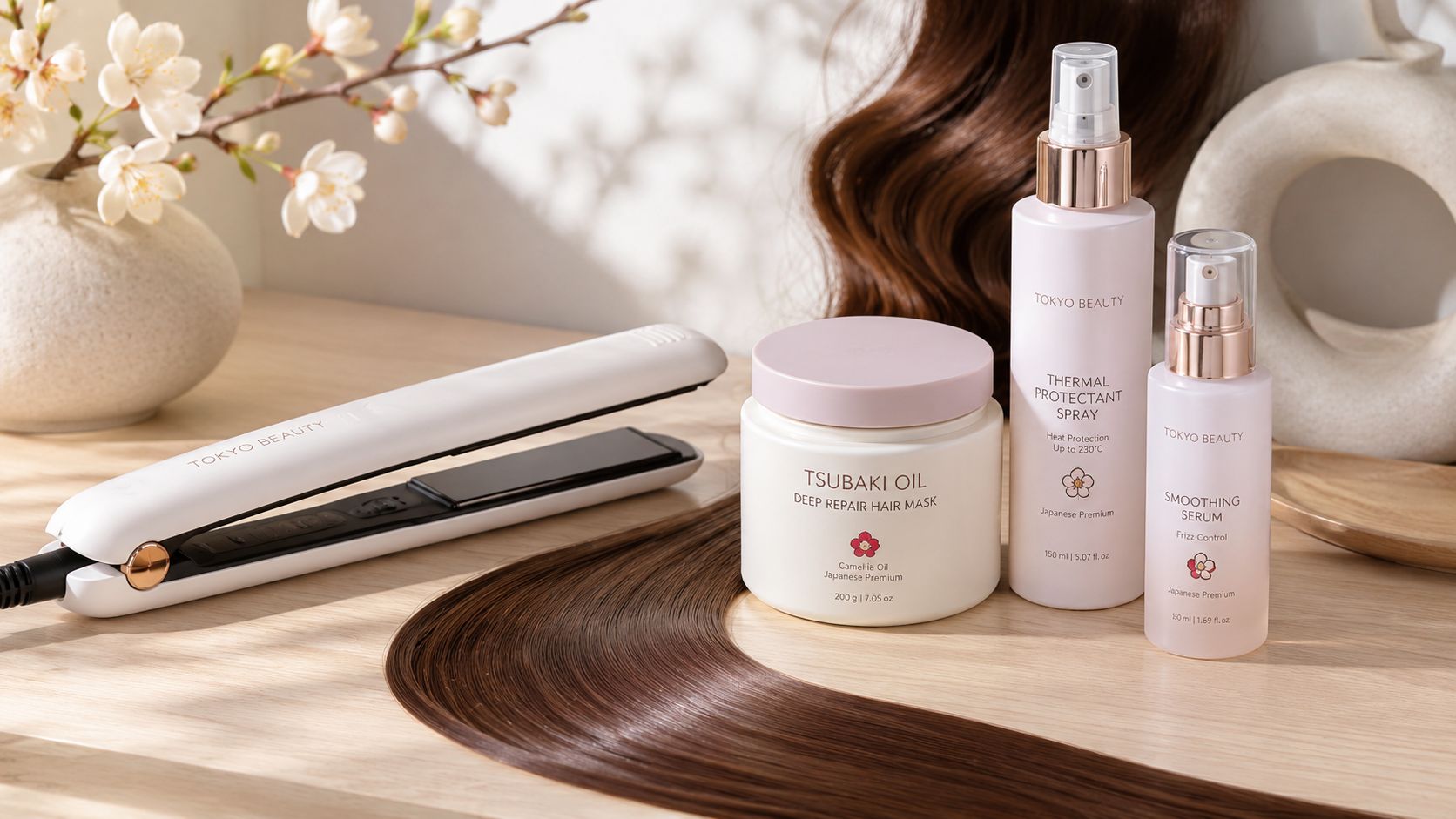
You're probably here because you want the sleek, glossy look often associated with Japanese hair care, but you're also running into a frustrating problem. Some products say “straightening,” some say “smoothing,” and some salon services promise a permanent result. It's not obvious what you can safely buy for home use and what belongs in a professional chair.
That confusion is normal. In Japanese beauty, “straight” hair can mean two very different things: a permanent chemical texture change, or a daily-care routine that helps hair look smoother, shinier, and more controlled. Both matter, but they're not interchangeable.
If you shop internationally, this difference becomes even more important. The products you can order from Japan are usually the second category: shampoos, masks, serums, oils, and styling aids that support a straight, polished finish. The first category, true thermal reconditioning, is a salon treatment with lasting structural change. Knowing which path you want will save you money, protect your hair, and help you choose the right Japanese hair straightening products.
Understanding Japanese Hair Straightening
You find a product online labeled “Japanese hair straightening,” add it to your cart, and then pause. Are you buying a permanent treatment, or a shampoo-and-serum routine that helps hair dry smoother? For international shoppers, that question matters because the two options solve different problems and are sold in very different ways.
The easiest way to sort this out is to separate hair structure change from surface control.
A salon straightening service changes the hair's internal shape. Daily-use products work on the outer behavior of the hair fiber. They can reduce frizz, help strands lie flatter, add slip, improve shine, and make blow-drying more predictable. They do not replace a professional chemical service.
Two meanings of straightening
Many Japanese beauty listings use “straight,” “straight care,” or “straight keep” in a broad way, so the label alone can be misleading. What matters is the job the product is designed to do.
- Permanent straightening: A salon-only chemical process that reshapes treated hair for long-lasting straight results.
- Daily smoothing care: Shampoos, conditioners, masks, serums, milks, and creams that help hair look sleeker and feel easier to manage.
- Styling support: Heat protectants and finishers that help maintain a straighter look during blow-drying or flat ironing.
A simple way to read this is to ask, “Will this change my curl pattern, or help me style my existing hair more neatly?” Most products available for online purchase fall into the second group.
That distinction saves frustration. Someone with light waves may use a Japanese smoothing mask and see hair dry noticeably flatter. Someone with dense curls may get softer, glossier, less puffy hair, but still need tension, a brush, or a flat iron to create a straight finish.
Hair condition affects the result just as much as product choice. Porous or damaged strands often soak up conditioning ingredients quickly but may also swell, frizz, or lose shape faster in humidity. Coarse, resistant hair usually needs richer formulas and stronger styling support. Conde Professional's guide to improving extension results gives a helpful explanation of hair structure, which makes these differences easier to understand.
If you are still comparing categories, the Buy Me Japan overview of top Japanese hair products is a useful reference for seeing how smoothing shampoos, masks, oils, and styling products fit into a full routine.
The Salon Secret Professional Thermal Reconditioning
A shopper often types “Japanese hair straightening products” expecting a bottle they can order online. Then they discover the most dramatic version is a salon procedure. That gap causes a lot of confusion, so it helps to separate the service from the products.

What actually happens to the hair
Japanese thermal reconditioning is a professional chemical straightening method that changes the structure of the treated hair. A reducing lotion softens the hair's internal disulfide bonds. The stylist then blow-dries and flat-irons the hair into a straight shape. After that, a neutralizer resets those bonds so the hair keeps that new pattern, as described in the 2021 review on hair straightening products and procedures.
A simple way to picture the process is to compare hair to a ladder with flexible rungs. The first solution loosens the rungs. Heat lines the ladder up in a straighter position. The neutralizer locks it there.
That is why treated sections stay straight until they grow out. This is a texture-changing service, not daily care.
Why salons handle it
Skill matters as much as formula choice. The stylist has to assess previous bleach, color history, porosity, elasticity, heat tolerance, and how evenly the product should be applied from roots to ends. Hair that looks healthy on the surface can still be too weak for this service.
Timing also matters. Leaving the solution on too long, using too much heat, or straightening hair that is already compromised can lead to breakage, severe dryness, or a flat result that looks stiff instead of glossy. This is why thermal reconditioning is usually offered through trained salons rather than sold as a casual home treatment for international shoppers.
If you are comparing options in your area, examples of professional hair styling services can help you understand how consultation, strand testing, and aftercare are usually framed in a salon setting.
The goal is permanent shape change on the treated hair, and that requires judgment, not just product application.
What result people are paying for
People choose thermal reconditioning because the straightness lasts on the treated lengths for months, while new growth comes in with the natural texture. That creates a clear line between salon-only chemistry and the online products many shoppers are browsing.
For an international customer, this distinction saves money and disappointment. If you want permanently straighter hair, you are looking for a salon service. If you want softer, sleeker, less puffy hair that styles straighter at home, you are looking for smoothing care and heat-styling support.
If your hair already feels dry, rough, stretchy, or fragile, repair should come first. A guide to hair damage repair products for weakened hair is a better starting point than any permanent straightening service.
Your At-Home Arsenal for Sleek Hair
You wash your hair at night, blow it out carefully, and still wake up with puffiness at the roots and bends through the mid-lengths. That is the moment many international shoppers start searching for "Japanese hair straightening products" and run into a confusing mix of salon treatments, masks, oils, and heat stylers.

For home use, the goal is different from permanent straightening. You are building a routine that helps hair dry smoother, reflect more light, resist fluff, and hold a straighter shape after brushing or heat styling. The result is a straightening aesthetic, not a permanent texture change.
A simple way to understand the product categories is to picture them as layers of control. Shampoo and conditioner set the surface. A mask adds weight and slip. A leave-in helps hair stay aligned. Heat protectant supports the final shape when you use a dryer or flat iron.
Start with wash-day smoothing
Wash day decides how hard the rest of the routine will be. If your shampoo leaves the hair squeaky, tangled, or swollen, styling becomes a fight. If it leaves the cuticle calmer and the lengths coated just enough, straightening at home gets much easier.
For shoppers looking for a softer, more polished finish, common Japanese options include:
- Shiseido Tsubaki lines for richer cleansing and conditioning with a glossy feel
- &honey Melty Moist Repair for hair that frizzes easily in humidity
- Ichikami smoothing-focused formulas for users who want a more traditional daily-care feel
- Kao Essential and Kao Liese styling-adjacent care for people who need easier shaping and less roughness
A good shampoo and conditioner pair will not erase curls or waves. It can reduce roughness, improve comb-through, and help the hair dry in a more controlled shape. If you want a broader product map before choosing, this guide to the best Japanese shampoo and conditioner gives a useful overview of the main categories.
Use a treatment mask for weight and slip
Masks are often the step that gives the fastest visible payoff. Hair that looks wide, fuzzy, or dull usually needs more surface conditioning than a daily conditioner can provide.
Two common examples are Shiseido Fino Premium Touch Hair Mask and Tsubaki Premium Repair Mask. People usually choose Fino when the hair feels rough, puffy, or difficult to smooth after washing. Tsubaki is a common pick when the goal is a softer, more coated finish before blow-drying.
What matters is the effect. A good mask temporarily fills in rough areas, lowers friction between strands, and helps the hair lie closer together. That is why hair often looks less bulky and more reflective after one use.
If your hair expands after drying, a richer mask often helps more than switching to a harsher cleansing product.
Add a leave-in to control movement
Leave-in products shape the day-to-day finish. This is often where the sleek, orderly look associated with Japanese hair care really starts to show.
The right texture matters more than the label:
- Light serum: suits fine hair that gets limp easily
- Oil: suits coarse, dry, or high-friction ends
- Milk or cream: suits mid-length frizz and hair that needs more control than oil alone gives
Japanese brands such as Momori, &honey, Tsubaki, and Milbon are popular for this step because they focus on softness, shine, and manageability. For an international shopper, that distinction is useful. You are not buying an at-home version of salon straightening. You are choosing products that help your natural texture behave in a straighter, smoother way.
A quick visual demo can help if you're not sure how these products fit into a real routine:
Don't skip heat protection
Heat protection is part of the straightening result, not just damage prevention. Hair that glides under a brush or iron usually finishes smoother and shinier than hair that catches, dries unevenly, or loses moisture too fast.
Look for products described as:
- Smoothing
- Moisture-locking
- Frizz control
- Heat styling support
Those terms usually point to formulas made to help hair stay aligned under tension and heat. That is exactly what many shoppers mean when they search for Japanese hair straightening products they can buy and use at home.
Decoding Key Straightening and Smoothing Ingredients
Brand names help, but ingredients tell you what kind of finish a product is likely to give. If you know a few common ingredient families, you can shop more confidently and avoid buying a formula that fights your hair instead of helping it.

Oils that reduce roughness
Japanese hair care often uses plant oils to increase slip and gloss. One of the best-known examples is camellia oil, especially in products associated with Tsubaki. Oils don't permanently alter texture, but they can reduce surface friction so strands separate less and reflect more light.
That's why oily or serum-like products often make hair look calmer even when the actual wave pattern hasn't changed.
For a deeper look at this ingredient family, the guide on how to use camellia oil for hair explains why it's so closely linked to Japanese glossy-hair routines.
Humectants that fight frizz differently
Honey, hyaluronic acid, and other moisture-binding ingredients are common in Japanese smoothing products. These ingredients help the hair hold water in a more controlled way. When hair is dry and uneven, it tends to puff up and feel coarse. Better moisture balance often means less visible frizz.
This is one reason products like the &honey range appeal to shoppers who want softness and flexibility rather than a stiff, coated finish.
Proteins and film-formers
Hydrolyzed proteins such as keratin or silk are popular in repair-focused formulas. Their role is usually cosmetic support. They help hair feel stronger, smoother, and less ragged at the surface.
Silicones also matter here. Some shoppers avoid them automatically, but in a sleek-hair routine they often do useful work. They can add glide, reduce tangling, and help heat tools move more evenly along the hair shaft.
Smooth-looking hair usually comes from a combination of moisture control, lubrication, and surface coating. No single ingredient does all of it.
A quick shopping shortcut can help:
| Hair concern | Ingredient types to look for | Likely finish |
|---|---|---|
| Puffiness and flyaways | Oils, silicones, honey | Sleeker surface |
| Dry, rough ends | Rich emollients, hydrolyzed proteins | Softer feel |
| Heat styling stress | Silicones, protective film-formers | Better glide |
| Dullness | Camellia oil, shine-enhancing serums | More reflection |
How to Choose the Right Products for Your Hair Type
The right product depends less on marketing words like “straight” and more on how your hair behaves after washing, air-drying, and brushing. If you buy based on texture, density, and damage level, your routine gets much easier.

Fine hair that gets flat fast
Fine hair needs smoothness without heaviness. Rich masks and thick oils can make it look stringy.
Choose:
- Lightweight shampoo and conditioner that don't leave a dense coating
- A small amount of serum on mid-lengths and ends
- Heat protectant mist or light milk before blow-drying
Avoid stacking too many rich products. Fine hair often looks straighter when it's lightly conditioned and carefully blow-dried, not overloaded.
Thick or coarse hair
This hair type usually benefits from richer formulas because friction is the main enemy. If your hair expands after drying, focus on products that add weight and slip.
Good candidates include:
- Dense treatment masks
- Oil-based or cream leave-ins
- Smoothing blow-dry products
- Repair-focused lines from brands like Milbon, Tsubaki, and &honey
With thick hair, one underpowered product rarely changes much. Layering a mask plus a leave-in usually works better than expecting your shampoo to do all the work.
Wavy or frizz-prone hair
This is the group that often gets the most visible payoff from Japanese smoothing routines. Hair doesn't need to be made straight from scratch. It just needs less swelling and more control.
Try this pattern:
- Use a smoothing shampoo and conditioner.
- Apply a mask once or twice a week.
- Add a leave-in before drying.
- Blow-dry downward with tension.
- Finish with a tiny amount of oil on the ends.
That kind of routine often creates the “naturally straight” look people are after.
Color-treated or chemically stressed hair
If your hair is colored, bleached, or previously relaxed, don't chase maximum smoothing at the expense of condition. Damaged hair may look frizzy partly because the cuticle is uneven. Repair-first products are often more useful than aggressive styling aids.
Hair that's too damaged won't hold a polished finish well, even with expensive products.
In this case, look toward reparative masks such as Shiseido Fino, gentler cleansing, and lower-heat styling. If your ends feel gummy, brittle, or overly elastic, reduce heat before adding more products.
Application Techniques and Long-Term Aftercare
Good products can still disappoint if they're applied in the wrong order. Most sleek-hair routines fail because people either use too much product or put it in the wrong place.
A better order of application
Use this sequence for most wash days:
- Cleanse gently: Focus shampoo on the scalp, not the ends.
- Condition or mask: Apply from mid-length to ends. Comb through with fingers.
- Rinse well: Residue can make the finish uneven.
- Towel-blot, don't rub: Friction creates lift and fuzz.
- Apply leave-in on damp hair: Start with a small amount.
- Use heat protectant before dryer or iron: This matters even for low heat.
- Finish only if needed: A drop of oil on the ends is usually enough.
The common mistakes
Three habits cause most problems:
- Applying oil to soaking wet hair: It often sits on top instead of distributing evenly.
- Using mask like conditioner every day on fine hair: This can collapse movement.
- Flat-ironing dry, rough hair with no prep: You get temporary smoothness and more long-term damage.
A practical example helps. If your hair is medium to thick and frizzy, use a mask in the shower, a smoothing milk on damp hair, then blow-dry in sections. Add oil only after the hair is fully dry if the ends still look fluffy.
For a more detailed treatment routine, this guide on how to use Fino Hair Mask is especially useful if you're trying to get more from a Japanese mask without overdoing it.
If you've had professional straightening
Aftercare is where many people underestimate the commitment. Japanese straightening is often marketed as low-maintenance, but the maintenance doesn't disappear. It shifts.
According to the user-based summary in this discussion of Japanese straightening upkeep and trade-offs, careful post-treatment handling and recurring root services are a real part of the experience, and returning to natural texture often means growing the treated hair out and cutting it off.
That changes how you should think about the service. You may spend less time blow-drying each morning, but you're taking on stricter aftercare, visible root contrast over time, and repeated salon planning.
Low daily styling doesn't always mean low overall maintenance.
Achieve Salon-Quality Sleekness at Home
The biggest takeaway is simple. True Japanese thermal reconditioning and everyday Japanese hair straightening products are not the same thing. One is a permanent salon service. The other is a collection of daily-use formulas that help your hair behave in a smoother, shinier, more polished way.
For most international shoppers, the practical and useful path is the second one. A thoughtful routine built around the right shampoo, conditioner, treatment mask, leave-in, and heat protectant can make a major visual difference without asking you to commit to permanent chemical change.
Japanese hair care stands out because many formulas are designed around finish, manageability, and feel. That's why products from lines like Shiseido Fino, Tsubaki, &honey, Ichikami, Momori, Kao, and Milbon are so often part of sleek-hair routines. They help hair look calmer, softer, and more intentional.
If your goal is glossy, controlled hair rather than a salon-level structural transformation, consistency matters more than chasing dramatic claims. Choose products based on your hair type, use them in the right order, and give the routine time to work.
If you're ready to build a practical Japanese hair care routine, Buy Me Japan is a straightforward place to browse authentic products shipped directly from Japan, including smoothing shampoos, treatment masks, leave-ins, and other hair care essentials that support a sleek, polished finish.


共有する:
Vegetarian Japanese Snacks: The Ultimate Buyer's Guide
What to Buy in Japan Cosmetics: 2026 J-Beauty Guide