


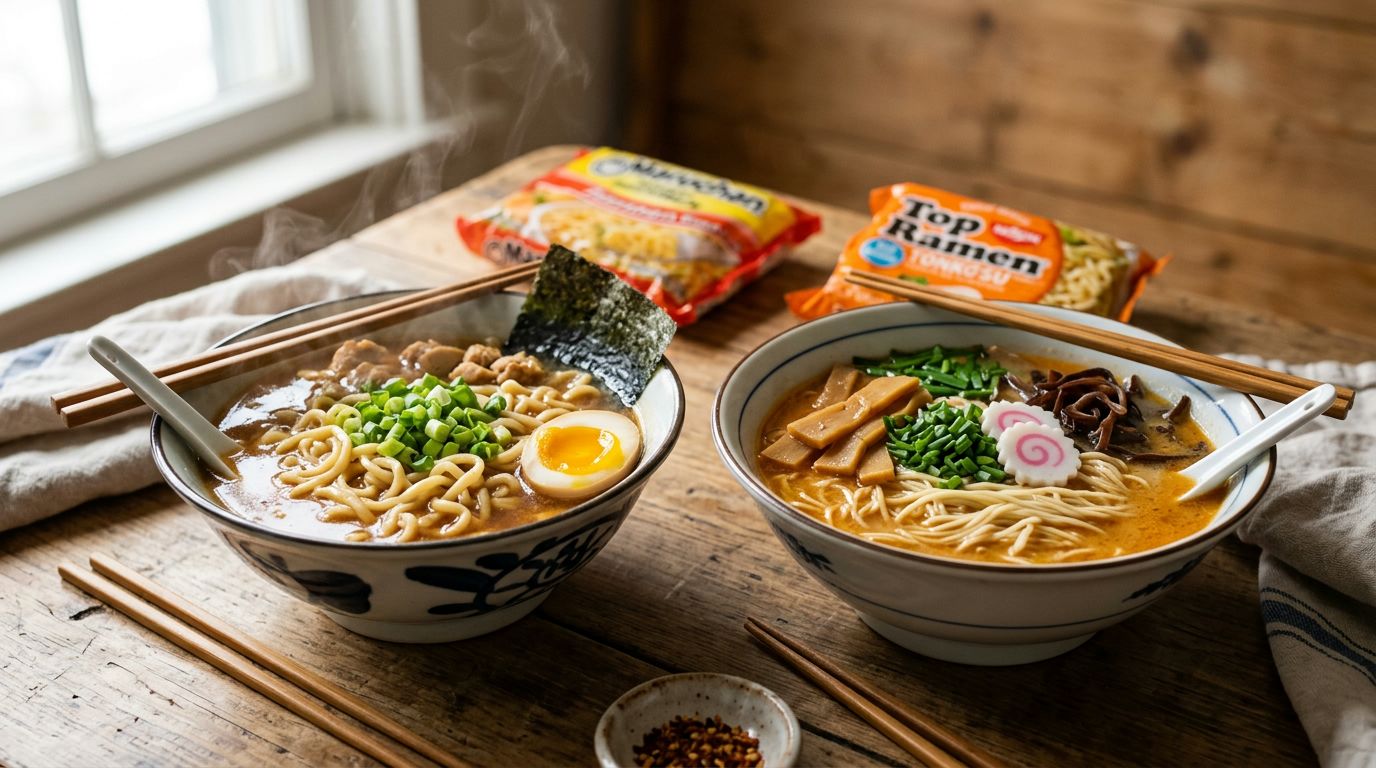
You're probably standing in the instant noodle aisle, looking at two names you already know: Maruchan and Nissin. One feels familiar, cheap, and dependable. The other carries a little more Japanese brand prestige, especially if you know Cup Noodles or Top Ramen. On the surface, this looks like a simple supermarket choice.
It isn't. Ultimately, the Maruchan vs Nissin ramen debate comes down to what you care about most: price, noodle texture, broth style, nutrition, and whether you're comparing the common export versions or the much better Japanese domestic market versions. That last point matters more than most international shoppers realize, especially if you've only tasted the standard packs sold outside Japan.
The Ultimate Ramen Dilemma Maruchan or Nissin

You are in front of a supermarket shelf, hungry, and the choice looks simple. Grab the familiar yellow Maruchan packet, or go with Nissin because the brand sounds more Japanese. For international shoppers, that shelf-level choice only shows part of the story.
A key comparison starts with a basic distinction. The Maruchan and Nissin products sold across the US and other export markets are often their cheapest, most standardized versions. The Japanese domestic market lines are usually better built, with stronger broth design, better noodle texture, and more variation from one product line to another.
That difference matters because the winner changes depending on what you are buying. If you are comparing common US budget packets, Maruchan often makes more sense for price and familiarity. If you are willing to buy Japanese Nissin lines, especially its better bowl and pouch products, the gap in noodle quality and soup depth gets much wider.
Here is the practical snapshot:
| Category | Maruchan | Nissin |
|---|---|---|
| Common US packet price | Usually the cheaper pick on mainstream US shelves | Usually a little higher in comparable packet lines |
| US shopper familiarity | Broad packet-ramen presence and strong habit buying | Strong recognition through Cup Noodles and Top Ramen |
| Noodle feel | Softer, slightly thicker, more absorbent in many export packs | Firmer or thinner, with more line-to-line variation |
| US shelf strategy | Wide packet coverage and easy-to-find flavors | Stronger identity across cups, bowls, and branded sub-lines |
| Best known export style | Low-cost comfort ramen | Cup noodles and Top Ramen |
| Best reason to seek Japanese versions | Noticeable improvement over export packs, especially in texture | Premium domestic lines often taste closer to a casual ramen-shop bowl |
I have found that many readers outside Japan make this comparison after trying only the export baseline. That usually favors Maruchan on value and familiarity, but it can undersell what Nissin does in its home market. In Japan, Nissin is not just Cup Noodles. Maruchan is not just the dorm-room packet either.
Use a simple rule. Judge the cheap international packs against each other. Judge the Japanese domestic products as a separate tier.
Once you do that, the dilemma becomes clearer. Maruchan usually wins the budget shelf. Nissin usually has the higher ceiling.
The Titans of Instant Ramen A Brand History
Walk into a convenience store in Japan and then look at a typical US supermarket ramen shelf. You are not really looking at the same contest. The names are the same, but the range, quality ceiling, and brand identity are much clearer in Japan than they are overseas.
Nissin shaped the category early and still benefits from that history. In the US, Top Ramen helped turn instant noodles into a pantry staple, while Cup Noodles gave Nissin a format that became recognizable far beyond Asian grocery shoppers. Maruchan built its reputation differently. It won shelf space, repeat purchases, and habit buying through cheap packet ramen that was easy to find almost everywhere.
That distinction still matters. In the US market, Maruchan often feels like the default budget packet, while Nissin feels split between two identities: Top Ramen on the low-cost side and Cup Noodles as the more iconic convenience product. On American shelves, that can make the two brands look closer than they really are.
In Japan, the picture is sharper.
Nissin has long carried stronger category prestige, especially in cup noodles, regional tie-ins, and premium lines that push closer to ramen-shop flavors. Maruchan, under Toyo Suisan, has a different strength. It is reliable, broad, and firmly woven into everyday eating. That does not mean low quality. It means practical products, familiar flavors, and wide coverage across price points that Japanese shoppers use every week.
This is the part many international buyers miss. The export versions are the floor, not the full catalog. If you want a better sense of what Japanese shoppers buy, this guide to Japanese ramen and instant noodles is a useful reference point.
I see this mistake all the time with readers outside Japan. They compare US Maruchan chicken flavor to US Top Ramen chicken flavor, then assume they have understood both companies. They have only compared the entry tier. Once you start buying Japanese domestic products, Nissin shows more ambition at the top end, and Maruchan shows more depth than its export reputation suggests.
Brand history matters here because it explains why the shelves look the way they do today. Nissin built category authority. Maruchan built everyday reach. If you only shop outside Japan, Maruchan can look bigger than it is and Nissin can look narrower than it is. Buy from Japan, and both brands make more sense.
Noodle Deep Dive Texture and Cooking Differences

If you care about how a bowl eats, noodle texture matters more than the seasoning packet. Many Maruchan vs Nissin ramen comparisons overlook this.
A less-discussed but important difference is soup absorption. According to Egoclown's comparison of Maruchan and Nissin chicken styles, Maruchan's noodles are often thicker and absorb soup better, giving a chewier and more satisfying texture, while Nissin's thinner Top Ramen noodles can become mushy faster. That aligns with what many regular instant noodle eaters notice after a few side-by-side bowls.
How Maruchan noodles behave
Maruchan's common packet noodles usually feel a bit rounder and softer in the mouth. They take on broth quickly, which makes the whole bowl taste unified fast. If you like noodles that feel cozy rather than springy, this works in Maruchan's favor.
That same quality can also be the weakness. If you leave the bowl sitting too long, the noodles keep drinking broth and lose definition. They're best when eaten right away.
A few practical notes:
- Best use case: Fast home meals where you want a full, soft slurp and don't plan to linger.
- What works: Slight undercooking helps preserve bite.
- What doesn't: Letting the noodles steep after cooking. That's when softness turns dull.
How Nissin noodles behave
Nissin's export products vary a lot by line. Top Ramen often feels thinner than Maruchan's common packet noodles. Some eaters prefer that because the strands can seem cleaner and less bulky. Others read it as less substantial.
If you cook Nissin carefully, the noodles can deliver a firmer chew. If you overdo the water or cooking time, they can lose that edge quickly. This is one reason people disagree so strongly about Nissin. It rewards precision more than many casual buyers expect.
For a broader understanding of how noodle structure changes during cooking, Buy Me Japan's article on Japanese cooking basics helps explain the small techniques that change texture.
The Japanese domestic difference
The export versions are only the entry level. In Japan, noodle texture gets much more deliberate. Premium Nissin lines often target a more restaurant-inspired chew. Better Maruchan domestic products often aim for a balanced, springy softness with stronger broth integration.
If you usually add toppings like egg, scallions, sesame oil, or leftover meat, texture becomes even more important. Thin noodles can disappear under heavy toppings. Thicker noodles can carry them.
That's why I don't treat “better noodle” as a universal category. Maruchan often gives a more forgiving bowl. Nissin often gives a more precise one. Japanese domestic products from both brands raise the floor considerably.
Flavor Face-Off Classic Profiles and Premium Lines
The basic export versions are built for broad appeal. Chicken tastes like the comfort-food idea of chicken ramen. Beef tastes like salty, nostalgic pantry ramen. That simplicity is part of their appeal, but it also means the flavor ceiling is low.

Maruchan's everyday flavor profile tends to read broader and rounder. Nissin often tastes a little more direct. When people say one brand has “more flavor,” they're often responding to shape, not intensity. Maruchan can feel fuller. Nissin can feel more pointed.
Standard international flavors
In cheap packet form, neither brand is trying to reproduce a serious ramen shop bowl. They're trying to hit the comfort zone quickly.
Maruchan usually works best for readers who want:
- A soft savory profile that feels familiar right away
- An easy base for add-ins like egg, cabbage, corn, or chili crisp
- A broth that rounds out quickly without much tinkering
Nissin usually works best for readers who want:
- A firmer flavor identity from line to line
- A lighter-feeling noodle-to-broth balance
- A cleaner starting point for customizing with soy sauce, sesame oil, or miso
Premium Japanese lines change the conversation
Once you move into Japanese domestic products, especially stronger Nissin lines like Raoh and higher-quality Maruchan offerings, the gap between “instant noodles” and “actual ramen craving” gets much smaller.
In a comparative noodle texture discussion of soy sauce variants, this r/InstantRamen benchmark notes that Maruchan uses a thicker, bouncier noodle that separates easily, while Nissin Raoh uses a thinner, denser-packed noodle structure, and Maruchan often comes out ahead in overall flavor and noodle quality in soy sauce instant variants.
That doesn't mean Nissin loses broadly. It means the premium space is more nuanced than brand prestige alone suggests.
A good way to understand why Japanese premium ramen tastes more layered is to learn the basics of umami flavor in Japanese food. Once you know what savory depth tastes like, budget export ramen feels flatter.
A quick visual comparison helps if you're new to Japanese premium instant ramen styles:
What usually works best
If you want the classic cheap comfort bowl, Maruchan often has the friendlier profile.
If you want a premium line with a more designed texture and broth concept, Nissin becomes much more compelling. But that doesn't make it automatic. Some of Maruchan's better Japanese products feel more harmonious from first sip to last bite.
Buy Japanese domestic versions when you want complexity. Buy export packets when you want nostalgia.
That's the cleanest distinction.
Nutrition and Ingredients Whats Really Inside
Open a cheap US packet and a Japanese domestic one side by side, and the difference starts before you even taste them. The export versions from both Maruchan and Nissin usually rely on a simple powder seasoning approach built for low cost, long shelf life, and a familiar salty-sweet profile. Many Japanese domestic products, especially in the better lines, add separate oil sachets, more layered seasoning bases, and noodles that taste less processed once cooked.
That matters more than a single nutrition label.
The broad pattern is easy to understand. Standard supermarket Maruchan and Nissin sold outside Japan are convenience foods first. Japanese domestic versions are still instant ramen, but the ingredient design is often more deliberate. You see it in the broth aroma, the fat quality, the balance between salt and savoriness, and how complete the bowl feels without needing as much doctoring.
A practical way to judge them is this: export ramen often gives you stronger salt impact up front, while Japanese domestic ramen more often spends that ingredient budget on broth depth, aroma oil, and noodle quality. Neither brand becomes a health food just because it came from Japan, but the better Japanese versions usually taste less one-note.
Ingredients also vary sharply by line. Maruchan's budget export packs are built for value. Nissin's international products, including familiar Cup Noodles and Top Ramen, are built for speed and consistency. In Japan, both brands sell products that move closer to restaurant-style ramen, with more distinct soup character and fewer shortcuts in the eating experience. That is the version I recommend if flavor matters more than shaving off a small amount at checkout.
For readers trying to put instant ramen into a broader diet instead of judging one bowl in isolation, this guide on what really makes Japanese food healthy gives useful context.
What to look for on the label
A few label details usually tell you what kind of bowl you're buying:
- Separate oil packet: Often a sign of better aroma and more realistic broth finish.
- Shorter, more specific flavor description: Products modeled after shoyu, shio, tonkotsu, or miso styles tend to have a clearer point of view than generic “oriental” or basic chicken flavors.
- Air-dried or premium noodle claims: These can improve texture, especially in Japanese domestic lines.
- Serving size tricks: Compare labels carefully. A packet, half-packet, and cup are not always equivalent bowls.
How to make either brand a better meal
- Use less seasoning powder if you want better balance and a less salty finish.
- Add a real protein such as egg, tofu, chicken, or leftover pork.
- Add vegetables like cabbage, spinach, bean sprouts, or scallions.
- Leave some broth behind if you want the comfort of ramen without taking in every bit of the seasoning.
Treat instant ramen as a base ingredient, not the whole meal. That improves both Maruchan and Nissin, and it matters even more with the cheaper export versions.
Price and Availability US Shelves vs Japanese Imports
You're standing in a US grocery aisle, looking at a cheap multipack of Maruchan and a nearby Nissin option. For a fast pantry refill, Maruchan usually wins on price and shelf presence. It tends to be the easier brand to find in big supermarket chains, discount stores, campus markets, and convenience-focused shops.

That advantage matters if you want inexpensive noodles for late-night meals, dorm cooking, or a backup lunch at work. In the US export market, both brands are built around convenience first. Maruchan usually feels more budget-driven. Nissin often asks you to pay a little more for a brand name that carries much more weight in Japan than it does on an American shelf.
The bigger difference is not Maruchan versus Nissin. It's US export versions versus Japanese domestic versions.
After years of buying instant ramen in Japan, that's the split I tell readers to focus on. The familiar US packets are fine for a quick, low-cost meal, but imported Japanese lines from either brand usually give you better noodles, better aroma, and flavor profiles that are closer to real shoyu, shio, miso, or tonkotsu ramen shops. You also see more variation in format, including premium bowls, region-inspired releases, and packs with separate soup base and finishing oil.
What US shelf versions do well
US supermarket versions still have a place in a smart pantry:
- They are cheap and easy to replace.
- They are sold almost everywhere.
- They work well as a base for eggs, vegetables, or leftover meat.
That said, they rarely show either brand at its best. Export recipes are usually simplified, the flavor lineup is narrower, and the bowls are designed for broad mass-market appeal rather than for ramen fans chasing a specific style.
Why Japanese imports are worth the extra spend
Japanese imports cost more, and international shipping can push the total up fast. The payoff is in the bowl. Noodles tend to hold their bite better, the soup has more definition, and the product design feels more intentional. Domestic Japanese Nissin lines often push harder into restaurant-style ramen ideas. Domestic Japanese Maruchan products are often more balanced than international shoppers expect, especially in bowls where the broth and noodle are built to match each other.
That's why I rarely tell people to compare only the cheapest packets on US shelves. If you want the version of these brands that explains why they became giants in the first place, buy from Japan.
If you're trying to find reliable shops for imported food, this guide on where to buy Japanese snacks online is a useful starting point.
Pay more, get a better bowl. In this category, that trade-off is usually real.
Buying Guide Which Ramen Should You Choose
If you want the short answer, choose based on the bowl you want to eat, not on brand loyalty.
Best for budget and everyday pantry use
Choose Maruchan if your priorities are low price, broad supermarket availability, and a familiar comfort-food profile. It's the easy recommendation for students, bulk pantry stocking, and anyone who wants a quick noodle base for extra toppings.
Best for a firmer identity and stronger brand legacy
Choose Nissin if you like exploring different product lines and care about a brand with deep instant ramen history. That matters even more if you're moving beyond Top Ramen into Japanese domestic options.
Best for noodle texture in cheap export packs
This comes down to preference.
If you want a thicker, more absorbent noodle that feels fuller in the mouth, go with Maruchan. If you prefer a slightly firmer chew and don't mind being more careful with cooking time, Nissin can suit you better.
Best for premium Japanese instant ramen
Don't limit yourself to the export products you already know. By looking beyond these, both brands become more interesting, and Nissin premium lines often gain ground with more restaurant-style ambition, while Maruchan premium Japanese products can surprise people with better noodle-broth harmony than expected.
Best overall choice
For pure everyday value, Maruchan is the safer recommendation.
For shoppers who want to explore the best version of what these companies make in Japan, Nissin and Maruchan domestic products are both worth seeking out. The export aisle is only the beginning.
If you want to move beyond basic supermarket packets and try authentic Japanese ramen, Buy Me Japan is a practical place to start. It ships directly from Japan, which makes it easier to find the domestic-market products international shoppers usually miss, along with other authentic Japanese food, beauty, and lifestyle items.



共有する:
How to Store Vitamin C Serum to Maximize Its Power
What Is Alpha Hydroxy Acid: Your 2026 Guide to AHAs